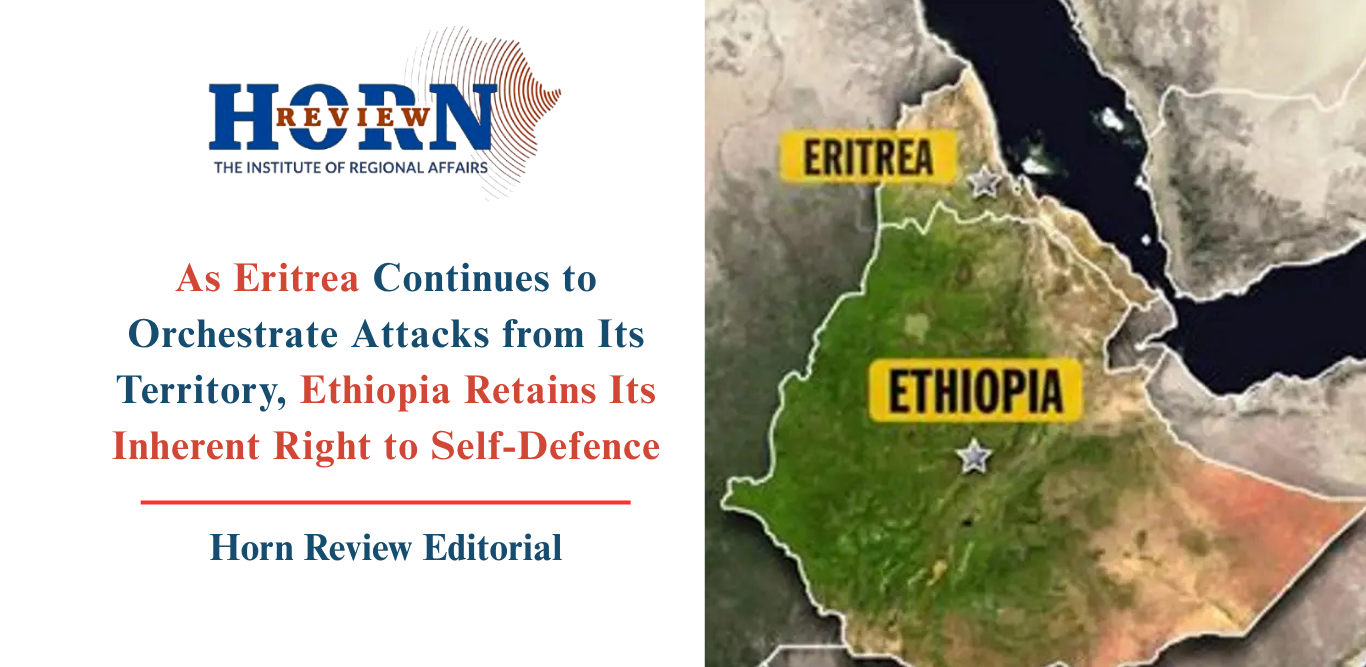
Ethiopia’s security concerns with Eritrea extend well beyond the presence of Eritrean troops inside its internationally recognised territory. Of equal, if not greater, concern is Eritrea’s alleged provision of political, military and logistical support to Ethiopian armed opposition groups, enabling them to coordinate their activities and pursue armed attacks against the Ethiopian state and the constitutional order thereof, from Eritrean territory. The challenge for Addis Ababa is therefore not simply to secure its borders, but to address the external infrastructure sustaining armed threats against the state, without being drawn into another interstate war. Avoiding such a confrontation, however, cannot mean accepting an indefinite deterioration of Ethiopia’s security environment.
As discussed in Horn Review’s recent analyses, Eritrea’s Incursion and Ethiopia’s Right to Self-Defence: Where Does the Law Stand? and Ethiopia’s Right to Self-Defence and the Strategic Fallacy of Symmetrical De-escalation, Eritrea’s military involvement inside Ethiopia and its longstanding relationships with armed opposition movements must be understood as interconnected security concerns. The formation of the seven-group Coalition of Ethiopian Peoples’ Forces Alliance for Survival in September 2026 brings this relationship into sharper focus. The alliance brings together organisations with fundamentally different political orientations, ethnic constituencies and histories of armed confrontation. Their common opposition to the federal government does not translate into a coherent political programme or a shared vision for Ethiopia’s future. The inclusion of the TPLF is particularly revealing. During the TPLF-dominated EPRDF era, Eritrea supported armed movements fighting against the Ethiopian government, including organisations now associated with the new coalition. The TPLF, once the dominant force in the government these movements opposed, has now joined them against the federal government. This extraordinary reversal suggests that the coalition’s immediate cohesion rests less on ideological reconciliation than on a common adversary and the external patronage attributed to Asmara.
Recently leaked intelligence reports provide a more immediate indication of this emerging alignment. According to the reports, Jaal Mero of the Oromo Liberation Army, Zemene Kassie of Amhara Fano and Debretsion Gebremichael of the TPLF held a convention in Asmara despite repeated diplomatic warnings from Addis Ababa. The press release issued on 31 October 2026 reportedly followed that meeting. The same information suggests that the Eritrean regime and elements within the Sudanese Armed Forces are encouraging the groups to intensify their military campaigns against Ethiopia, with assurances of continued political, logistical and other assistance.
The significance of the Asmara meeting lies in its apparent effort to revive an Eritrean military strategy that had already failed on the battlefield. In its late September 2026 iteration, the plan sought to bring the fight against the Ethiopian state into its own territory, using insurgent groups organised into a seven-group coalition as the ground force. The coalition was assembled and officiated roughly two weeks before Eritrea launched its offensive on the northern Tigray and north-eastern Afar fronts. That campaign was subsequently pushed back by the Ethiopian National Defence Force (ENDF), which advanced on both fronts, regained control of Ethiopian territory and forced much of the TPLF and Eritrean troops to retreat. Fighters belonging to the coalition were also pushed back. The reported gathering in Asmara therefore points to an attempt to reconstitute this failed strategy: coordinating and supporting armed groups from within Eritrean territory to continue the war campaign against Ethiopia, rather than abandoning the objective after the initial offensive was defeated.
Ethiopian national wealth, including gold, is also being transported into Eritrea in connection with armed networks operating against Ethiopia, adding a further economic dimension to the problem. These developments, once again, coincide with Ethiopia’s repeated accusations of Eritrean military incursions and material support for insurgent groups operating inside the country. Foreign Minister Gedion Timothewos has repeatedly demanded the withdrawal of Eritrean forces and an end to their collaboration with armed opposition groups over the past two years. Despite repeated diplomatic representations, including after Eritrea severed diplomatic ties with Ethiopia, Addis Ababa maintains that the violations have continued. The matter reached the United Nations Security Council in early October 2026. In a letter submitted on 9 October, Ethiopia accused Eritrean forces, including mechanised units, of advancing as far as 60 kilometres into northern Ethiopian territory.
At this point, Eritrea’s unceasing aggressive military posturing, its compartmentalised provocations and overt violations, its provision of military and logistical assistance and the Eritrean military incursions point to a security challenge that cannot be addressed through diplomatic procedures alone. Ethiopia has repeatedly communicated its concerns and sought international engagement. But diplomacy cannot become an indefinite substitute for the protection of national security, particularly when the conduct at issue continues despite repeated warnings. Ethiopia thus retains its inherent right to self-defense, something that has remained intact since Eritrean troops crossed into Ethiopia’s territory in what the later considers an act of war. Article 51 of the United Nations Charter preserves the inherent right of individual and collective self-defence in the event of an armed attack. Where a state is directly involved in such an attack, or armed groups operating from its territory carry out attacks meeting the applicable threshold under international law, the victim state retains its right to defend itself. The existence of an international border does not, by itself, extinguish that entitlement.
Nor should Ethiopia be expected to wait until another offensive has been launched from Eritrean territory, its forces have crossed the border en masse again and its population has suffered the consequences. While the scope of anticipatory self-defence remains contested under international law, Ethiopia or any state for that matter is not required to disregard a demonstrable and sufficiently imminent threat from a hostile regime right across its borders. It must retain the capacity to protect its territory and population through measures consistent with international law. The danger of another interstate war is real, but it cannot become a permanent constraint on Ethiopia’s ability to respond to external threats.
Eritrea can not and should not be allowed to continue to provide sanctuary and support to armed organisations operating against Ethiopia, and orchestrate attack from its territory into Ethiopia, while Addis Ababa is expected to confine itself to diplomatic procedures for fear of escalation. Such an arrangement would place the entire burden of restraint on the state whose security is being persistently challenged and whose sovereignty has been repeatedly violated. Ethiopia must therefore maintain diplomatic pressure while preserving a credible capacity for self-defence. This requires continued monitoring and documentation of Eritrean military activities, international engagement, stronger border security, the disruption of financial and logistical networks sustaining armed operations and, when necessary, to use force to defend it-self and its key national security interests that are being put at imminent risk by the Eritrean regime.
The objective is not to widen the confrontation, but to ensure that Ethiopia’s commitment to peaceful coexistence is not mistaken for an inability or unwillingness to defend itself. Ethiopia does not have to choose between pursuing pragmatic diplomacy and defending itself. It has every reason to avoid another war with Eritrea, but no obligation to tolerate an increasingly hostile security environment simply to prevent one. Its diplomatic restraint must remain a sovereign choice, not a vulnerability that another state can exploit indefinitely. Ethiopia retains its inherent right to take the measures necessary and lawful to defend its territory, population and constitutional order. The avoidance of war must never become an obligation to wait for another round of aggression from Eritrea.
By Horn Review Editorial