Nearly three decades of bilateral agreements have proven that Djibouti remains Ethiopia’s most reliable gateway to global markets, while Ethiopia serves as Djibouti’s economic engine. From the historic railway to modern container terminals, the Ethio-Djibouti corridor has long been the lifeblood of Horn of Africa trade. Today, as regional dynamics shift and the demand for diversified maritime routes globally grows, Ethiopia’s strategic drive for maritime access enters a pivotal moment. Yet, recent headlines regarding Ethiopia’s quest for alternative maritime access have sparked widespread questioning of the historic alliance. Far from these, a closer look at the data, history, and current diplomatic realities reveal an entirely different story: that quest for sea access is poised to catalyze deeper integration and redefining regional cooperation for the next generation.
The Historical Baseline vs. Decades of Djiboutian Solidarity
In the late 1990s, following Ethiopian ports vanishing overnight, it had to swiftly redirect its entire trade architecture to Djibouti. At that time Ethiopia’s population stood at roughly 60 million, with a nominal GDP hovering around $8 billion. Now Ethiopia holds more than 130 million people with over $121 billion nominal GDP. The modern reality fast forward to 2026, and the scale of both nations has completely transformed, having undergone an unprecedented demographic and financial explosion, altering the scale of regional logistics forever.
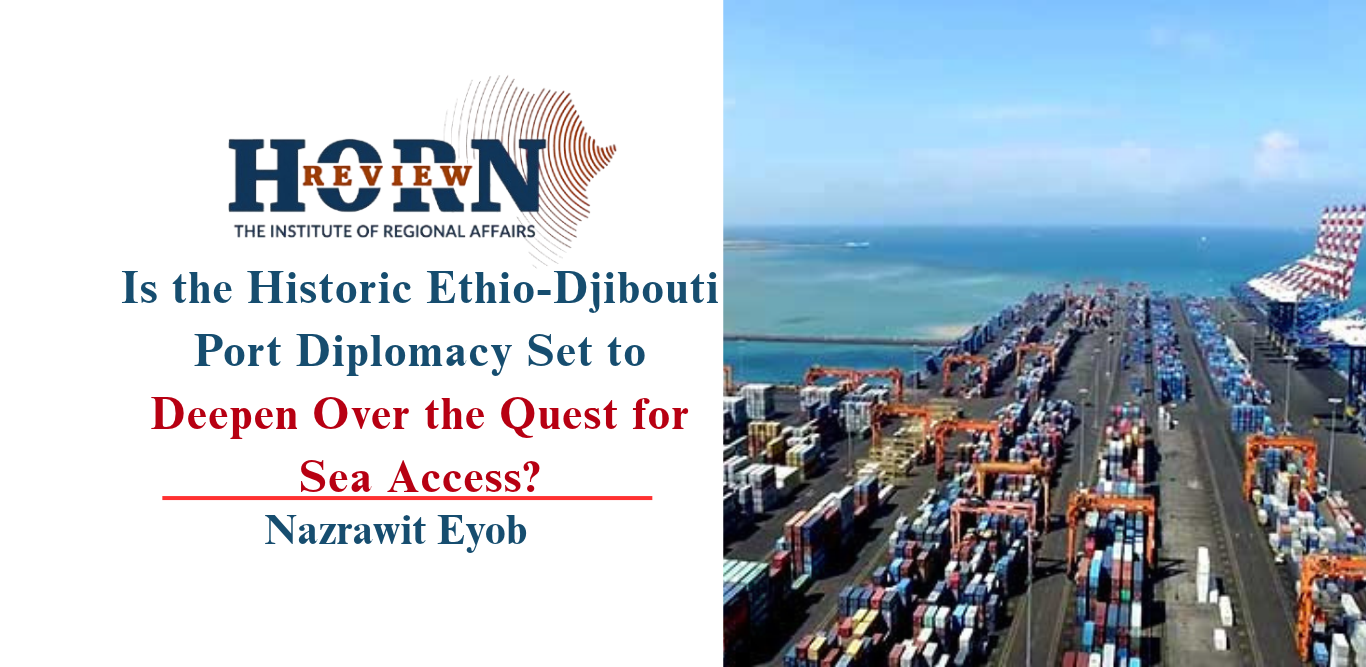
From early day to nearly three decades under all those changes, Djibouti did not just act as a commercial vendor; it acted as Ethiopia’s commercial lifeline in times of crisis. Working day and night, the Djiboutian government and port authorities prioritized Ethiopian cargo above all else to keep the landlocked giant afloat. Former Ethiopian Trade Minister Ambassador Girma Birru (current Macroeconomic Advisor to Prime Minister) famously captured this reliance during the formalization of their maritime ties press conference in Addis Ababa, stating that “if we look at the distance of all the ports Ethiopia could use, then Djibouti is the first—no doubt”, as Djibouti was the absolute best option. This relationship was codified through landmark legal frameworks like the 2002 Ethio-Djibouti Utilization of Port of Djibouti and Services to Cargo in Transit Agreement. Under these bilateral understandings, Djibouti granted Ethiopia access to the global market and guaranteed 60-day notices prior to tariff adjustments. Djibouti willingly took a commitment to construct specialized, world-class infrastructure tailored specifically to ingest and export a large volume of Ethiopian trade. The state-of-the-art Port of Doraleh, along with heavy bulk terminals and other ports in Djibouti, transformed its entire coastline into a highly efficient extension of the Ethiopian marketplace. This was a decades-long favor of stability, trust, and operational reliability. Additionally, it gives Ethiopian accommodations priority during emergencies, such as the present Strait of Hormuz tension, banning shipping agents from charging extra fee. This friendship is not getting through only through neighbors.
Adapting to Reality and Burden Sharing
Global shocks have severely burdened the Ethiopian economy, turning its landlocked vulnerability into a crisis. The consecutive compounded effects of the COVID-19 pandemic, the Russia-Ukraine conflict, the Israel-Palestine war, and U.S.-Iran tensions have disrupted maritime trade routes, causing local oil and market price inflation in Ethiopia. With over 90% of its trade reliant on a single chokepoint and as Africa’s second-most populous nation, Ethiopia faces accelerating geopolitical volatility that results in systemic supply chain delays and a massive economic burden. Thus, the distribution of logistic burden through alternative access is a globally proven practice utilized by both coastal and landlocked nations that actively rejects sole reliance on a single maritime gateway to avoid supply chain failure. Well, this diversification concept is not a new concept, while different countries in our world use alternatives to support domestic demand, whether they are landlocked or coastal states. Not going far, While the Democratic Republic of the Congo (DRC) is a coastal nation, along with its own ports, it frequently utilizes Tanzania, Zambia, Mozambique, and Angola to export critical minerals like copper and cobalt. The same goes with the United States, along with its own ports, frequently utilizes Canadian and Mexican ports that prove multi-port reliance.
Furthermore, several sovereign nations or state-backed entities leasing foreign ports, like in 2019, landlocked Hungary signed an agreement to lease a 32-hectare (72-acre) terminal site at the Port of Trieste in Italy.Whereas Bolivia’s 99-year, tax-freelease of Puerto Ilo (Peru) and Saudi Arabia’s [Red Sea Gateway Terminal (RSGT)] 30-year concession lease to develop and operate the Port of Tadjourah. These show that secure access, either directly or indirectly, allows those countries to typically diversify their routes to keep massive global trade through and maximize logistics redundancy. On the day of the geopolitical crisis surrounding the Strait of Hormuz and the Red Sea, much like Ethiopia’s pursuit of strategic autonomy, several Middle Eastern and European nations are aggressively changing their routes, investing in alternative ports, to bypass dangerous chokepoints. So, effectively distributing the strategic and economic burden with peaceful alternative sea access in the Horn of Africa is essential, aligning with the prime minister’s recent proposals. H.E. Abiy Ahmed’s reappointment as prime minister revealed the new government’s five-year priorities, that the government’s focus is on national resilience with an emphasis on securing Red Sea access and maintaining regional stability in a rapidly changing global environment. Ethiopia aims to strengthen cooperative relations with neighbors based on mutual interests and prioritize dialogue to ensure reliable sea access, reaffirming Ethiopia’s role as a key regional power.
Economic Resilience and the Future of Ethio-Djibouti Ties
Sensationalist narratives suggest that Ethiopia diversifying its trade to other regional ports will trigger a question in Djibouti’s economy. This view severely underestimates Djibouti’s strong financial independence and economic resilience. Beyond a highly sovereign economy and transit trade, Djibouti has successfully commodified its strategic geography and serves as a premier global geopolitical hub. It hosts major naval military for the world’s superpowers. Furthermore, Djibouti anchors the primary undersea international fiber-optic cables connecting Africa, Europe, and Asia. Recent high-level directives from the Djibouti Ports and Free Zones Authority (DPFZA) to dynamically slash and suspend port extra fees during global maritime crises demonstrate a highly agile, autonomous maritime economy capable of insulating itself from single-market fluctuations. This economic resilience is fundamentally linked to the peaceful framework of both nations, despite the political noise surrounding sea access, proving that it is unshakable. The foundation of the Ethio-Djibouti relationship does not sit in government title; it rests on deep historical, linguistic, and cultural integration between the depths of Afar and Somali People-to-People Diplomacy spanning in both sides. The Addis Ababa-Djibouti railway, ensuring that Djibouti remains most cost-effective gateway for the Ethiopian heartland. Ethiopia supplies fresh underground water and clean electricity to Djibouti, while Djibouti secures the maritime trade routes to Ethiopia. The recent announcement of a major strategic investment connecting Damerjog in Djibouti to Dewele in Ethiopia through a new refined petroleum products pipeline is the landmark energy security project. The reconstruction of the road connecting Dikhil to the Galafi border serves as a major trade lifeline linking the Port of Djibouti to Ethiopia’s highway. Furthermore, the two countries operate a highly advanced, peaceful framework that serves as a foundational pillar of the Intergovernmental Authority on Development (IGAD) and the African Union. Their diplomatic and political coordination on regional security, counter-terrorism, and Horn of Africa stability remains at the highest institutional level. They are one people living in two states. Thus, when we look at the political question and these deep structural realities, it becomes clear that, of course, a mature redistribution of regional weight with peaceful access will deepen the friendship. Therefore, when Ethiopia seeks sea access, it ensures that massive population and economic growth of landlocked markets can breathe over repeated maritime disruption and sustainably protect coastal states from bearing the entire region’s burden alone. In turn, it also answers unemployment, migration and household economy significantly and can be shared across East Africa.
Thus, Ethio-Djibouti three-decades port relationship resilient friendship turn deepen over the peaceful quest to access sea; one that ensures both nations can sustainably operationalize a collective response of a booming East African century.
True regional integration relies on flexibility for growth. Ethiopia and Djibouti have built a strong partnership over decades, supporting each other’s development. In this regard, Ethiopia’s pursuit of sea access is a catalyst for a resilient alliance. Their three-decade friendship fosters peace and enables a collective response to East Africa’s emerging opportunities. As global trade dynamics shift, both nations must adapt to share the regional logistics burden. Ethiopia’s search for alternative sea access will transform the region diversifying corridors and distributing logistics risks. This will solidify historical bonds and create strong framework for shared security, mutual economic relief, and lasting prosperity across the Horn of Africa.
By Nazrawit Eyob