
“Decaffeinated Sovereignty”: Eritrea’s One-Way Street with Ethiopia
There is a peculiar contradiction at the heart of Eritrea’s political discourse about Ethiopia. Asmara speaks of sovereignty with almost theological intensity. The word appears whenever Ethiopia discusses the Red Sea, whenever Addis Ababa proposes economic integration, whenever Ethiopian officials contemplate a strategic relationship with Eritrea, and whenever Ethiopia attempts to redefine its position in a region from which it became physically separated in 1993. Yet the same absolute conception of sovereignty becomes considerably less absolute when the direction of attention is reversed. For three decades, Eritrea has maintained an extraordinary degree of interest in Ethiopia’s internal political life. The Eritrean regime has, at different points, hosted, armed, trained, financed, or otherwise supported Ethiopian armed opposition movements as instruments of pressure against successive governments in Addis Ababa. Among the groups that have operated from, received support from, or maintained relationships with Eritrea at various periods are the Oromo Liberation Front (OLF), Arbegnoch–Ginbot 7, the Tigray People’s Democratic Movement (TPDM/Demhit), the Ogaden National Liberation Front (ONLF), the Afar Revolutionary Democratic Unity Front (ARDUF), and other Ethiopian armed movements. Eritrea has also maintained relationships with armed actors beyond Ethiopia, most notably Al-Shabaab in Somalia. The precise nature and intensity of these relationships have varied over time, but the broader strategic pattern is difficult to miss: Eritrea has repeatedly treated Ethiopia’s internal political fractures as part of its own security environment.
The 2018 rapprochement temporarily interrupted this pattern; it did not necessarily erase it. The opening between Addis Ababa and Asmara created the possibility that Eritrea might abandon the logic of proxy competition in favour of a more conventional state-to-state relationship. For a period, that appeared plausible. Yet the underlying strategic problem remained unresolved: what kind of Ethiopia would Eritrea consider compatible with its own security and regional position? The outbreak of the Tigray war in 2020 brought that question sharply back into view. Eritrea entered the conflict with calculations of its own, most immediately centred on the destruction or decisive weakening of the TPLF, its longstanding adversary. But the strategic implications extended beyond the TPLF. A second calculation appears to have been to prevent the war from producing a sufficiently strong and consolidated federal centre in Addis Ababa – one capable of projecting political, economic, and military power Asmara would have no influence over.
Eritrea’s objective here need not be understood simply as the restoration of some particular Ethiopian political order. Its deeper interest is maintaining an Ethiopia sufficiently fragmented, contested, or internally preoccupied that no Ethiopian centre of power can easily dictate the strategic balance of the Horn. This was a fundamental dynamic that gradually contributed to the 1998–2000 Ethiopia–Eritrea war and, again, underlies much of the tension, brinkmanship, and casus belli that have accumulated over the past four years. That calculation, however, contained a contradiction of its own. As the Ethiopian federal government ultimately emerged from the Tigray war sufficiently intact – and subsequently rebuilt its military and diplomatic capacity – Eritrea could not indefinitely rely on the political consequences of the Tigray conflict to determine Ethiopia’s trajectory. The logic of the old strategy therefore began to reappear: cultivate relationships with actors capable of exerting pressure on the Ethiopian centre. This helps explain the significance of Eritrea’s subsequent relationship with Amhara Fano, the TPLF and other Ethiopian insurgent militias. The relationship did not emerge simply as an accidental consequence of a dispute over the Red Sea. Besides the longer history of Eritrea’s engagement with Ethiopian armed opposition, the cultivation of its current relationships with Ethiopian militias predates the formal conclusion of the Tigray war and the Pretoria peace agreement. It also predates the Ethiopian government’s public articulation of its contemporary Red Sea strategy. That chronology matters.
It complicates the increasingly dominant narrative in which Eritrea’s confrontation with Ethiopia is presented primarily as a reaction to Ethiopia’s renewed interest in the Red Sea. If the cultivation of Ethiopian armed actors was already underway before Addis Ababa publicly elevated the Red Sea to a central strategic issue, then the causal sequence cannot simply be reversed. The Red Sea dispute may have become a powerful language through which the confrontation was subsequently articulated, but it does not adequately explain the earlier strategic behaviour. The sovereignty discourse therefore deserves to be read not only as a statement of principle but also as a political instrument. Asmara cannot legitimately frame Ethiopian engagement with the Red Sea as an existential violation of Eritrean sovereignty while simultaneously treating political developments inside Ethiopia as matters of direct strategic concern. The apparent contradiction becomes less puzzling once sovereignty is understood asymmetrically: Eritrean sovereignty is treated as absolute when Ethiopian power approaches Eritrea’s strategic space, while Ethiopian sovereignty is treated as permeable whenever political developments inside Ethiopia affect Eritrea’s regional calculations.
The sequence is therefore more revealing than the rhetoric alone: secession → war → stalemate “no peace no war” → proxy subversion → temporary rapprochement → intervention in the Tigray war → attempt to shape the post-war balance → cultivation of Ethiopian armed actors once again → intensification of sovereignty rhetoric around the Red Sea. Seen in this longer continuity, the Red Sea is not necessarily the beginning of the confrontation. Neither is the issue about Eritrean sovereignty. Sovereignty for the Eritrean regime is the newest strategic rhetoric and, increasingly, the principal vocabulary through which an older contest over the distribution of power in the Horn is being expressed.
Besides, the timing of the escalation of the Eritrean sovereignty rhetoric matters because during the Tigray war, Eritrean forces operated deep inside internationally recognised Ethiopian territory. The subsequent insistence on the absolute inviolability of sovereignty therefore acquired a distinctly selective character when juxtaposed with Eritrea’s own military presence in Ethiopia, both during and after the 2020 Tigray war – and the current Northern Ethiopia crisis, and the unresolved question of withdrawal from territories occupied during the war. The point is not to deny Eritrea’s legitimate security concerns or its sovereign rights. Nor is it to suggest that every Eritrean action is reducible to a single master plan. Rather, it is to identify a recurring strategic logic: Asmara has historically sought to prevent the emergence of an Ethiopian political centre strong enough to dominate the regional balance, and has repeatedly used Ethiopia’s internal political divisions as one instrument for doing so. The contemporary confrontation should therefore be analysed as a continuation and adaptation of that strategic logic – not as an entirely new dispute created by Ethiopia’s recent Red Sea policy.
Ethiopia in Eritrea’s Political Discourse:
Eritrea’s pattern of intervention and violation of Ethiopia’s sovereignty has also not been simply military. Ethiopia occupies an outsized place in Eritrean official political discourse. President Isaias Afwerki’s speeches and interviews routinely devote substantial attention to Ethiopia’s political system, leadership, military posture, alliances, economic direction, Nile policy and Red Sea ambitions. A recent analysis of his 2025 Independence Day address noted precisely this Ethiopia-centered framing: even on the anniversary of Eritrea’s “independence”, much of Afwerki’s political argument was constructed through an account of Ethiopia’s alleged failures, foreign dependencies and strategic ambitions. This raises a question that is rarely posed directly: What happens when a state demands absolute sovereignty for itself while treating the internal and external trajectory of its neighbour as a matter of permanent national concern? Call it decaffeinated sovereignty. Not sovereignty without legal recognition. Not sovereignty in name only. Rather, sovereignty whose most potent ingredient – reciprocity – has been removed.
For the EPLF generation, Ethiopia was never simply another neighbouring state. The political identity of the Eritrean liberation movement was constructed in opposition to the Ethiopian state. The struggle produced an exceptionally powerful political mythology: Eritrea as a nation that had fought for its existence against a much larger neighbour, and sovereignty as the ultimate achievement of that struggle. But it also produced an enduring psychological and strategic paradox. Once secession was achieved, Ethiopia did not disappear from Eritrean political consciousness. If anything, Ethiopia remained the central reference point through which Eritrea’s security environment, diplomatic choices and political identity were interpreted. This is visible in the language of the country’s leadership. Eritrean political discourse frequently explains Eritrea by explaining Ethiopia: Ethiopian intentions, Ethiopian alliances, Ethiopian internal divisions, Ethiopian economic development, Ethiopian foreign relations, Ethiopian access to the sea, Ethiopian military procurement and Ethiopian domestic politics. The neighbour becomes the object of almost permanent strategic interpretation. And this is where the asymmetry begins.
A state that has defined itself through separation from Ethiopia nevertheless continues to devote enormous political attention to Ethiopia’s trajectory. Yet when Ethiopia begins speaking about its own strategic predicament – particularly its loss of direct maritime access – the response from Asmara is that Ethiopia has no right to discuss the matter because doing so violates Eritrean sovereignty. There is an obvious distinction here that should not be blurred. Ethiopia’s strategic interest is not the same thing as Ethiopian sovereignty over Eritrean territory. Ethiopia can have a legitimate interest in maritime access without possessing a territorial right to an Eritrean port. Eritrea can therefore defend its sovereignty while negotiating, or refusing to negotiate, particular arrangements. But the issue becomes more complicated when “sovereignty” is deployed not simply to reject territorial claims, but to delegitimize the very expression of Ethiopian strategic interests. That is the contradiction.
Sovereignty as Shield, Sovereignty as Sword:
The most revealing way to understand the Eritrean sovereignty rhetoric is to separate two propositions that are often collapsed. The first is: Eritrea is sovereign over Eritrean territory. That is a straightforward proposition of international law. The second is: Ethiopia therefore has no legitimate strategic interest in the Red Sea. That does not follow. A state can recognize another state’s sovereignty while still having profound interests in what happens around its borders, trade routes, waterways and security environment. Indeed, Eritrea itself has never behaved as though Ethiopian internal or regional affairs were none of its business. That historical record is substantial. This is not a criticism of Eritrea for having security interests. Every state has them. The problem is the normative asymmetry.
Eritrea has historically treated Ethiopia’s political configuration as a legitimate object of Eritrean strategic policy. Yet Ethiopian concern about Eritrea’s strategic environment is frequently described as aggression. Eritrea can calculate how a particular Ethiopian government might affect Eritrean security. But Ethiopia’s calculation about Eritrea’s relationship with its own security environment is described as interference. Eritrea can cultivate relationships with states that have serious disagreements with Ethiopia. But when Ethiopia seeks relationships or arrangements affecting Eritrea’s strategic environment, the vocabulary changes immediately to sovereignty and territorial integrity. The result is what might be called a one-way sovereignty principle. Eritrea’s sovereignty is invoked to insist that Ethiopia should not concern itself with Eritrea. But Ethiopia’s affairs remain central to the Eritrean state’s own political narrative. This is not merely a rhetorical curiosity. It suggests something about the strategic worldview of the Eritrean ruling establishment. Ethiopia is not treated as politically irrelevant. It is treated as too important to ignore but too illegitimate to reciprocate.
The contradiction becomes even sharper when examined through security policy. The post-secession relationship has repeatedly moved through cycles of confrontation, proxy politics, war and temporary rapprochement. What is notable, however, is how durable the Ethiopia-centered strategic posture became. That is precisely why Eritrean sovereignty cannot be the whole EPLF/PFDJ argument. The current dispute over Red Sea access brings this contradiction into its clearest form. Ethiopia became landlocked after Eritrea’s secession in 1993. The post-Derg transitional government signed off Ethiopian ports to Eritrea with no clear and legitimate constitutional mandate to do so. That geographical fact has enormous economic and strategic consequences. Ethiopia has subsequently relied heavily on Djibouti for maritime trade, while successive Ethiopian governments have sought alternatives and greater autonomy in maritime access. Ethiopian leaders therefore have a legitimate reason to regard Red Sea access as a major national strategic issue. That does not automatically establish an Ethiopian territorial claim to Assab, Massawa or any other Eritrean territory. But neither does Eritrean sovereignty require Ethiopia to pretend that the Red Sea is irrelevant to Ethiopia. This distinction is frequently lost.
The Ethiopian position can be reduced to: We need reliable maritime access. The Eritrean response is often framed as: You are violating our sovereignty. A negotiated port arrangement, commercial corridor, lease, transit agreement, joint economic zone or other mutually agreed mechanism can preserve Eritrean sovereignty while addressing Ethiopian economic interests – if it was not for the diplomatic rigidity and persistent rejection of the Eritrean regime. Indeed, that is precisely what sovereignty should make possible: a sovereign state chooses the terms on which it cooperates. But sovereignty becomes something else when it is used to transform every Ethiopian proposal – from economic integration to transactional diplomacy – into an existential challenge. The Eritrean state has been exceptionally successful at making sovereignty the moral centre of its foreign-policy vocabulary. Yet the same state has historically exercised considerable strategic agency beyond its borders. It has supported armed groups. It has intervened in neighbouring conflicts. It has built relationships with states opposed to Ethiopia. It has persistently commented on Ethiopia’s political trajectory. And its leadership has continued to devote considerable political attention to Ethiopia. None of these facts, individually, invalidates Eritrean sovereignty.
Together, however, they raise a question about reciprocity. If Eritrea reserves the right to assess, influence and respond to developments in Ethiopia because those developments affect Eritrean security, then Ethiopia necessarily possesses the same category of interest with respect to developments in Eritrea. The answer cannot consistently be: “Your interest in us is interference; our interest in you is security.” That is not a principle of sovereignty. It is a hierarchy of sovereignty. Sovereignty can operate as a shield against external interference. But Eritrea has turned it into a rhetorical sword for delegitimizing the legitimate interests of the other side. It cannot claim sovereignty as an absolute shield against legitimate Ethiopian interests in Eritrea, while simultaneously behaving as though it is fully entitled to intervene in, influence, and shape everything Ethiopian – and then resorting to direct and indirect coercion when confronted with the limits of that entitlement.
This is ultimately what the famous phrase by the Ethiopian Foreign Minister Gedion Timothewos on his Keynote speech at Horn Review’s Foreign Policy Forum at Addis Ababa University, “Decaffeinated Sovereignty” is meant to capture. The problem is not that Eritrea insists on sovereignty. It should. The problem is the possibility of a sovereignty doctrine that becomes absolute in one direction and porous in the other. Eritrea cannot continue to demand Ethiopia to treat Eritrea as a sovereign neighbour, while Eritrea continues to treat Ethiopia as a strategic problem. It cannot conntinue with its Ethiopia for us all, Eritrea for us only illusion. That is not a sustainable regional equilibrium. Sovereignty should close the door to conflict, not to reciprocity. Until that distinction is accepted, “sovereignty” will remain less a framework for coexistence than an Eritrean vocabulary through which it justifies radically different rules for themselves and Ethiopia.
Authors Bio
Blen Mamo is Executive Director of Horn Review and a researcher specializing in law, international security, and geopolitics in the Horn of Africa. She holds an LL.B and an M.Sc. in International Security and Global Governance.

RELATED
Posts
7
Oct
Leaked Documents Allege Sudanese Army Weapons Pipeline to TPLF-Aligned Forces as Tigray War Reignites
Leaked documents alleging a Sudanese army weapons pipeline to TPLF-aligned...
7
Oct
Eritrea Has Officially Invaded Ethiopia, Says Government Communication
Ethiopian Government Formally Condemns Eritrean Territorial Incursion as Its Forces...
7
Oct
Turkey, Somalia and the Transactional Reading of Alamein
The Alamein Declaration functions less as a coherent framework...
7
Oct
Somalia's Alamein Signature and the Costs of Diplomatic Alignment
The Alamein Declaration between Egypt, Sudan, Eritrea and Somalia...
7
Oct
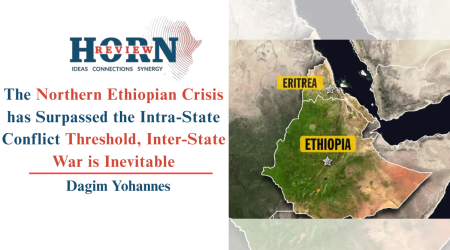
The Northern Ethiopian Crisis has Surpassed the Intra-State Conflict Threshold, Inter-State War is Inevitable
The Eritrean regime and its newly allied TPLF hardliners share...
6
Oct
Egypt's Nile for All, the Red Sea for Some - Except Ethiopia
The contradiction was laid out almost perfectly at El Alamein....
6
Oct
Isaias Afwerki has Long Wanted to Rule Ethiopia, Why He will Never
President Isaias Afwerki is among the most enduring figures in...
6
Oct
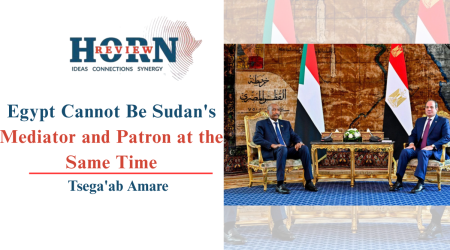
Egypt Cannot Be Sudan's Mediator and Patron at the Same Time
Abdel Fattah el-Sisi received Abdel Fattah al-Burhan in New...
6
Oct
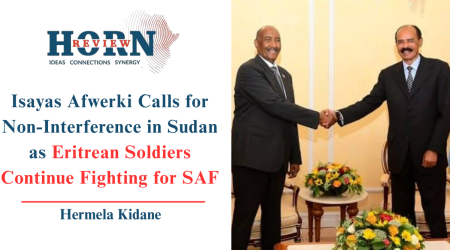
Afwerki Calls for Non-Interference in Sudan as Eritrean Soldiers Continue Fighting for SAF
At the New Alamein summit in October 2026 Eritrean...
6
Oct
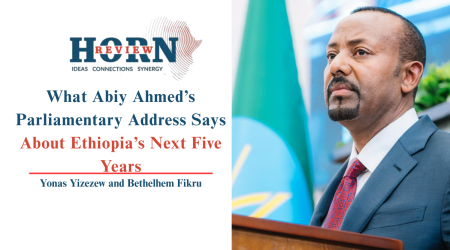
What Abiy Ahmed’s Parliamentary Address Says About Ethiopia’s Next Five Years
In his reappointment to the premiership, Abiy Ahmed offered a...