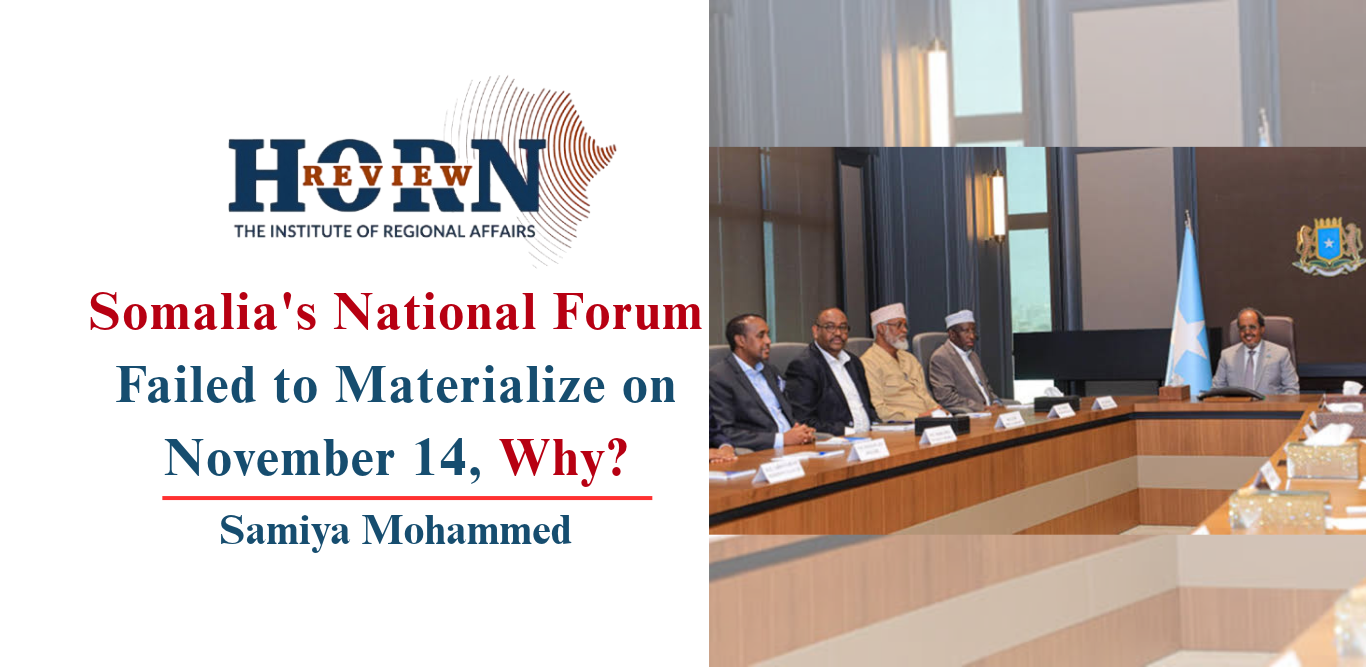
The gathering scheduled to take place in Mogadishu between November 14 and November 18 did not materialize as the national political forum initially envisaged. Its failure reflected a deliberate and political decision by the opposition not to confer additional political legitimacy on President Hassan Sheikh Mohamud at a time when the Supreme Court had raised fundamental questions about the constitutional status of his mandate. The invitation issued by Villa Somalia could not be considered politically neutral given that it originated from a president whose tenure had become the subject of judicial scrutiny. Participation under those circumstances risked implicitly affirming his continued authority to convene the country’s political actors, determine the terms of engagement and set the agenda for national consultations. The opposition’s decision not to participate on those terms therefore represented a refusal to endorse the political and institutional framework within which the proposed meeting was organized. It was this underlying disagreement over constitutional authority, political legitimacy and the conditions for dialogue that ultimately undermined the November 14 initiative.
Once the Supreme Court brought the question of presidential legitimacy into sharper focus by indicating that the president’s term had already expired, the opposition faced a choice between two political risks and opted for the one it considered more manageable. Participating in a meeting convened at Hassan Sheikh’s invitation could have effectively reduced the judicial determination to a secondary political consideration as attendance would have suggested that the dispute over constitutional tenure and presidential authority had been set aside in favor of a presidentially initiated process. In doing so the opposition risked compromising its strongest legal and constitutional argument in exchange for participation in a forum whose framework, agenda and political optics were largely determined by the other side.
Declining to participate allowed the opposition to maintain the legitimacy question as an unresolved constitutional and political issue while preserving its negotiating leverage for a subsequent process in which external partners could help establish more balanced conditions for engagement. This approach should not necessarily be understood as political incoherence or obstructionism but rather as a calculated response by actors who recognize that within Somalia’s current political arrangements the authority to convene political dialogue carries substantive institutional and political significance. Accepting the convening authority of one party is not just a procedural accommodation and it can also constitute a meaningful political concession.
The federal government does not currently possess the authority or the trust to convene the full set of necessary players under its own roof and the November sequence demonstrated this rather than disproving it. A convening authority must be accepted by the parties it seeks to convene and the regional leaders whose participation was indispensable treated the Villa Somalia invitation as an instrument of the host rather than as a neutral framework for negotiation. The opposition’s position was that a presidential initiative facilitated from outside was still a presidential initiative and that the Quartet’s involvement however welcome did not change the fundamental structure of the meeting because the host retained control over who spoke, in what order, under what agenda and to what public narrative. The Future Council therefore refused to attend under Villa Somalia’s terms and told the Quartet directly that it wanted stronger guarantees and actual mediation rather than the facilitation of a presidential project and that distinction between mediation and facilitation is the precise point on which the November 14 non event turned.
The Quartet comprising the United States, the United Kingdom, Türkiye and the European Union is the external stabilizer attempting to prevent total political collapse and it is not a neutral referee enforcing the Supreme Court ruling or Somali law. Its members agreed to facilitate the talks that Hassan Sheikh had called which turned a Villa Somalia invitation into something with outside involvement and troop contributing countries were asked to provide physical security for Puntland’s Deni and Jubaland’s Madobe so that they could even consider coming to Mogadishu which is the concrete shape of the Quartet’s role, mediation and facilitation plus protection sufficient to make key regional leaders feel safe enough to show up. That involvement was real and it was consequential but it was not enough because it met only part of the opposition’s demand while leaving the host in control of venue, agenda and optics, and the opposition judged that the residual advantage to Hassan Sheikh was still too large to accept. The Quartet’s reported involvement therefore looked like a concession without functioning as one and the opposition treated it accordingly.
This is where the structural weakness of the external role becomes visible. The Quartet exists to manage the crisis, protect the counter terrorism posture and avoid a vacuum and it does not exist to install rule of law or to deliver a clean electoral transition which means its involvement signals that the local parties lack the trust or the power to resolve the dispute themselves without outside help. An external actor that is trying to prevent collapse is not the same as an external actor that is enforcing a court ruling and the Quartet’s priorities are stability and counter terrorism rather than constitutional purity which is why its facilitation could not supply the guarantee the opposition was asking for. Türkiye is the most invested and least neutral member of the group and its bilateral contacts with the opposition formed part of the same shuttle diplomacy that kept channels open without producing a binding outcome. The rest of the activity around those days including the Turkish ambassador’s meetings with opposition figures and continued Quartet contacts was more of the same, external actors moving between parties to prevent immediate escalation and none of it produced the national forum that had been advertised for November 14 to 18 or a binding electoral deal.
The federal government’s response to this outcome has largely framed the failure of the proposed meeting as a consequence of opposition intransigence. However a government unable to bring key political stakeholders into a common forum under mutually acceptable conditions faces a fundamental deficit of political convening authority, one that cannot be addressed simply by portraying absent parties as uncooperative or acting in bad faith.
By Samiya Mohammed, Researcher, Horn Review