
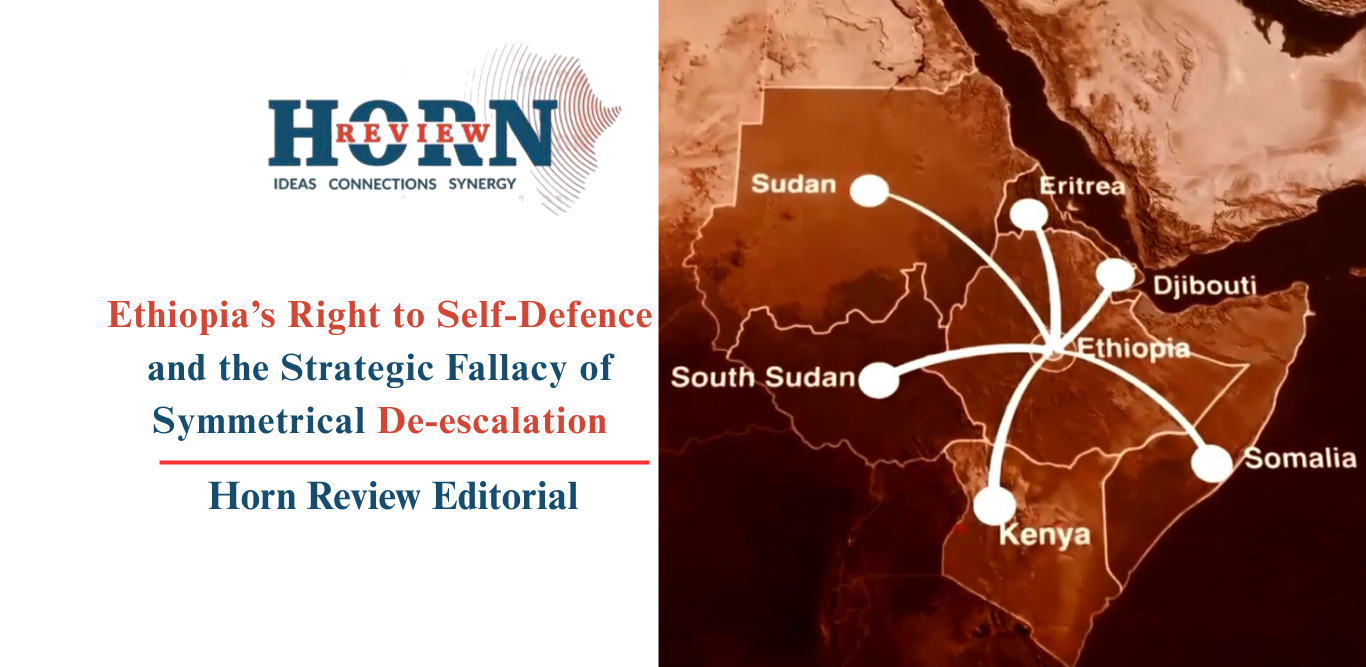
Ethiopia’s Right to Self-Defence and the Strategic Fallacy of Symmetrical De-escalation
The growing calls for de-escalation to the Ethiopia–Eritrea crisis risks conflating conflict prevention with the preservation of an unstable status quo, raising fundamental questions about deterrence, sovereign equality and the application of international law. It also raises an important question about the prevailing approach to conflict prevention in the Horn of Africa: whether the pursuit of de-escalation is genuinely intended to eliminate the conditions that produce conflict or merely to suppress the actions through which those conditions become visible. The recent statement by U.S. Secretary of State Marco Rubio following his conversation with Ethiopian Prime Minister Abiy Ahmed illustrates a broader international tendency to frame the crisis around the imperative of preventing Ethiopia from crossing into Eritrean territory, without sufficiently confronting the fact that Eritrean forces have already entered Ethiopian territory, deployed armed and mechanised formations, and participated in a broader pattern of military preparation. The United States is an important part of this international response, but the problem extends beyond Washington. It concerns the conceptual framework through which external actors interpret the crisis, allocate responsibility and determine what they expect Ethiopia to do in the name of regional stability.
De-escalation is an instrument of conflict management, not an end in itself. Its value depends on whether it reduces the underlying probability of war or merely postpones confrontation under conditions that leave one party exposed to renewed aggression. Where the parties are not similarly situated, a formally symmetrical demand for restraint can produce a substantively asymmetrical outcome. If one state has established a threatening military posture while the other is expected to refrain from measures intended to counter it, the result may be less a reduction in the risk of conflict than a redistribution of strategic advantage. The state alleged to have created the threat, Eritrea in this case, retains its position, while the state exposed to that threat, Ethiopia, is asked to accept the costs and uncertainties of continued restraint.
This is the central deficiency in an international approach that treats the Ethiopia–Eritrea crisis principally as a problem of reciprocal escalation. Ethiopia’s position is that it has not invaded Eritrea or threatened to do so, while Eritrean forces have moved into Ethiopian territory with armed and mechanised units. Ethiopia further maintains that Eritrea has spent approximately two years engaged in military preparation and efforts to organise a regional coalition. International partners, including Washington, have been repeatedly informed by the Ethiopian government, upon official letters from the Ministry of Foreign Affairs, of these developments and requested to pursue the Eritrean regime for mediation to avoid further escalation. Such appeal should have not been responsibly placed, and now there is a generalised appeal for both countries to exercise restraint. Eritrean forces have crossed into Ethiopian territory or participated in an armed attack, so the starting point for international crisis management must be the conduct that has produced the threat and how it could be further deterred, not merely the possibility of an extended Ethiopian response.
A diplomatic statement that concentrates on preventing Ethiopia from crossing an international border may appear neutral, yet neutrality of language does not necessarily produce neutrality of effect. If it fails to establish whether a border has already been crossed by the other party, it risks obscuring the sequence of events and creating a false equivalence between an act of aggression by Eritrea and a potential exercise of self-defence by Ethiopia. The result is a framework in which the state facing the alleged threat is subjected to immediate diplomatic restraint, while the conduct and military posture giving rise to its security concerns remain insufficiently addressed. The problem is not that Ethiopia should be exempt from international scrutiny. No state is entitled to disregard international law, and Ethiopia’s actions must be assessed according to the same legal standards that apply to others. However, the international community cannot demand restraint from Ethiopia while treating allegations concerning Eritrean military activity as secondary considerations. Nor can it assume that preventing a possible Ethiopian response is equivalent to preventing war. The relevant question is whether the proposed approach removes the conditions that make renewed conflict possible, not just temporarily – but sustainably.
Ethiopia’s pursuit of reliable and sovereign access to the sea must be understood within this broader context. The Ethiopian government has openly articulated its intention to secure dependable maritime access and has repeatedly maintained that it seeks to do so through diplomacy, negotiation and mutually beneficial transactional arrangements. The pursuit of that objective is neither inherently unlawful nor, in itself, an act of aggression – and nor does that pursuit fall within the realm of Ethiopia’s strategic objectives and goals in its act of self-defense against Eritrean incursion. The distinction between a strategic objective and the means employed to achieve it is fundamental to international relations. Seeking negotiated port access, commercial transit rights or other mutually acceptable arrangements does not automatically constitute a threat of armed force. Nor does the expression of an ambition to secure sovereign maritime access establish an intention to acquire territory by military means. The legality of Ethiopia’s conduct must be assessed through its actual actions and proposals, rather than inferred from the geopolitical consequences that Eritrea may associate with them.
Ethiopia’s pursuit for access to the sea by no legitimate order establishes Eritrea’s right to threaten Ethiopia militarily or to violate its territorial sovereignty. Ethiopia’s declared objective cannot be converted into a casus belli simply because it affects the regional balance of power. The appropriate response is negotiation over mutually acceptable arrangements, not the presumption that competing strategic interests justify Eritrean military coercion. This distinction has not received sufficient attention in the wider international discourse. By placing Ethiopia’s pursuit of maritime access alongside warnings about possible cross-border military action, external actors risk conflating two analytically separate questions: whether Ethiopia has a legitimate interest in securing reliable access to the sea, and whether Eritrea has violated international law through the use of force.
The legal position concerning self-defence is equally important. Article 51 of the United Nations Charter recognises the inherent right of individual or collective self-defence if an armed attack occurs against a member state. This right is not categorically confined to the territory of the state under attack. Where an armed attack originates across an international boundary, defensive measures may, under the applicable conditions, be directed against the forces responsible for conducting or sustaining that attack. The mere fact that a military objective lies on the territory of the attacking state does not, by itself, settle the legality of action against it. The decisive considerations include whether an armed attack has occurred, whether the threat is active, whether the proposed response is necessary and proportionate, and whether the measures taken are directed towards a legitimate defensive purpose. Article 51 also requires states exercising the right of self-defence to report their measures to the Security Council, which Ethiopia did on the 9th of October 2026.
The significance of this framework for Ethiopia is straightforward. Eritrean forces have attacked Ethiopia and the threat remains active. Hence, the proposition that Ethiopia must under all circumstances confine its defensive response to its own territory is legally unsustainable as an absolute rule. International law does not require a state to remain passive simply because the military capabilities responsible for an attack are relocated across an international border. The geographical location of defensive action is not, by itself, the decisive legal test. The circumstances of the attack, the necessity and proportionality of the response, and its relationship to the defensive objective are central to the assessment.
Ethiopia may cross into Eritrea and neutralize every capability it considers imminently threatening to its national security. Such neutralisation of a hypothetical future threat cannot rest on speculation alone, and the legality of anticipatory self-defence in the face of an actual armed attack remains valid. Even if it is counterargued that Ethiopia’s claims are not sufficiently substantiated, those limitations do not negate Ethiopia’s right to defend itself. They establish the legal criteria through which particular defensive measures must be assessed. The Ethiopian argument has been strengthened by establishing the chronology, location and nature of the alleged Eritrean military movements, documenting any armed attacks, identifying the forces responsible and demonstrating why particular measures are necessary and proportionate to repel or halt those attacks. The international community should thus not replace legal analysis with the blanket proposition that territorial integrity categorically prohibits defensive action beyond the victim state’s borders.
A related concern is the apparent inconsistency in the political narratives through which Eritrea’s conduct is presented. Eritrea invokes claims of ownership, strategic entitlement or victory when these advance its interests, while presenting itself as the victim when confronted with its own conduct. Such contradictions, as substantiated by the record, illustrate how selective narratives can be used to shape international perceptions and obscure questions of responsibility. But neither victory claims nor declarations of victimhood determine the legality of a state’s actions. Eritrea’s invocation of Chapter VII of the UN Charter must be assessed against the same legal requirements that apply to Ethiopia’s claims. A state cannot establish its innocence by asserting victimhood, just as it cannot establish the legality of its conduct merely by invoking national security.
The international community must also consider Ethiopia’s experience with the Pretoria Agreement and the broader problem of incomplete conflict termination. Some argue that, had the federal government completed its military operation and fully taken over Tigray during the 2020 war, Ethiopia would not be confronting the present security situation. This remains a counterfactual interpretation rather than an established historical conclusion. The broader lesson is nevertheless pertinent. A ceasefire can stop active hostilities without resolving the conditions that sustain conflict. A political settlement that fails to address security concerns and the possibility of renewed mobilisation may defer confrontation rather than eliminate it. This does not mean that war should invariably be pursued until one side achieves complete military victory. It means that the success of a settlement must be assessed not merely by the immediate de-escalation but by whether its provisions make renewed violence less likely.
An international approach that restrains Ethiopia’s response without establishing credible safeguards against renewed Eritrean aggression could reproduce this problem at the interstate level. If military deployments remain in place, allegations of coalition-building remain unexamined and no effective mechanisms exist to prevent further incursions, the absence of immediate fighting cannot be taken as evidence that the underlying danger has been resolved. The international policy response should not leave Ethiopia exposed to a credible and continuing threat. If Ethiopia is expected to refrain from cross-border action, the international community must explain what concrete and verifiable measures will prevent further incursions, constrain threatening deployments and provide effective security guarantees.
A demand for restraint without reciprocal obligations risks weakening deterrence and creating incentives for the party maintaining a threatening posture to consolidate its position while the other party is discouraged from responding. This is the strategic danger of confusing de-escalation with the preservation of the status quo. A state facing a genuine military threat cannot be expected to regard the absence of immediate hostilities as a sufficient guarantee of security. Nor can the international community assume that postponing a confrontation necessarily reduces its eventual cost. If the underlying military and political conditions remain unchanged, the result may be a more dangerous future crisis rather than a durable settlement. The measure of successful diplomacy is not simply whether the parties refrain from fighting today. It is whether the arrangements established today reduce the likelihood that they will fight tomorrow.
By Horn Review Editorial

RELATED
Posts
12
Oct
Ethiopia or Eritrea, Who Is the Aggressor?
Eritrea has answered, in kind, a letter that Ethiopia...
12
Oct
The Recurring Script of Eritrea’s Invasion-Victim Cycle
In the Horn of Africa, history under Isaias Afwerki does...
12
Oct
Under the Banner of Red Sea Security, Egypt Encircles Ethiopia
Reports of Egyptian naval movements toward the southern Red...

12
Oct
Egypt's Attack on Sudan's Gold Mines and the Long Road That Led to It
The airstrikes that tore through the artisanal gold mining...
9
Oct
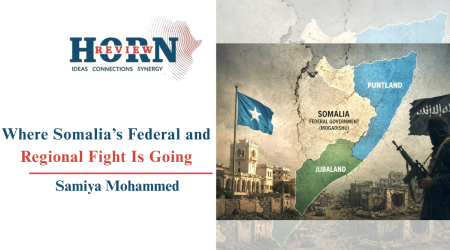
Where Somalia’s Federal and Regional Fight Is Going
The 2012 federal settlement was less a constitutional order...

9
Oct
Eritrea’s Post-Pretoria Strategy and the Escalation in Ethiopia
Our latest report examines Eritrea’s post-Pretoria trajectory and how selective...
8
Oct
The Houthi-al-Shabaab Nexus and the Emerging Security Architecture of the Gulf of Aden
The growing relationship between Yemen’s Houthi movement and Somalia’s al-Shabaab...
8
Oct
After Years of Turnover, Ethiopia Chooses Continuity in Its Foreign Ministry
Abiy Ahmed’s decision to retain Gedion Timothewos as foreign minister...
8
Oct
Ethiopia’s Northern Crisis: Actors, Interests and the Anatomy of Escalation
Our latest report, examines the renewed conflict in northern Ethiopia...
7
Oct
“Decaffeinated Sovereignty”: Eritrea’s One-Way Street with Ethiopia
There is a peculiar contradiction at the heart of Eritrea’s...