The trajectory of the Sudanese war is being reshaped at its southern and central margins, where two theatres pull the Sudanese Armed Forces (SAF) in opposing directions. In West Kordofan, SAF and allied units have registered their first locality-level recoveries in over a year. In Blue Nile state, the Rapid Support Forces (RSF) and allied groups are pressing the approaches to the Roseires Dam and the city of Ed Damazin. Both fronts draw on the same finite stock of manpower, drones and command attention, and the dam has become the point where civilian survival, Egyptian strategic anxiety and the politics of the Nile converge. How the SAF-led authorities resolve that competition will reveal whose priorities govern their conduct of the war.
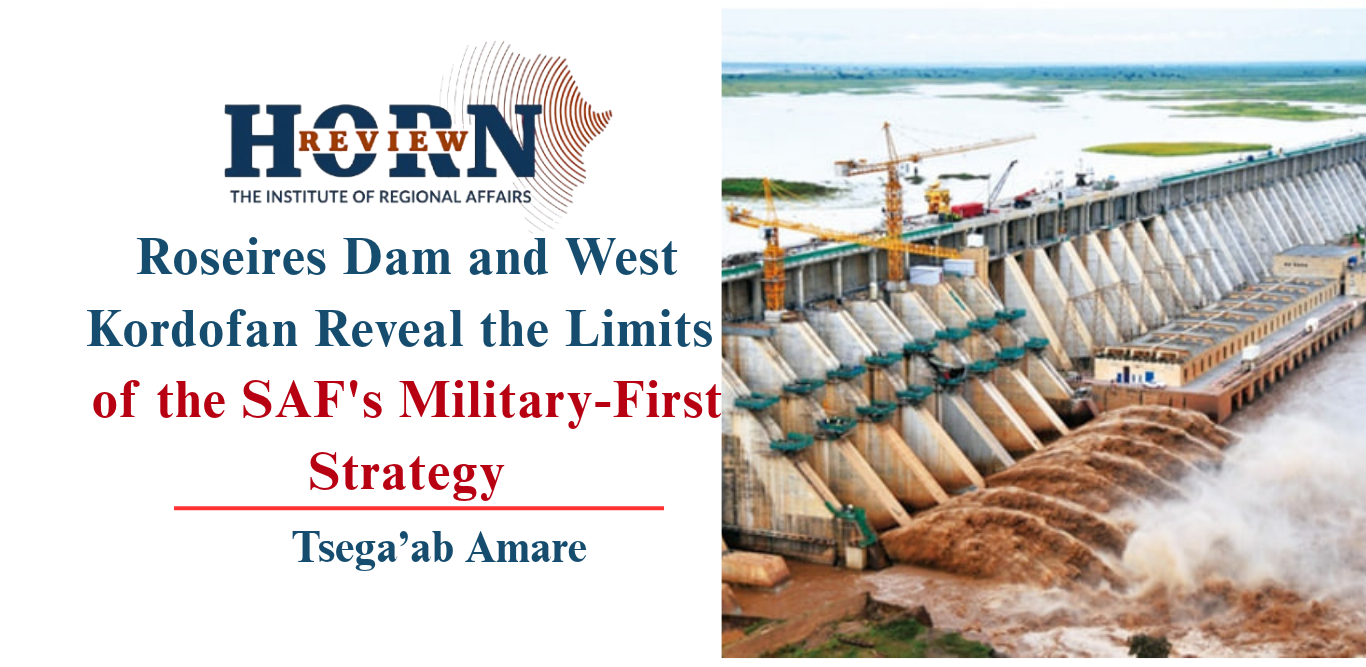
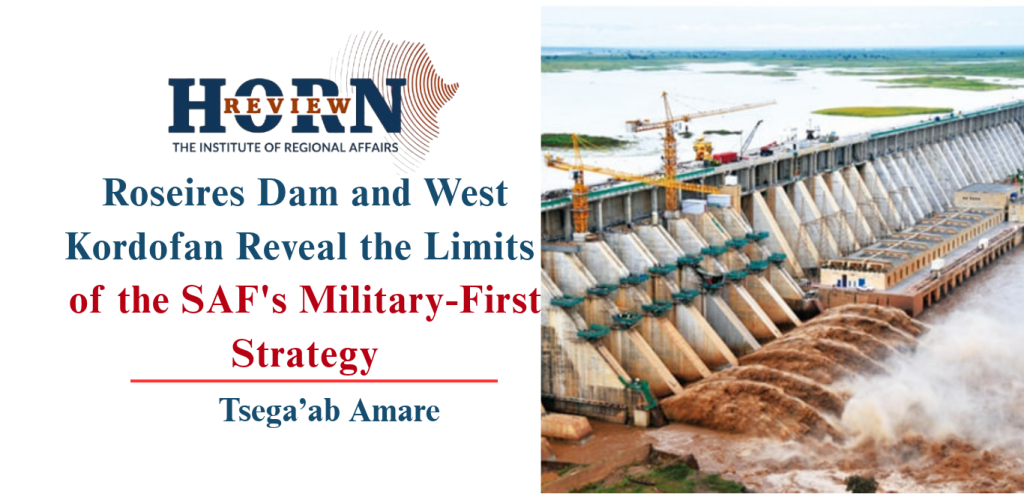
Completed in 1966 and heightened in 2012, the Roseires Dam stores roughly 7.3 to 7.4 billion cubic meters of water and generates around 280 MW. It anchors irrigation systems linked to the Gezira scheme and regulates flows that continue downstream to Egypt. Its position below Ethiopia’s Grand Ethiopian Renaissance Dam (GERD) gives it a further function as a counter-regulator, and the GERD’s upstream regulation is generally credited with moderating flood peaks and easing the sedimentation that has constrained Roseires’ storage, so the two structures operate as complementary elements of a single system.
Recent reporting indicates that the RSF and allied groups, including elements of the SPLM-N, have intensified pressure around Roseires and the Ethiopian border, through claimed seizures of localities, drone strikes on Ed Damazin and assertions of camps across the frontier. The cross-border assertions deserve particular caution. Although no independent verification has appeared, they circulate largely through sources with an evident interest in presenting Ethiopia as a party to the fighting, while Addis Ababa has maintained a position of neutrality coupled with calls for a ceasefire and an inclusive civilian-led political process. The RSF bears responsibility for the drone strikes and the cuts to power and water that burden civilians, and the SAF-led authorities answer for how little protection those civilians have received.
Cairo treats uninterrupted Blue Nile flows and the security of Sudanese regulation infrastructure as core national security interests. It has aligned itself with the SAF-led authorities through diplomatic cover, military assistance, technical cooperation and broader strategic backing, and former Egyptian officials describe aggression against Roseires as aggression against Egyptian security. Such framing treats a Sudanese asset on Sudanese soil as an extension of Egypt’s own security perimeter. Egypt did not create the dam’s importance, but it amplifies it, raising the political cost of any loss, embedding a non-Sudanese red line within SAF decision-making and narrowing the army’s freedom to allocate forces on operational merit. A patron that shapes the defensive priorities of its client cannot credibly present itself as a neutral convener of a Sudanese settlement.
Egypt and Ethiopia remain at odds over the GERD, and Cairo has an evident incentive to cast instability in the Blue Nile borderlands as an Ethiopian-linked threat. Allegations of RSF-linked activity near the dam approaches should be read with that incentive in view, since describing the borderland as a proxy contact zone converts a Sudanese security problem into a regional rivalry narrative and makes localized arrangements harder to negotiate. Ethiopia’s interest lies in a stable Sudan with functioning water infrastructure.
In mid-November 2026, SAF and allied forces took Al-Khuwai and nearby positions after earlier captures such as Ayal Bakhit, and units are reported to be within roughly 40 to 60 kilometers of Al-Nahud, a hub linking Kordofan to Darfur, to gold-mining zones and to western supply routes. The advance marks the first locality-level recovery in West Kordofan and the largest movement in central Sudan since mid-2025. Its significance lies less in the territory than in the connective tissue it threatens, which allows the RSF to move fuel, weapons, fighters and revenue between its Darfur base and the central fronts.
Air and drone superiority, together with coordination with Darfur-aligned joint forces, appear to have enabled the push. That combination raises questions about the sources of the technology involved and the political price of the local partnerships on which the advance rests. The RSF still holds important pockets in the west and south (Kordofan) and has shown a readiness to open distracting fronts, including in Blue Nile, when pressed in Kordofan, though whether this reflects coordinated diversion or opportunistic effort remains unclear.
The interaction between the two theatres produces an overstretch problem that the SAF’s military-first strategy has itself created. A campaign premised on continuous advance depends on momentum, secure logistics and trained manpower, all of which are finite. Diverting units to satisfy water security red lines slows that momentum and gives the RSF time to reorganize, whereas under-protecting Roseires would invite a loss of leverage that Cairo would regard as intolerable and that millions of Sudanese dependents on the dam would feel directly. The dilemma illustrates a war approach in which politics has been displaced by operations, and because the SAF relies on external backers, part of the price of failure will be set outside Sudan.
The RSF’s calculation differs without being simpler. Losing ground in Kordofan erodes its territorial coherence and economic base, since the corridors under threat carry gold, livestock and the material that sustains its war effort, while pressure on Blue Nile imposes disproportionate costs on the army at low expense. An attempt to seize the dam would risk drawing in external actors on unfavorable terms, and the recently reported Egyptian attack on civilian gold miners showed how readily Cairo applies force on Sudanese territory wherever it perceives its interests to lie. The more plausible RSF strategy is therefore calibrated harassment, which preserves leverage without provoking a decisive response, at the expense of civilians whose water and electricity become instruments of that leverage.
The competition between the dam and the highway will not be settled by whichever belligerent manages its overextension better, because the underlying problem is political. The SAF has built a strategy that depends on territorial momentum while its most sensitive defensive commitment is set partly by Cairo, leaving the army’s priorities answerable to an external patron rather than to the Sudanese public. Egypt cannot act as both guardian of the SAF’s defensive agenda and honest broker of a settlement, and its framing of the Blue Nile borderlands as a theatre of Ethiopian-linked risk adds regional suspicion to a conflict that already has too many external stakeholders. Ethiopia’s consistent call for a ceasefire and a civilian-led process, together with its hydrological stake in a functioning Blue Nile, positions it as a constructive participant in any durable arrangement.
The most credible way out is a protected status for Roseires, negotiated among Sudanese civilian and military actors with Egypt and Ethiopia, and guaranteed by the African Union and IGAD with independent monitoring. Such an arrangement would reduce the RSF’s cheapest source of leverage, relieve civilians of the consequences of the contest and remove the dam from the logic of bargaining chips. Without it, Roseires will keep setting the tempo of the war while the people who depend on it carry its costs.
By Tsega’ab Amare, Researcher, Horn Review