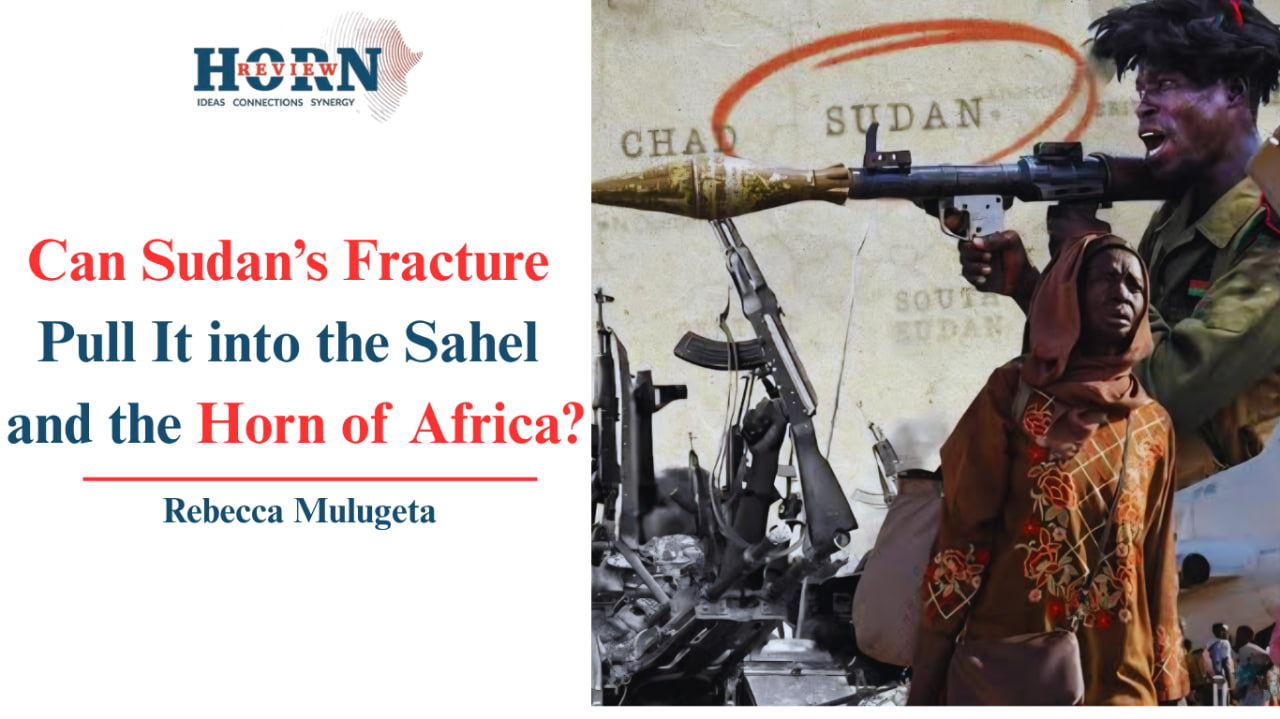
Sudan is no longer simply a war zone; it is becoming a corridor in the making and if the conflict continues without resolution, that corridor may link some of the most volatile insurgent landscapes in Africa into a single, continuous arc that is the shawl and horn of Africa.
What makes the Sudanese crisis uniquely dangerous is not only the scale of violence or the humanitarian collapse, but the country’s geographic and political position. Sudan sits at the intersection of North Africa, the Sahel, the Horn of Africa, and the Red Sea basin. For decades, this location allowed it to function as a buffer, an imperfect but meaningful barrier separating distinct conflict systems. Today, as state authority erodes, that buffering role is reversing. Sudan is no longer containing instability; it is at risk of transmitting and connecting it.
If the war persists, Sudan will not fragment neatly along administrative lines. Instead, it is likely to dissolve into functional zones shaped by external gravitational pulls. Western regions such as Darfur and parts of Kordofan are already aligning with Sahelian conflict dynamics, while eastern territories are becoming increasingly embedded in the political and security realities of the Horn of Africa. This dual process does not produce two isolated spheres. It produces a bridge, a continuous, porous space through which armed groups, illicit economies, and conflict logics can circulate.
In western Sudan, the resemblance to the Sahel is no longer speculative. The patterns are already visible: cross-border militia movements, the proliferation of arms, and the erosion of central authority in favor of localized power structures. Darfur’s connections with Chad, southern Libya, and the Central African Republic are not new, but they are intensifying under conditions of war. Supply lines run across borders, fighters move with relative ease, and the distinction between domestic and regional conflict is steadily fading. This is precisely how the Sahelian system expanded over the past decade not through formal alliances, but through the gradual integration of conflict zones into a shared ecosystem of insecurity.
The Sahel offers a clear warning. Countries such as Mali, Niger, and Burkina Faso have experienced a collapse of state authority in peripheral regions, followed by the rise of highly mobile insurgent groups that operate across borders. These groups do not require ideological uniformity to cooperate. What binds them is opportunity: access to territory, resources, and networks. Over time, this has produced a belt of instability stretching across West Africa, where violence is sustained not by isolated actors but by interconnected systems. If western Sudan becomes fully absorbed into this dynamic, the Sahel will effectively extend eastward, bringing its insurgent networks closer to the Red Sea.
At the same time, eastern Sudan is being pulled into a different but equally complex security environment. The Horn of Africa is characterized by deeply interconnected conflicts, where internal crises often spill across borders and interact with neighboring tensions. South Sudan’s fragility, and Somalia’s long-running insurgency all contribute to a regional landscape in which instability is rarely contained. As Sudan’s eastern frontier weakens, it risks becoming an extension of this landscape, a transit zone for arms, fighters, and political influence. This is not merely spillover; it is integration. Sudan becomes part of the Horn’s conflict system, not just a neighbor to it
The real danger lies in the convergence of these two processes. Sudan’s fragmentation would not create separate zones of instability, but a continuous corridor linking the Sahel and the Horn. Armed groups operating in western Sudan could move eastward, while those in the Horn could extend their reach westward. Even if their goals differ, the logic of survival and expansion encourages cooperation. Shared routes, shared markets, and shared adversaries create incentives for coordination. Sudan, in this scenario, becomes the connective tissue that allows these interactions to occur.
History provides several powerful examples of how state collapse can produce exactly this kind of bridging effect. The fall of Libya after 2011 is one of the most instructive cases. When the Libyan state disintegrated, it did not fragment into isolated enclaves that remained internally focused. Instead, it became a hub for regional instability. Weapons from Libyan stockpiles flowed across the Sahel, fueling insurgencies in Mali and beyond. Fighters moved across borders, linking conflicts that had previously been more contained. Libya’s collapse effectively connected North Africa to the Sahel in new and dangerous ways, transforming the regional security landscape.
Somalia offers another relevant parallel. The prolonged absence of a strong central government did not result in a static or localized conflict. Instead, it created space for the emergence of transnational insurgent networks. Groups such as Al-Shabaab were able to expand their operations beyond Somalia’s borders, reaching into Kenya and influencing dynamics across the Horn of Africa. Somalia became not just a site of conflict, but a platform from which instability could spread and adapt. The key lesson is that ungoverned spaces rarely remain empty; they are filled by actors who operate across borders and build networks that transcend national boundaries.
Even the breakup of the former Yugoslavia, though different in many respects, illustrates how state disintegration can produce cross-border insurgent linkages. Armed groups operated across newly formed boundaries, and external actors became deeply involved, turning localized conflicts into broader regional crises. While the ideological and historical contexts differ from Sudan, the underlying pattern is similar: fragmentation creates permeability, and permeability allows conflicts to connect.
Sudan’s potential trajectory combines elements from all of these cases, but with a unique and more expansive geographic reach. Unlike Libya and Somalia Sudan directly links multiple major conflict systems. Its fragmentation would therefore not only amplify existing instability but also fuse different regions into a more integrated and resilient network of insurgency.
The Red Sea dimension adds another critical layer. Eastern Sudan’s coastline places it at the heart of a strategic maritime corridor that attracts the interest of regional and global powers. In a fragmented Sudan, control over coastal areas could become contested, opening the door for increased involvement by external actors. This includes not only states but also non-state groups seeking access to routes, resources, and influence. The Red Sea could become an additional channel through which insurgent networks connect with actors in the Middle East, further expanding Sudan’s instability.
This transformation would have profound implications for governance and political order within Sudan. Fragmentation tends to produce localized centers of power, each backed by armed groups and external patrons. In such environments, coups and counter-coups become more likely, as different factions compete for dominance. The distinction between political authority and armed groups blurs, and legitimacy becomes tied to control rather than consent. The experience of the Sahel, where repeated military takeovers have become normalized, offers a glimpse of what such a future could look like.
For the Horn of Africa, the consequences would be immediate and far-reaching. The region is already under strain from overlapping crises, and the emergence of a fragmented Sudan as a source of instability would exacerbate these challenges. Sudan could serve as a rear base for insurgent groups, a transit corridor for arms and fighters, and a point of entry for external actors seeking influence in the region. This would not simply add another layer of complexity; it would fundamentally alter the nature of security in the Horn, making it more interconnected and more difficult to manage.
Sudan, in this sense, stands at a critical juncture. It can either remain a fragmented but recoverable state, or it can become something more structurally destabilizing, a bridge that links multiple conflict systems into a single, continuous arc. The difference between these outcomes depends on whether a political settlement can restore some degree of centralized authority and limit the spread of ungoverned space.
If such a settlement fails to materialize, the implications will extend far beyond Sudan’s borders. The country will not simply disappear from the geopolitical map. It will be transformed into a new kind of space, one defined not by sovereignty, but by connectivity of conflict. In that space, insurgent groups from the Sahel, the Horn, and potentially the Middle East will find opportunities to interact, cooperate, and expand.
If the war grinds on, Sudan is unlikely to simply break apart along internal lines; it will be pulled outward into two different regional orbits. Its western regions will increasingly fuse with the conflict patterns of the Sahel, where authority fragments and insecurity spills across borders, while its eastern corridor will be drawn into the strategic rivalries of the Horn of Africa and the Red Sea arena. In that scenario, Sudan ceases to act as a buffer and instead becomes the connective tissue of instability, a space where distinct regional crises meet, overlap, and intensify each other in ways that are far harder to contain or reverse.
By Rebecca Mulugeta, Researcher, Horn Review