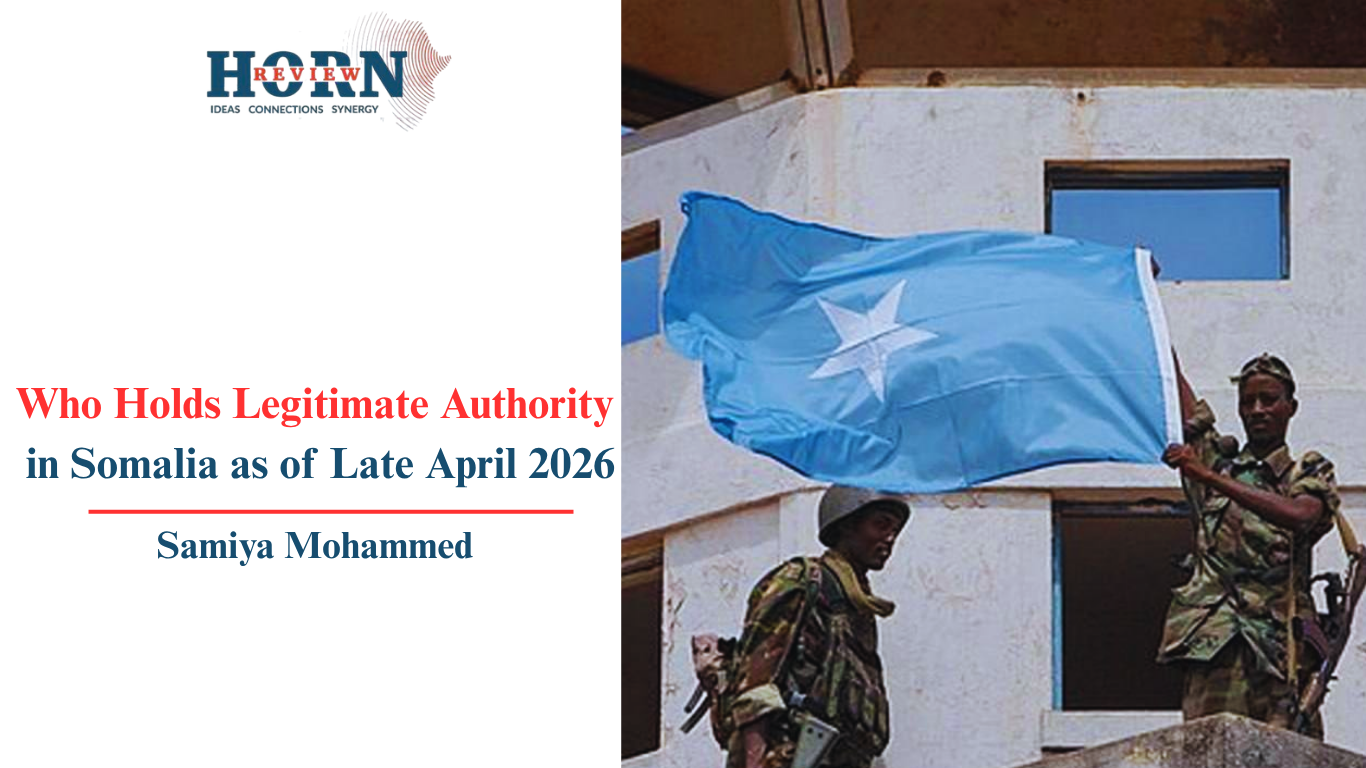
For any modern state the question of legitimate authority is operational reality. It determines which orders are obeyed which salaries are paid which borders are defended and which political decisions carry the weight of law. As of the final week of April 2026 Somalia is in a situation where that fundamental question has no single clear answer. Hence it is now confirmed that the 4 year term of the Federal Parliament expired on April 14 under Article 60 of the 2012 Provisional Constitution. The five year term of President Hassan Sheikh Mohamud is scheduled to end on May 15 under Article 91 of the same foundational document. In March 2026 the government passed and the President signed a set of constitutional amendments that extend presidential and parliamentary terms to five years while shifting the electoral system toward direct one person one vote elections.
Prime Minister Hamza Abdi Barre publicly defended these amendments on April 21. Opposition groups including the Somali Future Council, former Prime Minister Mohamed Hussein Roble and former President Sharif Sheikh Ahmed have rejected the amendments as illegitimate for lacking broad national consensus. After meeting with Hawiye traditional elders in Mogadishu they formed a National Salvation bloc and explicitly declared that President Mohamud will no longer be recognized as head of state once his term expires on May 15. On April 25 former Custodial Corps Chief General Mahad Abdirahman delivered an assessment that state authority has effectively collapsed declaring there is no government. The central argument is that Somalia’s constitutional order is now contested along three dimensions which are legal text, political consent and institutional control.
In March 2026 the government completed a legislative process that produced revised constitutional amendments extending presidential and parliamentary terms to five years. President Mohamud signed these amendments into law. Prime Minister Barre defended the move as a necessary stabilization measure that aligns Somalia with standard regional practice and enables the transition to direct elections. Therefore the old expiration dates are superseded. The President and Parliament retain their authority until a new electoral process under the amended framework is complete.
The opposition rejects this reasoning on several grounds. They argue that fundamental constitutional amendments require a broader national consensus including approval from federal member states and traditional elders neither of which was adequately secured. Secondly they contend that extending one’s own term in office is a classic abuse of incumbency regardless of the legal mechanism used. They also point to the fact that Parliament’s mandate had already effectively expired on April 14 raising the question of whether a body without a mandate can legitimately pass amendments that extend its own existence.
The impasse reveals three distinct doctrines of legitimacy in play. The first is legal positivism which holds that whatever is properly enacted according to existing legislative procedures is valid law. Under this doctrine the March 2026 amendments are legitimate because they followed the formal process of parliamentary vote and presidential signature. The government controls the institutions that produce legal texts and from that institutional perspective there is no crisis of authority. There is simply a transition to a new five year cycle.
The other doctrine is consensual or social contract legitimacy which holds that no constitutional change of this magnitude is legitimate without broad acceptance from federal member states, clan elders and civil society. Under this view the government’s unilateral action is not law but a power grab. The opposition and the elders backing them argue that legitimacy flows from consensus not from parliamentary procedure alone. Because that consensus does not exist the amendments are void, and the original expiration dates remain binding. Therefore after May 15 President Mohamud will be acting without constitutional basis.
The last doctrine is effective control legitimacy which asks not what the law says but who actually commands the security forces, controls the national budget, disburses salaries, receives international recognition and can enforce decisions on the ground. The government still commands the bulk of the Somali National Army and police forces in Mogadishu still controls access to central bank accounts and international aid flows and still enjoys recognition from the United Nations, the African Union, and bilateral donors. The opposition has political support clan backing and some officials but it does not control federal institutions. From a purely realist perspective the government retains effective authority today. The question is whether that control will hold after May 15 if a portion of the security apparatus and federal member states declares the President illegitimate.
If no agreement is reached before May 15 and no election takes place the following scenario unfurls. The government will argue that President Mohamud remains in office under the amended five year term. The opposition and its allied elders will argue that he is an illegitimate occupant of Somalia whose authority expired on May 15. Federal member states such as Puntland and Jubbaland which have previously resisted federal term extensions may formally withdraw recognition. The National Salvation bloc may attempt to establish a parallel political structure or call for mass civil disobedience. Security forces could face contradictory orders with some units loyal to the sitting President and others defecting to opposition figures or clan militias. The most dangerous outcome is not a single coup or a single declaration but a slow fragmentation in which no single actor controls the capital, the regions or the security forces.
Any discussion of a Somali constitutional crisis that omits Al‑Shabaab is incomplete to the point of irresponsibility. The Islamist militant group has never accepted the federal government’s legitimacy under any constitutional framework whether from 2012 or the amended 2026 version. What Al‑Shabaab requires expanding its territorial control, recruitment and attack cadence is not a weak government but a divided one. The current impasse offers exactly that.
Historically, Al‑Shabaab has proven exceptionally skilled at exploiting periods of political infighting. During the 2021 term‑extension crisis, the group increased its attacks in Mogadishu and regained several small towns in the Lower Shabelle and Middle Shabelle regions that had previously been cleared by government forces. When Somali security forces are distracted by internal political disputes particularly disputes that pit factions within the security apparatus against one another intelligence sharing collapses, joint operations stall, and commanders become preoccupied with which political faction will control their salaries and promotions rather than with frontline counterinsurgency. The period immediately following a contested expiration of a president’s term is precisely the kind of window Al‑Shabaab’s military planners look for.
Somalia has experienced term extension crises before most notably in 2021 when the previous administration’s attempt to extend its mandate led to armed clashes in Mogadishu and a breakdown of trust between federal and state governments. Each such crisis weakens the normative power of the constitution. Each time a term is extended without an election or a clear national consensus the constitution becomes less a binding social contract and more a tool to be rewritten by whoever holds power at a given moment. The opposition’s charges that the March 2026 amendments are an illegitimate power grab gains traction precisely because of this history. Conversely the government’s argument that it is moving toward direct elections and longer, more stable terms has its own logic. The problem is that in the absence of mutual trust neither side accepts the other’s reading of the law.
The question of who has legitimate authority after May 15 cannot be answered by looking only at the constitutional text because the text itself has been amended in a disputed manner. It cannot be answered only by looking at institutional control because control may fragment. It cannot be answered only by looking at clan consensus because no single clan or coalition speaks for all of Somalia. The answer for now is that multiple competing authorities will claim legitimacy simultaneously. The government will claim it through the amendments and institutional control. The opposition will claim it through the original expiration dates and clanelders’ backing. Federal member states may claim it by asserting their own constitutional autonomy.
True legitimacy however cannot be claimed by decree alone. It requires broad acceptance from institutions, clans and the people. Without that acceptance declarations of no government may become operational reality rather than political rhetoric. As of late April 2026 Somalia has a sitting government that controls Mogadishu, a parliamentary term that has expired, a presidential term days from its original expiration, a set of contested amendments, an opposition bloc backed by major elders and a Senate Speaker criticizing the entire system’s disregard for law. This is not a situation where one side holds a clear monopoly on legitimate authority. It is a constitutional crisis in real time and the answer to who has authority here will be determined not by legal arguments alone but by which institutions hold together, which security forces follow which orders and whether a negotiated off ramp materializes before May 15 passes. Until then the only honest answer is that authority is contested and legitimacy is in the balance.
By Samiya Mohammed, Researcher, Horn Review