Many analyses of the Sudanese conflict typically focus on the collision of rival militaries, the collapse of legacy institutions, and the resulting humanitarian catastrophe. While these factors are undeniably real, they offer an incomplete narrative that captures the carnage without acknowledging the tectonic transformation underneath. Nowadays Sudan conflict is more than a conventional struggle for dominance; this is a fundamental shift in the logic of power itself. The rising alliance of Tasis, the foundational act of constructing a new political environment, represents a departure from the traditional grammar of civil war. It signals that the core tension is no longer a race to seize the existing state.
For much of its modern history, Sudan’s conflicts revolved around a single organizing principle: the state. Armed movements fought to seize it, reform it, or escape it. Even in moments of fragmentation, the state retained its position as the ultimate source of legitimacy and recognition. The creation of the alliance was itself an extension of this logic, a rejection of Khartoum’s authority, but not of the idea of statehood. What makes the current moment different is that this assumption is beginning to erode.
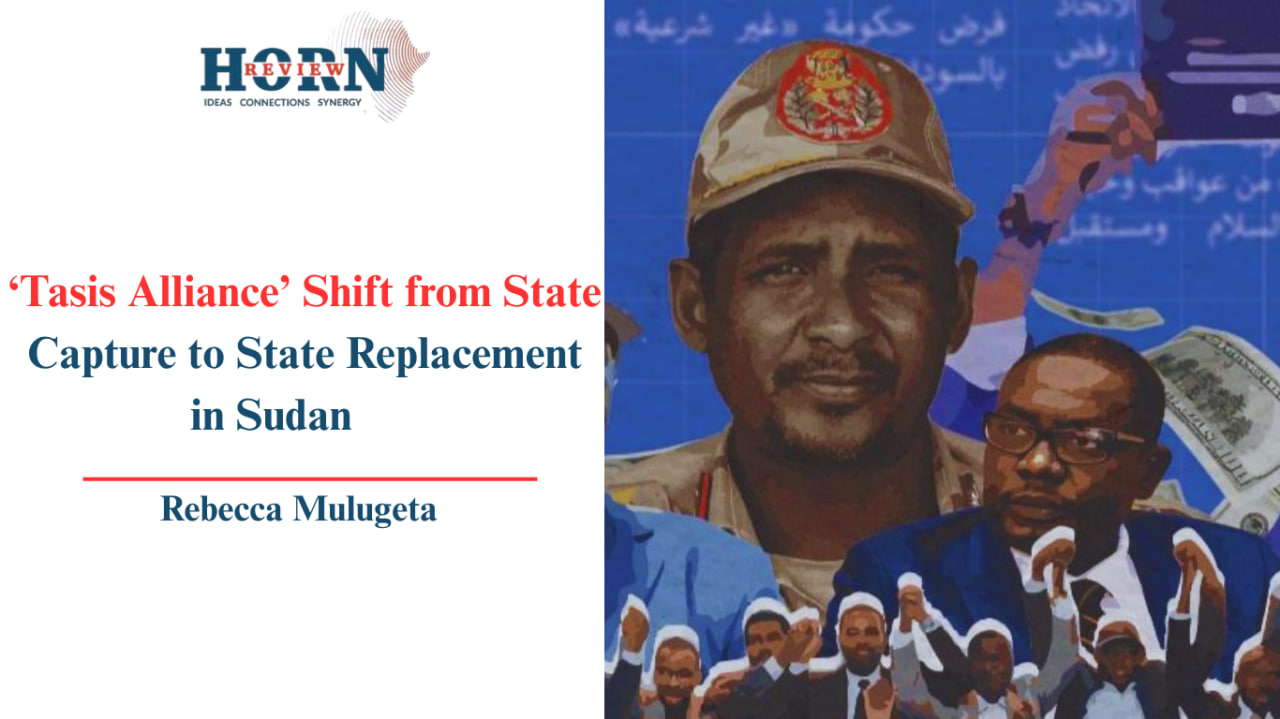
Tasis has transcended the definition of a mere alliance, signaling a strategic pivot where victory is no longer measured by the capture of Khartoum, but by the construction of authority in the vacuum left by a receding state. The convergence between the RSF and the SPLM-N crystalizes this shift; despite their disparate histories, both actors have recognized the structural reality that the old center is dead and national authority cannot be reconstituted in its original form. What is surfacing is not a singular alternative state, but a far more consequential landscape of “constructed authority” , a patchwork of independent governance where taxation, localized security, and administrative systems operate entirely outside the traditional national framework.
At this stage, it is important to be precise about what Tasis actually represents. It is not a single, formal organization or unified movement. It is better understood as a political project or emerging doctrine, a way of thinking about power that is being adopted, unevenly, by armed actors in Sudan. When observers refer to a “Tasis alliance,” they are usually pointing to the convergence between groups like the RSF and the SPLM-N, alongside other localized actors, who are beginning to operate under a shared logic: the state is no longer the only or even primary source of authority.
Beyond a mere quest for military dominance, these actors have pivoted toward a more sophisticated strategic endgame: the institutionalization of power where the state has failed. Their objective is not to inherit the wreckage of Khartoum, but to architect autonomous governance systems that force their recognition as legitimate stakeholders in any future resolution. Within this framework, Tasis serves as a shared strategic vernacular shifting the conflict from a binary struggle for succession into a landscape of multiple, entrenched centers of authority. This transformation is effectively dissolving traditional notions of sovereignty, as fluid borders, cross-boundary trade routes, and armed networks merge local struggles with broader regional instability. By founding power from the ground up rather than seizing the center, these groups are not just fighting a war; they are fundamentally reshaping the territorial and political logic of the Horn.
At its core, Tasis represents a paradigm shift from a politics of capture to a politics of construction, bypassing the state entirely to build authority from the ground up rather than imposing it from the center. This movement fundamentally challenges the modern assumption of singular, fixed sovereignty, replacing it with a “parallel sovereignty” where multiple centers of power coexist and compete within the same national space. The result is a profound redefinition of governance as something dispersed, negotiated, and contingent rather than centralized and absolute. Drawing a cautionary parallel to South Sudan where independence failed to resolve internal divisions Sudan is now experiencing the gradual unmaking of an existing state. Both cases show the same structural crisis: the inherent inability of a centralized authority to accommodate diverse, localized, and competing claims to power.
The logic of Tasis resonates deeply across the Horn of Africa, providing a potent model for insurgent movements to move beyond state opposition toward making the state entirely irrelevant by constructing authority outside formal institutions. This shift fundamentally alters the regional threshold of possibility, blurring the lines between war and governance as order begins to emerge from fragmentation rather than consolidation. These decentralized systems are reinforced by robust war economies, particularly through resource extraction like gold, which provide armed actors with the financial autonomy necessary to sustain independent governance. Consequently, fragmentation evolves from a mere political condition into a deliberate economic strategy, creating powerful, entrenched incentives for local power centers to resist any return to a unified, centralized state.
The pressure on borders further complicates this landscape, as the emergence of parallel authorities intensifies the reality of cross-border movement, trade, and social ties. Neighboring states are increasingly drawn into these networks by necessity or design, engaging with non-state actors who exercise effective territorial control. This creates a regional environment where conflicts are no longer contained, but interconnected and increasingly unmanageable. Sudan’s path reflects a broader crisis of statehood in the Horn of Africa, where the state is often viewed as an exclusionary structure rather than an inclusive institution. The appeal of constructing authority outside formal systems is rooted in a deep disillusionment with failed political models, positioning Tasis as a movement that captures both the urgent need for alternatives and the risk of accelerating the very fragmentation it aims to solve.
The question that emerges from this analysis is not whether Tasis can unify Sudan, but what kind of unity, if any, it can produce. The convergence between the RSF and SPLM-N does not point toward the restoration of a centralized state. Instead, it suggests the emergence of a more decentralized and negotiated order, in which multiple centers of authority coexist within a loose political framework. Such an arrangement could, in theory, provide a form of stability that reflects the country’s diversity. But it would also be inherently fragile, dependent on ongoing negotiation and vulnerable to shifts in power and interests.
In this sense, Tasis does not resolve Sudan’s crisis; it reframes it. It moves the focus from the question of who controls the state to the question of whether the state remains the primary vehicle for political order. The answer to that question is still unvelling, but the direction of change is clear. Sudan is no longer simply a state in conflict. It is a political space in which new forms of authority are being tested, contested, and constructed in real time.
For the Horn of Africa, the implications are significant. If the logic of Tasis takes root beyond Sudan, it could reshape the region’s political environment in ways that are challenging to reverse. Conflicts may become less about capturing power and more about building it in fragmented spaces. Borders may become less relevant as lines of control, and more important as zones of interaction. The distinction between state and non-state actors may blur further, as authority becomes defined less by recognition and more by effectiveness.
What is at stake, is not just the future of Sudan, but the future of political order in a region where the state has long been both central and contested. Tasis represents a turning point in that road. It reflects a world in which power is no longer something to be taken from the center, but something to be built where the center no longer holds. Whether this leads to new forms of stability or deeper and more enduring fragmentation remains uncertain. But one thing is clear: the terms of conflict have changed. And in Sudan today, those terms are being rewritten in ways that will shape the region for years to come.
By Rebecca Mulugeta, Researcher, Horn Review