After completing the Grand Ethiopian Renaissance Dam and inaugurating it in September 2025, Ethiopia in late March this year rolled out plans to construct three additional dams on the Abbay, named Karadobi, Mabil, and Mendaya, each projected at $3.5 billion. Reports from Cairo registered a sharp reaction. As late as December last year, President Abdel Fattah al-Sisi had stated that further dam construction would be met with “a firm and decisive response.” The announcement put that posture under immediate pressure.
The GERD itself represented a significant diplomatic achievement for Ethiopia. Addis Ababa financed the project domestically, through government bonds and payroll contributions, in the face of sustained Egyptian pressure that had successfully blocked international financing for decades. Cairo’s efforts to draw the dam into a binding multilateral framework repeatedly failed. Egypt sought an agreement that would share operational sovereignty over the GERD and constrain Addis Ababa’s upstream ambitions. That strategy stalled at every turn, and with the dam now fully operational and a cascade of further infrastructure announced, the room for leverage through direct negotiation has effectively closed for Cairo.
Unable to secure those concessions through bilateral diplomacy, Cairo has been reconfiguring its regional posture, assembling an indirect pressure architecture that works through Ethiopia’s neighbours rather than engaging Addis Ababa directly, with Eritrea emerging as the most consequential node in that constellation.
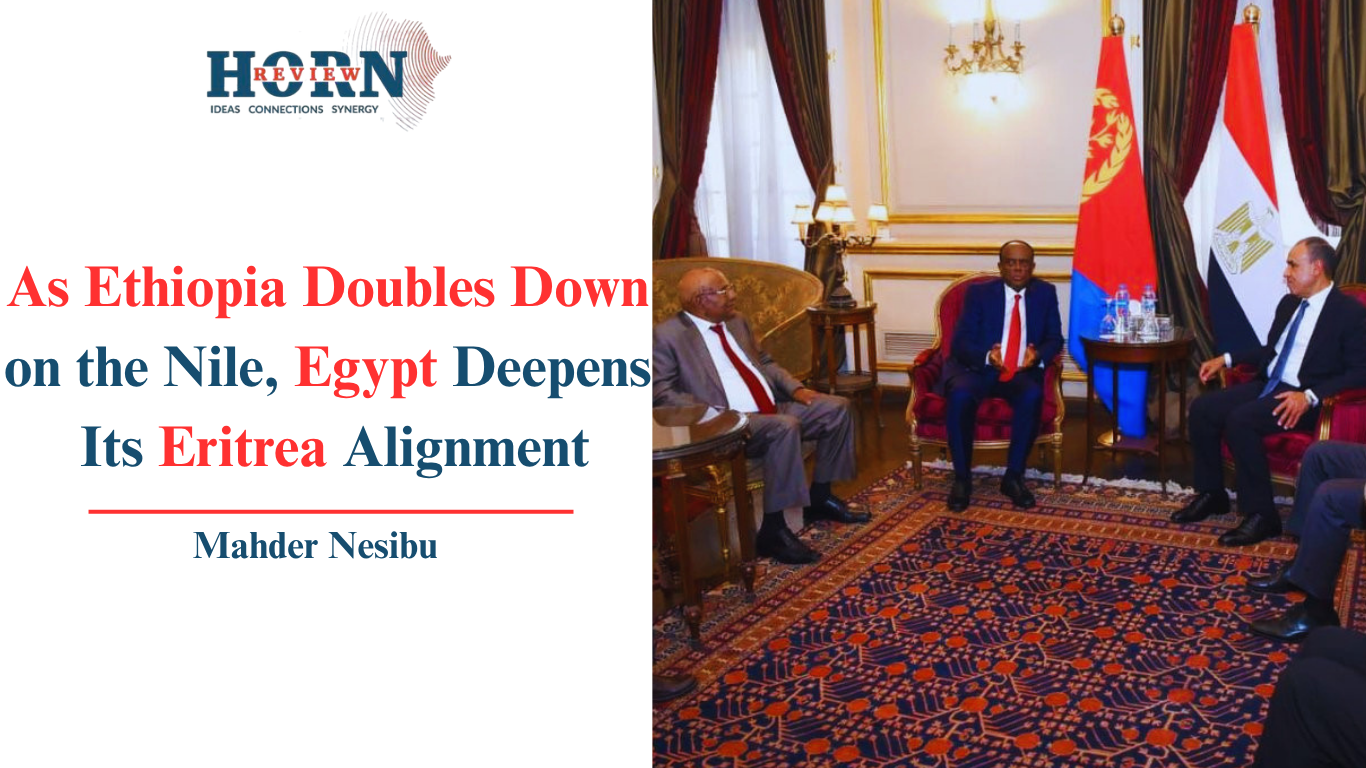
In mid-April, a senior Eritrean delegation arrived in Cairo for a three-day official visit. The delegation was led by Hagos Gebrehiwet, Head of Economic Affairs of the PFDJ and the principal economic architect of the Isaias administration, alongside Nesredin Salah, Minister of Trade and Industry. Over the course of the visit, both sides held meetings spanning foreign affairs, investment, trade, industry, transport, electricity, agriculture, and the central banking authorities. Egypt’s Foreign Minister Badr Abdelatty reaffirmed Cairo’s support for Eritrea’s sovereignty and territorial integrity. Both governments declared intent to deepen economic cooperation and expand trade volumes.
The calibre of the delegation, and the breadth of the ministerial programme it undertook, reflects the degree to which Egypt is now actively shaping Eritrea’s external economic orientation. Hagos Gebrehiwet, the most powerful economic figure in Asmara after Isaias himself, does not make such a visit for commercial purposes alone. That the engagement produced no formal agreement likely means it was primarily aimed at public signalling, directed as much at Addis Ababa as at either capital’s domestic audience, that Asmara’s strategic orientation is increasingly consolidated within Cairo’s orbit.
Egypt’s interest in Eritrea runs deeper than its utility as a pressure point in the Nile dispute, though that function remains primary. Cairo has long held that the Red Sea is exclusive to Egypt and allied states, and keeping Ethiopia away from the coast has been a consistent Egyptian strategic priority. This disposition carries historical weight. Egypt’s support for Eritrean liberation movements during the decades of armed struggle was motivated in significant part by the desire to establish dominance over the Red Sea and degrade Ethiopia’s capacity to maintain its own presence. The ruling party in Asmara was partly shaped by that patronage. The logic of the current alignment draws on the same foundations.
In late 2025, Egypt reportedly moved to give that logic concrete form, concluding agreements to upgrade Assab in Eritrea and Doraleh in Djibouti, two ports positioned near the Bab al-Mandeb strait, the southern gateway to the Red Sea. The agreements reportedly provide for berths capable of hosting warships, re-fuelling facilities for Egypt’s southern naval fleet, and the option to deploy small military contingents. Assab is the port Ethiopia has most openly identified as a potential route back to the sea. Doraleh handles the vast majority of Ethiopian trade. Egyptian military assets positioned at both locations amount to a deliberate encirclement of Ethiopia’s commercial lifeline, and in turn put pressure on Addis Ababa.
That sequencing is interesting. In February, reports emerged that Egypt had proposed to facilitate Ethiopia’s commercial access to Red Sea ports, conditional on Addis Ababa demonstrating flexibility in Nile negotiations and abandoning any ambition for a military coastal presence. Cairo denied the reports within twenty-four hours. Egypt has used this manoeuvre before: a proposition is advanced, pressure is registered, and when scrutiny intensifies, the offer is withdrawn while the underlying leverage remains in place. What the revealed was the structure of Cairo’s coercive diplomacy in the region. Egypt was offering to moderate pressure it had itself constructed, in exchange for concessions it had been unable to extract through negotiation. The implicit threat was its inverse: that the leverage at Assab and Doraleh would be used to obstruct Ethiopian commerce if the offer was refused.
The alignment between Cairo and Asmara extends well beyond the Nile and the Red Sea, and nowhere more consequentially than in Sudan. In the final months of 2025, President Isaias conducted a concentrated regional tour, visiting Cairo, then Port Sudan to meet SAF commander General Abdel Fattah al-Burhan, and subsequently Riyadh. The visit to Cairo followed an earlier trip by Burhan to Asmara and preceded a series of additional SAF delegations to Eritrea. Asmara has provided the SAF with training, weapons, and logistical support, with Eritrean territory serving as a transit route for materiel destined for the war effort. Egypt’s extensive backing of the SAF in Sudan’s civil war and Eritrea’s own alignment with Burhan’s forces place both firmly behind the same side of the most consequential conflict in the region.
Compatible as they are, the two capitals arrived at that alignment through distinct calculations. The collapse of the Bashir government was, for each, an opening of a different kind. Egypt views the SAF-controlled administration as an amenable interlocutor for reasserting Cairene influence over Khartoum, a priority with direct implications for Nile governance and Sudan’s posture in the GERD dispute. For Eritrea, the SAF is useful in multiple regards, for one, it controls the border regions, and a friendly administration in Port Sudan limits the risk of Sudan being used as a platform by actors hostile to Asmara.
Egypt’s pressure campaign reaches further still. Cairo is gradually deploying the approximately 1,100 troops it committed to AUSSOM, the African Union’s new stabilisation mission in Somalia, marking the first time Egyptian forces have participated in an AU Somalia operation. The deployment also follows a bilateral defence agreement signed with Mogadishu in 2024. An Egyptian military presence in Somalia gives Cairo a foothold on Ethiopia’s south-eastern flank, reinforcing its ability to operate through a government already at odds with Addis Ababa over Somaliland. Cairo is simultaneously positioned at Djibouti’s Doraleh port. Across the Nile Basin, Egyptian diplomatic engagement with upstream signatories to the Cooperative Framework Agreement, which entered into force in October 2024 and which Egypt rejects, appears calibrated to prevent the new Nile River Basin Commission from consolidating institutional authority and eroding the colonial-era arrangements on which Cairo’s historical claims rest.
From Eritrea’s vantage point, the deepening alignment with Egypt carries appeal given its own deteriorating position relative to Ethiopia. The proxy strategy Asmara has pursued inside Ethiopia, supporting armed groups in Amhara and Tigray to pressure the federal government from within, has shown diminishing returns. The Fano rebellion in the Amhara region is fragmenting, with factions negotiating with regional authorities and withdrawing from active confrontation. The TPLF, weakened by internal divisions and disputes between its political and military leadership, offers less reliable purchase as an instrument of indirect pressure. Further embedding within Egypt’s broader regional architecture offers Eritrea a compensatory form of leverage, a way of sustaining pressure on Addis Ababa through external alignment as internal instruments lose their effectiveness.
Egypt’s engagement with Asmara is tactical in character, and those costs can accumulate quietly. Cairo treats Eritrea as one instrument among several and extends support commensurate with that valuation. As Eritrea anchors itself more deeply within this architecture, the strategic equidistance and capacity for manoeuvre that have historically defined its foreign policy posture become harder to sustain. Asmara’s ability to operate across competing alignments, rather than within one, has been its principal source of regional relevance. The deeper the alignment with Cairo, the more Eritrea’s external orientation is shaped by Egyptian priorities, and the narrower its room to recalibrate when those priorities shift.
For Ethiopia, the consequences of Egypt’s regional architecture are visible most directly in its bilateral relationships. The Ethio-Sudanese relationship illustrates the pattern. Beyond their own bilateral tensions, Sudan’s posture toward Addis Ababa has long been inflected by Khartoum’s standing with Cairo. The SAF’s increasingly antagonistic disposition toward Ethiopia, and its alignment with Egypt’s position on the Nile, reflects that dynamic. Egypt’s deepening engagement with Eritrea adds a further layer of pressure on Ethiopia’s northern frontier, where tensions remain elevated despite the absence of open conflict.
Egypt’s regional engagement is framed officially in the language of cooperation, stability, and solidarity. The architecture being constructed reflects a different orientation. From Eritrea’s ports to Somalia’s peacekeeping framework, from the SAF’s supply lines to sustained diplomatic pressure on Nile Basin signatories, Cairo is assembling a constellation of relationships whose common denominator is the containment of Ethiopian influence. This is a strategy oriented toward coercion rather than resolution, and its intensification has tracked precisely with the recession of any prospect for a negotiated Nile settlement. The encirclement of Ethiopia has deepened in direct proportion to Cairo’s inability to compel it to the table. Those two trajectories are not coincidental; one is the cause of the other.
By Mahder Nesibu, Researcher, Horn Review