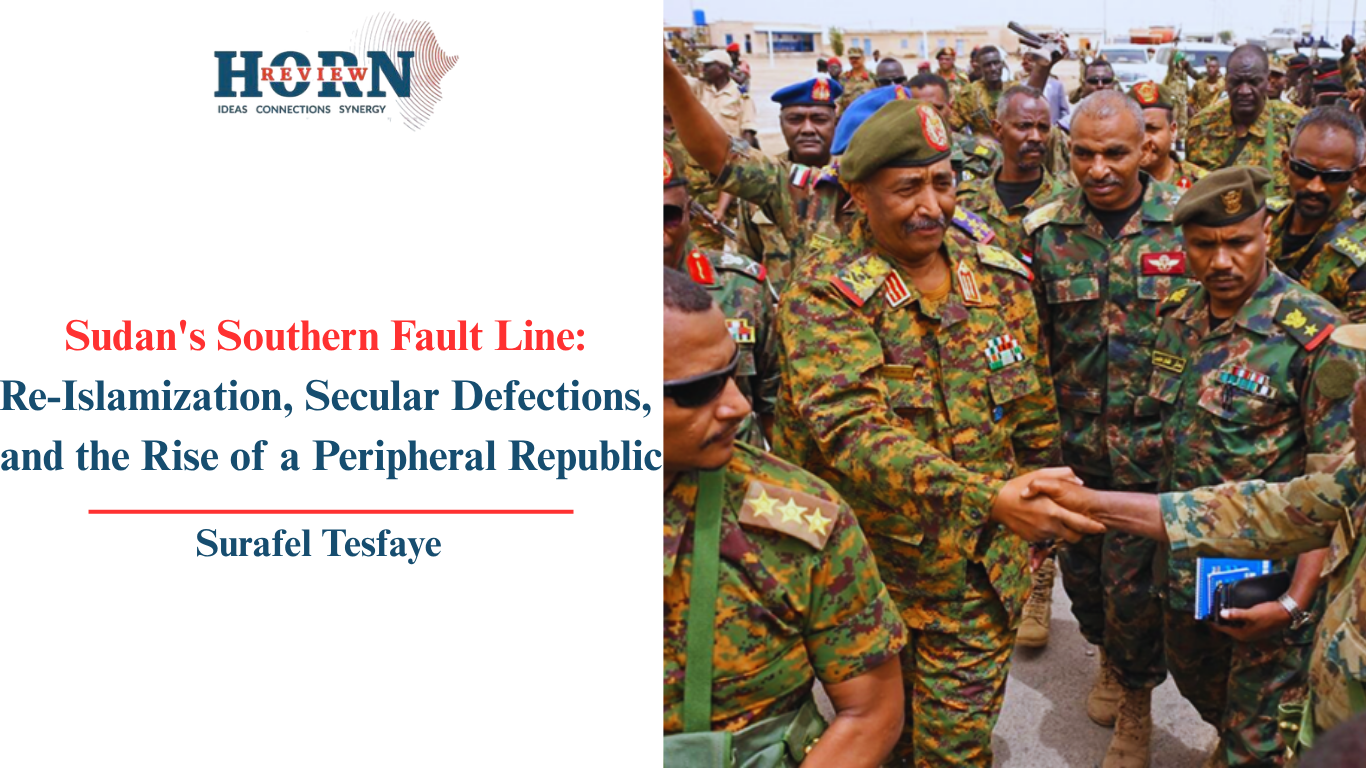
In April 2026, Major General Hassan Adam al-Hassan, the second-in-command of the Sudan People’s Liberation Movement–North (SPLM-N, Agar faction), defected to the TASIS alliance in Blue Nile State. His move, joining forces loyal to Abdelaziz al-Hilu and supported by the Rapid Support Forces (RSF), marked a pivotal turn in Sudan’s conflict. The TASIS alliance, controlling strategic territories south, east, and west of Ed Damazin including Majga and Deim Mansour now commands a corridor that opens southeastern Sudan to RSF influence, threatening to unravel Al-Burhan’s grip on the center and northeast.
The defection reflects a deeper ideological rift within the Sudanese Armed Forces (SAF). Al-Burhan’s earlier purge of professional and secularist officers ostensibly to satisfy international actors wary of a resurgent Islamism has backfired. Secularist generals, feeling marginalized and betrayed, are leaving or defecting, taking with them the most capable and politically connected elements of the SAF coalition. The incorporation of Islamist militias, including remnants of the National Congress Party (NCP) loyalists and units like the Al-Baraa bin Malik Brigade, signals not just military expedience but the institutional re-Islamization of the army. While al-Burhan may try to “dismantle” or rename the brigade to evade sanctions, their deep integration into the security apparatus and their battlefield successes make them a dominant and perhaps uncontrollable force in Sudan today. Al-Burhan’s public denials mask a reality in which survival increasingly depends on forces aligned with the Muslim Brotherhood and other Islamist networks.
When Bashir was overthrown by popular revolution in April 2019, the Brotherhood did not disappear. It retreated into the very institutions it had spent thirty years building: its networks within the military, intelligence, and economy remained intact. When civil war broke out between the Sudanese Armed Forces and the Rapid Support Forces in April 2023, the Brotherhood saw an opportunity to reclaim the state it had lost. This turn is historically resonant. Sudan’s peripheral regions Blue Nile, South Kordofan, and Darfur have long borne the weight of marginalization. Under Nimeiry’s imposition of Sharia law in 1983 and its expansion under Bashir, these areas became battlegrounds of exclusion and rebellion. John Garang’s SPLM/A had sought a united, secular Sudan, drawing fighters from these peripheries to challenge the central Arab-Islamic elites. The post-2011 legal arrangements left the “Two Areas” trapped in the North, unable to join South Sudan, while the CPA’s “Popular Consultations”denied them meaningful political autonomy. What the SPLM-N fights for today is the secular vision Garang championed: a New Sudan founded on equality rather than Arab-Islamic identity.
The depth of the Brotherhood’s control over the SAF is no longer a matter of speculation. A leaked video, reported by Sky News Arabia, showed a senior Brotherhood figure openly declaring that General al-Burhan serves merely as the public face of the military while the Islamist organization exercises actual command over the army’s strategic direction. This admission aligns with what many Sudanese analysts have long argued: that the Sudanese Islamic Movement operates as the real power behind the military’s war effort. Its network supplies the SAF with manpower, financing, and public mobilization capacity that al-Burhan’s conventional military structure cannot generate on its own.
In return, the Brotherhood secures its grip over Sudan’s institutions and positions itself to dominate the post-war political order. A recent analysis by Daniel J. Deng, published by the Konrad Adenauer Foundation, would be a useful place to start. Deng, an East Africa and South Sudan peace-building specialist argues that the war is not merely a quest for military dominance but is, significantly, a “war of visions” over the future architecture of the Sudanese state. Deng sees the Rapid Support Forces, led by Mohammed Hamdan Dagalo (“Hemedti”), as a product of both the collapse of centralized governance and, potentially, as a catalyst for more inclusive, decentralized national reconstruction the ‘New Sudan’. The Sudanese Armed Forces under General Abdel Fattah al-Burhan is cast as the contemporary custodian of Sudan’s long-standing centralist, military-Islamic order. Moreover, it can be argued, Hemedti, whether by conviction or design, is the inheritor of that vision Garang’s vision. Certainly, in his rhetoric, he appears to have adopted its central tenets and made them central to the vision that lies behind his political coalition, Tasis, and the ‘government of peace and unity’ it has set up in Nyala.
The rise of the TASIS alliance is a manifestation of this vision in practice. By establishing a 31-member governance council with Hemedti as President and al-Hilu as Vice President, it has institutionalized a rival state structure in the South and West. Control of Blue Nile provides the RSF with a strategic depth that could allow operations north toward Sennar and central Sudan, reopening access routes long held by the SAF. The alliance’s attempt to create an independent civil registry, currency, and parallel institutions signals a de facto partition, transforming the conflict from a contest over territory into a struggle over competing state models.
The RSF’s acquisition of a “Garang-aligned” base in the periphery has deep implications. Hemedti is replicating Garang’s strategy: attracting marginalized constituencies from Blue Nile, South Kordofan, and Darfur, while framing the conflict as a secular, decentralized struggle against the Nile Valley elites. Yet, the historical difference is stark. Whereas Garang commanded legitimacy as an intellectual and principled democrat, Hemedti’s RSF is a force built on coercion and opportunism, albeit now cloaked in the rhetoric of secularism and reform.
Al-Burhan’s position is increasingly precarious. Should the RSF consolidate a belt of control along Sudan’s southern border from Darfur through South Kordofan to Blue Nile he risks being confined to Port Sudan and northeastern territories, reliant on Red Sea access but severed from the oil-rich regions in the south. The port would remain economically and militarily relevant but no longer central to national governance. Internationally, his alliances with Egypt, the UAE, and Saudi Arabia provide limited cover, as these states are wary of a resurgent Islamist influence yet powerless to enforce compliance while regional attention is diverted to Middle East.
The shift toward Islamism within the SAF is therefore both tactical and systemic. Al-Burhan’s reliance on Islamist militias now formally integrated into the army’s command reverses the purges of secularist officers and institutionalizes ideological forces that previously threatened his international standing. In early March 2026, the SAF arrested Islamist commander Al-Naji Abdullah after he publicly pledged to send fighters to defend Iran. Analysts described this as a “messaging discipline” performance to distance the SAF from the U.S. terrorist designation of the BBMB on March 9, 2026. Experts note al-Burhan’s “maneuvering option” denying ties in public meetings with U.S. envoys while continuing to meet regularly in Port Sudan with Ali Karti, the Secretary-General of the Sudanese Islamic Movement. Under Bashir, the Brotherhood penetrated every state institution.
Today, the NCP is re-emerging by reintegrating former members into the political, military, and bureaucratic apparatus, effectively creating a “state within a state” once again. The departure of figures like Major General Hassan Adam al-Hassan underscores the ideological collapse within the SAF: the secular vision is abandoned, while reliance on militias with Islamist agendas grows. The consequences are not merely military; they extend to sectarian and territorial polarization, threatening a Sudan fragmented along both ideological and geographic lines.
Previously, al-Burhan had purged Islamist militia men, including the dismissal of the commander of the presidential guard, Major General Nader al-Mansouri, who had saved him from the RSF in the initial days of the conflict. However, if the situation moves toward a sectarian division, and al-Burhan continues to ally with Islamist militias and sanctioned groups, the secular elements may leave, and the conflict may gain another dimension beyond power grip. The situation may turn in another way one that leaves Burhan with the reality of the re-Islamization of the army, mirroring the previous regimes’ cycles in a different time. Beyond the halt of the war or territorial dominance, the situation in Sudan may turn into a sectarian conflict, forcing Burhan into a balancing act of reimagining his relationship with the Islamist groups.
South Sudan faces an equally precarious scenario. Control of the southern periphery by the RSF and TASIS alliance effectively places Salva Kiir’s government in a “hostage economy.” Oil pipelines from Unity and Heglig must traverse RSF-controlled territory, giving Hemedti leverage over South Sudan’s revenues. Historical ties between border commanders and RSF-aligned forces further complicate Kiir’s position, potentially empowering internal opposition factions and destabilizing the young state.
In sum, Sudan is entering a critical historical juncture. Al-Burhan’s dependence on Islamist militias, the defection of secularist generals, and the RSF’s strategic consolidation along the southern belt represent a confluence of territorial, ideological, and sectarian forces. If the current trajectory continues, Sudan may bifurcate: an Islamist-leaning North under Al-Burhan and a secular-periphery Republic under Hemedti and the TASIS alliance. This realignment is more than a territorial struggle; it is a clash of visions, echoing Garang’s dream while redefining Sudan’s political geography in profoundly destabilizing ways.
By Surafel Tesfaye, Researcher, Horn Review