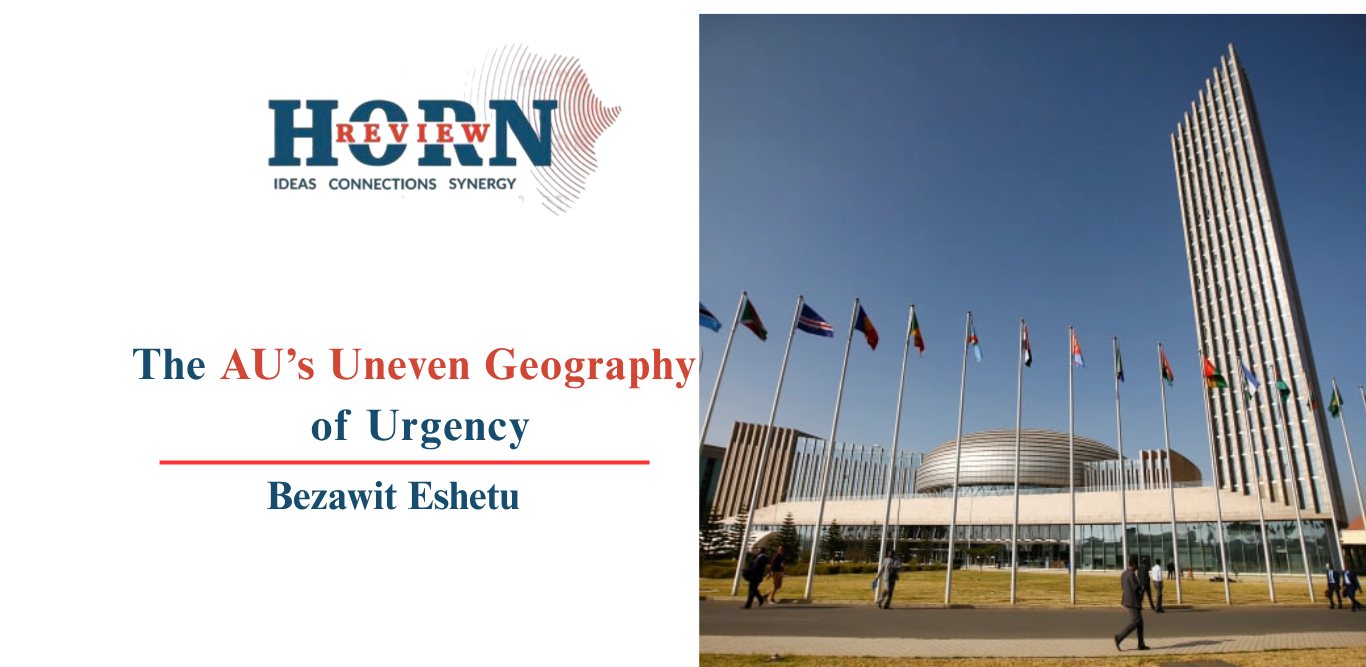
Since Mahmoud Ali Youssouf assumed leadership of the African Union Commission in March 2025, the institution has confronted an increasingly entangled continental security environment, from the war in Sudan and renewed conflict in eastern Democratic Republic of the Congo to instability across the Sahel and intensifying strategic competition around the Red Sea. Youssouf brings extensive diplomatic experience from Djibouti, a state whose geography and foreign relations connect the Horn of Africa with the Arab world and the wider Middle East. This experience gives the Commission valuable access to political networks and regional negotiating channels. It also raises a broader institutional question about how diplomatic familiarity shapes continental priorities, particularly when the interests of influential Arab member states intersect with African security crises. The question concerns the Commission’s institutional posture, its management of competing regional interests and the credibility of its claim to represent the continent as a whole.
Youssouf’s professional formation offers a useful starting point. According to the African Union’s official biography, he served as Djibouti’s foreign minister from 2005 until his election to the Commission chairmanship, having previously represented Djibouti in Egypt, the Arab League and several Middle Eastern capitals. He also held leadership responsibilities within the Arab League and the Organization of Islamic Cooperation. These positions cultivated diplomatic relationships, negotiating practices and political knowledge that can be valuable to a continental institution. His background should therefore be understood as a source of institutional capacity, while its possible influence on the Commission’s regional outlook deserves scrutiny. Diplomatic networks shape which interlocutors are readily available, which channels can be activated quickly and which political languages feel familiar. Over time, such advantages can influence institutional attention even without a deliberate preference for one regional constituency.
The deeper issue is how professional networks interact with the geography of power. Djibouti occupies a strategic position at the intersection of African, Arab and international maritime interests. Its diplomatic outlook has necessarily given considerable weight to Red Sea security, Gulf relationships, commercial transit and the political dynamics of the Horn. These concerns carry genuine continental significance. Shipping disruptions affect African economies, military competition around Bab el-Mandeb changes the security calculations of neighboring states, and instability in the Horn can reverberate across several regional organizations. Yet a perspective formed around this strategically interconnected corridor can produce a particular understanding of continental urgency. Crises that connect readily to established diplomatic networks may acquire immediate visibility, while conflicts farther from those networks depend more heavily on institutional procedures, collective member-state pressure and sustained bureaucratic attention.
The institutional structure of the African Union makes this distinction especially important. The Commission serves as the Union’s executive secretariat, initiates proposals, implements decisions, coordinates common positions and manages programmes under the guidance of member-state organs. The Assembly determines common policies, while the Peace and Security Council functions as the standing decision-making body for conflict prevention, management and resolution. These arrangements distribute authority across the institution and constrain the extent to which the Chairperson can independently determine the continental agenda. Nevertheless, the Chairperson has considerable influence over public messaging, diplomatic engagement, the presentation of emerging crises and the pace at which the Commission mobilizes its relationships. The relevant question is therefore how personal diplomatic capital interacts with institutional mandates, collective decisions and administrative routines. A regional imbalance can emerge through accumulated habits of engagement even where formal policy remains pan-African.
The Red Sea provides a revealing example of this interaction. In July 2026, Youssouf strongly condemned Houthi attacks on commercial oil tankers and expressed full solidarity with Saudi Arabia. In September, the Commission issued another statement condemning attacks on Saudi civilian targets and economic infrastructure, highlighting threats to holy sites and commercial navigation and reaffirming freedom of navigation through Bab el-Mandeb. These statements reflected legitimate concerns about regional security and the economic exposure of African states. The July statement and September communiqué nevertheless demonstrate how closely the Commission’s public language can align with the immediate security concerns of a major Arab partner.
The strategic question concerns the framing of maritime insecurity and the distribution of diplomatic attention. When attacks against Saudi interests receive prominent condemnation and explicit solidarity, the Commission communicates a clear political position. A similarly comprehensive framing of Red Sea security would also examine the consequences of militarization for African coastal states, the dependence of landlocked economies on maritime corridors, the expansion of external military access, and the regional tensions that follow from competing claims over security governance. Ethiopia’s dependence on Djibouti, for example, gives developments around Bab el-Mandeb direct economic significance, while the military and diplomatic competition involving Eritrea, Egypt and other regional actors affects the strategic environment of the Horn. A continental perspective should connect solidarity with affected partners to a wider African account of the corridor’s political and economic consequences.
This question of framing became particularly visible in October 2026, when the Commission issued a statement concerning escalating tensions between Ethiopia, Eritrea and Egypt. The statement of 1 October urged all three countries to exercise restraint and preserve diplomatic channels. Following Egyptian objections, the Commission issued a clarification on 4 October, emphasizing that its initial intervention was a general appeal for de-escalation and reaffirming Egypt’s importance as a founding member of the Union. The clarification coincided with Egypt’s hosting of the AU Mid-Year Coordination Meeting in Alamein.
The sequence matters because institutional neutrality depends partly on how the Commission manages diplomatic objections from powerful member states. Clarification can be appropriate when a statement is misunderstood or risks aggravating a crisis. However, a rapid clarification following a member state’s objection can create the impression that political sensitivity influences the Commission’s public posture. The subsequent reaffirmation of Egypt’s institutional importance sharpened that perception. The timing raises a legitimate question about whether the Commission applies consistent standards when explaining statements concerning different member states. For an institution whose authority rests heavily on political confidence, such perceptions carry consequences beyond the immediate dispute. They influence whether smaller states and less influential regional groupings expect the Commission to defend its own mandate when challenged by a powerful government.
Sudan presents a more sustained institutional challenge. In a September 2025 interview with The National, Youssouf argued that Sudan must avoid a Libyan-style fragmentation and said the AU needed to continue engaging the Sovereign Council led by General Abdel Fattah al-Burhan while bringing other political forces into an inclusive dialogue. The position reflected a practical concern about preserving state institutions and avoiding rival administrations. It also placed the Port Sudan authorities at the centre of engagement while Sudan’s AU membership remained suspended following the October 2021 coup. The tension between practical access and political legitimacy subsequently became more visible.
On 30 December 2025, Youssouf welcomed a peace initiative presented by Sudan’s transitional authorities to the United Nations Security Council, describing it as a credible foundation for sustainable peace. Civilian and political actors, including the Somoud coalition associated with former prime minister Abdalla Hamdok, argued that the statement effectively endorsed one party’s negotiating position. More than one hundred parties, organizations and public figures signed a memorandum criticizing the Commission’s language as inconsistent with institutional neutrality.
The Sudan controversy exposes a fundamental dilemma in African conflict mediation. Engagement with de facto authorities can preserve channels for humanitarian access, ceasefire negotiations and the maintenance of public institutions. Public endorsement of a proposal advanced by one belligerent carries a different political weight, particularly when the proposal’s terms are contested by civilian constituencies and the opposing side. The issue is the boundary between maintaining operational access and conferring political legitimacy.
This dilemma is not isolated from the broader pattern of attention and influence that has marked the Commission under Youssouf. his experience in Arab-world diplomacy and Horn of Africa geopolitics can be a significant asset to the African Union. The danger lies in allowing the advantages of established networks to become an informal hierarchy of continental attention. The institution’s legitimacy depends on the confidence of member states that its diplomatic language, political engagement and crisis response reflect common African commitments. That confidence is tested when the Commission appears especially responsive to some partners, while its handling of other conflicts generates sustained complaints about neutrality and inclusion.
By Bezawit Eshetu, Researcher, Horn Review