Every time Sudan’s war comes up in public discussion, mentioning the abuses of one side, it almost always produces the same reflex: the audience assumes an endorsement of the other. Point to the Rapid Support Forces’ documented conduct in Darfur and El Fasher and the response is an accusation of carrying water for Port Sudan. Point to the Sudanese Armed Forces’ sieges, blocked humanitarian corridors, and the chemical attacks attributed to it, and the accusation runs the other way, toward sympathy for the RSF. This reflex has little to do with the facts themselves. It follows from the shape of the conversation, which admits only two positions and nothing between them.
Carl Schmitt’s account of the political provides a useful framework for understanding why political claims acquire meaning through processes of differentiation. Schmitt argues that the political is constituted by the distinction between friend and enemy, a distinction that becomes particularly salient when groups confront one another as collective political actors. From this perspective, political discourse tends to acquire significance through its relationship to an existing political opposition. Facts and statements that appear neutral or independently documented may therefore be interpreted differently depending on how political actors position them within an established field of contestation.
Applied to Sudan, Schmitt’s distinction helps explain why a claim about SAF’s conduct gets read either as an attack on SAF, and therefore as support for the RSF, or as a defense of SAF against exaggeration, and therefore as hostility to the RSF. The same sorting runs in reverse for any claim about RSF conduct. What the claim actually says matters less than which side it appears to serve, because the discourse Schmitt describes was never built to hold a third position.
This has less to do with the ability of the audiences to reason carefully but more to do with how the underlying structure works. A war that is being fought this bitterly with the parties implicated in documented atrocity and both heavily invested in narrative control, produces the exact political space Schmitt describes; one where neutrality itself is read as a hostile act because neutrality denies the binary that both belligerents and their external patrons need for the conversation to hold.
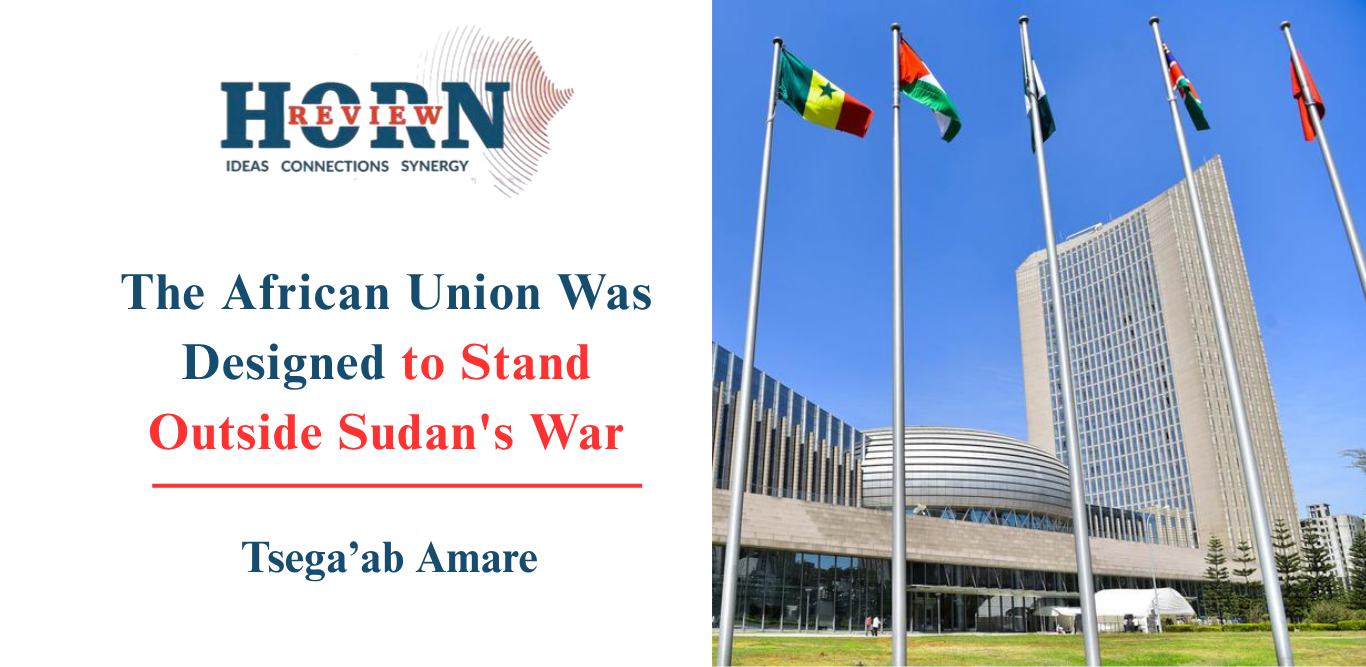
The African Union gives a stark case worth examining, precisely because it was created to be the institution that occupies the third position Schmitt says ordinary discourse cannot hold.
The AU PSC suspended Sudan after the October 2021 military coup that paved the way for the current structure whilst removing the civilian prime minister, Abdalla Hamdok. The suspension did not mean that the AU ceased engaging Sudan’s authorities. Rather, it meant that Sudan’s participation in AU activities was suspended until the restoration of a civilian-led transitional authority. The distinction is that the AU could continue diplomatic engagement without treating the military authorities as the legitimate expression of Sudan’s constitutional order.
The record of the AU’s action on Sudan since then, however, suggests otherwise. In December 2025, AU Commission Chairperson Mahmoud Ali Youssouf welcomed a peace initiative originating from Port Sudan, the seat of one of the two warring parties. What followed was a protest memorandum signed by more than one hundred Sudanese political parties, civil society organizations, experts and individuals who argued that no AU institution has grounds to recognize a legitimate government or efforts by a faction while the suspension stands.
In another incident Sudanese civilian coalition members described, to Horn Review, how organizers of the AU facilitated dialogue in Addis Ababa restructured seat allocations to favor a pro-SAF bloc without clear procedural justification. This pattern continued with the Commission’s recent endorsement of the proposed Sudanese-Sudanese Dialogue spearheaded by al-Burhan, extending the same tilt rather than correcting it.
When the institution that is mandated to hold the neutral position repeatedly drifts, through statements and procedural choices rather than formal policy, toward one side of the binary it was built to resist, it poses a critical question: Is procedural neutrality merely a mask that inevitably slips when an institution is forced to interface with belligerents?
The RSF is not a passive victim of this drift; rather, it has pursued its own claim to legitimacy independent of AU recognition by agreeing on a charter for a parallel decentralized government at a meeting held in Nairobi in February 2025. Both parties are contesting sovereignty by whatever means are available to them, which is exactly why an external arbiter’s impartiality matters more here than in a conflict with a clearer legal asymmetry between the sides.
International Humanitarian Law offers a more precise wording for what the AU has failed to do than the conventional language of bias usually allows. It distinguishes ‘Impartiality,’ applying the same evaluative standard to all parties regardless of political sympathy, from ‘Neutrality,’ which is declining to hold any view on who is right. The AU is not obliged to adopt neutrality in this stronger sense as it has views on which side bears more responsibility for particular atrocities, as IHL doesn’t require equivalence for the belligerents.
What the AU owes Sudan is impartiality, a consistent standard applied evenly. However, incidents mentioned above represent a departure from that standard rather than from an unrealistic demand for neutrality which the AU was never required to meet.
Amid this institutional drift, it is worth noting that a genuine attempt to occupy the third position that the AU was supposed to model already exists among Sudanese civilians themselves. The Somoud coalition, led by former PM Abdalla Hamdok, represents one of the clearest attempts to construct a civilian political space that refuses military rule by either belligerent, making it distinct from the Democratic Bloc aligned with the SAF and from Tasis, the RSF backed alliance that stood up its own parallel government. Yet its political history also demonstrates how difficult that position is to sustain: engagement with either side can itself be interpreted as alignment with that side.
Somoud’s proposed political architecture pointedly excludes both warring parties from transitional authority. Its founding declaration refers to the SAF and the RSF only as ‘warring parties’ rather than naming either, as a legitimate counterpart in a deliberate refusal to grant either side the legitimacy that comes with recognition. That even-handedness is not symbolic; rather, it reflects the coalition’s base which is disproportionately made up of resistance committees, displaced communities, and civil society actors who have borne the atrocities of the SAF’s aerial bombardment, the RSF’s ethnically targeted campaigns, and a sexual violence campaign UN monitors attribute mostly to the RSF, with a smaller share of verified cases linking SAF and aligned forces.
Somoud is, in effect, trying to build the institutional home for the “common rule” argument in real political terms. It is a constituency that has no stake in either side winnisssng and only in both being held to account. Its structural weakness however is the same, without naming the belligerents precisely, a roadmap to peace struggles to build enforceable accountability provisions. Consequently, a sincere attempt at neutrality must still resolve the tension between diplomatic ambiguity and the specificity that accountability requires.
Some of the AU institutional drift traces to a narrower institutional problem than outright policy capture. The AUC chairs operate with real latitude to make statements and structure dialogue processes that member states never explicitly authorized. This paves the way for the chair’s own outlook and understanding of the situations, with the interests of his home state, to diverge from the organization’s formal mandate without anyone deciding to abandon the mandate.
As a result, an institution meant to model the third position that ordinary discourse cannot sustain has instead reproduced the binary, leaving Sudanese civilians and civilian political actors without the one venue that was supposed to judge both belligerents by a common rule.
This is what makes the civilian project harder than it looks on paper. Somoud is trying to hold the very position that the AU has abandoned, yet it must do so without the AU’s convening authority, without recognized sovereignty, and while competing for legitimacy against two better-armed rivals who can each point to partially functioning parallel governments.
The binary trap in Sudan’s war discourse is therefore not a failure of individual commentators to think clearly; rather, it is a structural feature of how politically organized conflict is discussed, an outcome that Schmitt’s friend-enemy framework predicts, and that Sudan’s war illustrates with unusual clarity given how both the SAF and the RSF are implicated in documented atrocities and war crimes.
The corrective, both for the AU and for anyone assessing Somoud’s viability, is not a demand for an impossible neutrality on the war’s politics. The question is whether the same institutional standard is applied to both. Impartiality does not require the AU to assign equal blame; it requires it to apply equal rules. That distinction is crucial for Sudan, and it is precisely the distinction between neutrality and impartiality that the war has exposed and Somoud’s founding language and proposal suggest it is at least trying to hold itself to.
By Tsega’ab Amare, Horn Review