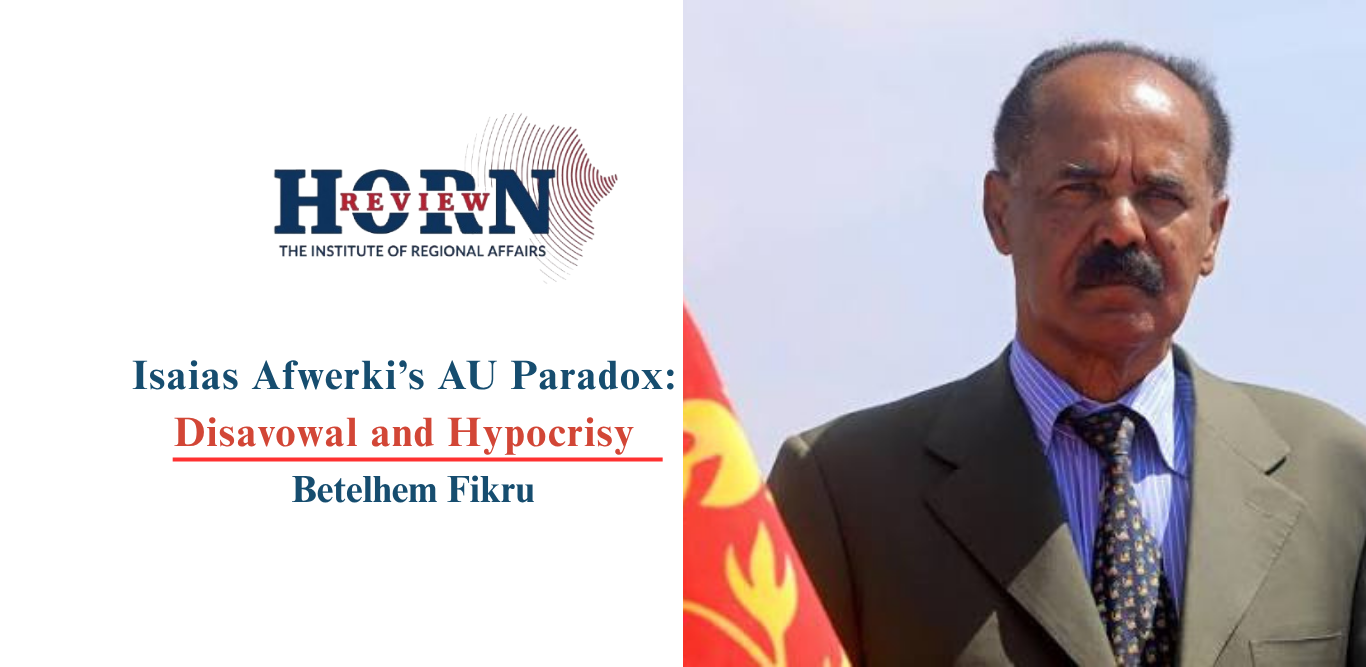
Isaias Afwerki’s categorical dismissal of the African Union (AU) as dysfunctional, irrelevant, and incapable of producing meaningful solutions, on a Sputnik Africa interview conducted on the sidelines of the Third Russia–Africa Summit in Moscow, and was published on 28 October 2026. His remarks exposes a fundamental contradiction between Eritrea’s official political discourse and its diplomatic practice. Having portrayed the continental organization, alongside its predecessor, the Organization of African Unity (OAU), as a historical experiment that has failed to fulfil its institutional promises, Isaias has advanced a critique that extends beyond dissatisfaction with particular policy outcomes to question the utility of African multilateralism itself. Yet Eritrea’s subsequent appeal to the AU over Ethiopia’s expulsion of Eritrean diplomats reveals an unmistakable contradiction between this professed institutional scepticism and the government’s expectation that the same organization should intervene to protect Eritrea’s diplomatic interests. The resulting inconsistency is not merely rhetorical. It raises a deeper question about the coherence of Afework’s conception of regional order: whether its repudiation of continental institutions constitutes a principled critique of his structural deficiencies or a strategically contingent position that recedes when those institutions might serve his immediate interests.
What he delivered was not institutional criticism, but institutional rejection and dismissal of multilateralism. A critique of the AU’s performance may be grounded in defensible observations but the organization’s institutional architecture places substantial constraints. Like any other multilateral establishments, its ability to impose collective preferences upon sovereign governments resist external scrutiny. This limitations provide legitimate grounds for questioning the effectiveness of continental governance. They do not, however, necessarily establish that the AU is devoid of political or legal significance and that it has to be replaced by a new continental multilateral establishment. Afeworki’s remarks underscores his failure to clearly grasp the distinction between an institution’s limited enforcement capacity and its normative or procedural authority that is central to understanding the politics of multilateralism. The African Union remain consequential even when facing constraints to independently compel compliance, because it provide forums for contestation, establish expectations of conduct, confer political legitimacy, and create opportunities for continental and extra-continental diplomatic coordination.
Isaias’s formulation, thus, appears to collapse these distinctions. By treating the AU’s historical shortcomings as evidence of its contemporary irrelevance, he advanced a sweeping institutional verdict that leaves little conceptual room for selective utility. On the other hand, however, Eritrea’s recent appeal to the organization regarding Ethiopia’s expulsion of ten diplomats assigned to Ethiopia only (on national security grounds), where the regime in Asmara later chose to remove all the 14 diplomats, and later push for reinstatment of its diplomats by the African Union and the UNECA. And this presents a not just a problem of political consistency, but of personal hypocrisy and unrpincipled diplomatic manuever.
If the AU is as fundamentally incapable of generating meaningful solutions, on what basis does Asmara expect it to address a dispute involving Eritrea’s diplomatic representation? If the organization retains sufficient institutional authority to scrutinize Ethiopia’s conduct and facilitate the restoration of Eritrea’s participation, then its relevance cannot be dismissed categorically. If Afeworki believes as he says that the organization deosn’t retain that ability, then his regime has to cease its call for the AU’s intervention to reinstate its diplomats that it chose to withdraw from Addis Ababa when clearly its representation to the AU and ECA were not at all affected by Ethiopia’s declaration of Persona Non Grata.
The contradiction is even more pronounced as Eritrea has barely been consistently observing the AU’s proceedings or meaningfully participating in its political deliberations; it is rather invoking the organization as a potential guarantor of interests that its own leader’s rhetoric suggests cannot realistically be protected through continental mechanisms. Nevertheless, the political significance of Eritrea’s appeal extends beyond the technical merits of the diplomatic dispute. By seeking AU intervention, Asmara implicitly acknowledges that the organization possesses residual institutional value. It recognizes that the AU’s standing, procedures, and continental mandate may provide a basis for contesting the consequences of Ethiopia’s actions. This is not necessarily irrational. Governments frequently employ institutions they distrust, and states that criticize multilateral organizations may still invoke their rules when doing so advances national interests.
The compelling contradiction rather concerns the breadth and categorical nature of Isaias’s institutional repudiation. There is a substantive difference between arguing that the AU has repeatedly failed to resolve major continental crises and asserting that expecting anything useful from it is a waste of time. The former position allows for differentiated assessments of institutional performance and recognises that an organization may fail in one domain while retaining utility in another. The latter implies a much more comprehensive judgment about institutional incapacity. Once that judgment is advanced, an appeal to the same institution for a favourable intervention and selective invokation of international laws and norms requires an explanation of why the organization’s limitations are supposedly decisive in general but surmountable in the particular case affecting his regime. A state that demands respect for its own diplomatic rights while dismissing the principal continental institution through which those rights might be defended faces a burden of political explanation.
Eritrea must thus clarify whether its objection is to the AU’s institutional existence, to its demonstrated performance, or to its perceived inability to constrain member states. These are materially different positions, carrying different implications for regional policy. Isaias’s position, however, is that the AU is inherently incapable of generating meaningful outcomes, Eritrea’s reliance on it becomes more difficult to reconcile with the logic of his own argument. In that case, the government must explain why it expects an institution it considers fundamentally ineffective to deliver an outcome it regards as sufficiently important to pursue through formal diplomatic channels. The absence of a clearly articulated distinction between these positions weakens the analytical coherence of Isaias’s critique.
By Betelhem Fikru, Researcher, Horn Review