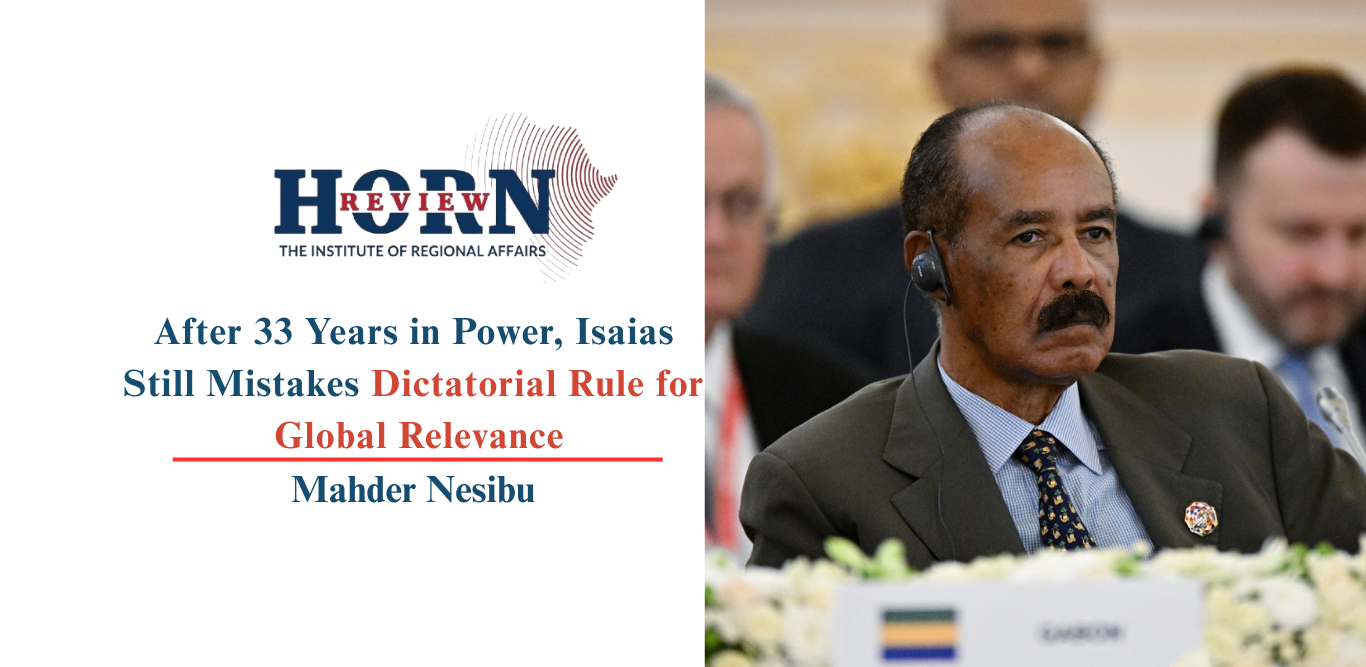
Among the participants at the third instalment of the much-publicised and arguably significant Russia-Africa Summit, held in Moscow in October, was Eritrea’s President Isaias Afwerki. His presence there, according to interviews he gave, was framed in terms of the broader issues of the international system, which Isaias has repeatedly stated his desire to see changed, with the bilateral relationship between his country and Russia taking a secondary place. For him, Russia has served as a bulwark against Western led liberal order. Yet his words carry scant real weight, given Eritrea’s marginal role on the international stage, where it wields little to no influence, owing above all to the damaging rule of Isaias himself.
Russia holds considerable appeal for President Isaias, who has maintained an iron grip on Eritrea for more than three decades. His autocratic rule has faced little challenge at home. The condemnation and pressure to change the behaviour of his regime (including its aggressive role in Eritrea’s neighbourhood, the Horn of Africa) have instead come from outside, primarily from the West and from the international institutions, such as the United Nations, that it arguably leads. When Russia went to war with Ukraine in 2022, Eritrea was one of five countries that voted against a UN resolution condemning Russia’s actions as aggression, the others including North Korea, whose African version Eritrea is often said to be. In his bilateral meeting with Russia’s President Vladimir Putin at the previous Russia-Africa Summit, in 2023, Isaias told him that there was “no Russia-Ukraine war”, only a broader struggle between Russia and the West, which he sees as a declining power “in intensive care”. He urged Putin to spearhead the fall of the liberal order and Russia to lead a new system.
Russia’s appeal to Isaias arguably carries a personal connotation, as he sees in President Putin a fellow strongman, albeit of a different calibre. More significantly, Russia, like Eritrea, has been a target of Western sanctions. In reaction to its war with Ukraine, the United States, the European Union and the United Kingdom all struck at the Russian economy, with sweeping sanctions on its banks and energy sector and Europe cutting its consumption of the Russian gas that had primarily been exported to it.
Eritrea, on the other hand, has been emerging from punishing sanctions, imposed by the United Nations and others such as the United States, only since 2018. The sanctions were a result of its support for al-Shabaab, a terrorist group in Somalia, as well as Isaias’s harsh rule, which has seen the arbitrary detention of political rivals and dissidents, the curtailment of independent media and the subjugation of Eritrea’s population to the state under a national service programme.
Beyond the sanctions, which Isaias and his regime identify as the cause of the country’s hardship, Eritrea is a severely limited state economically. Since emerging into statehood in 1993, it has shown little growth, as Isaias deems development and economic concerns a luxury, secondary to security concerns and to Asmara’s own geopolitical entanglements, which have oriented Eritrea toward the demands of war (Eritrea maintains one of the largest standing armies in Africa relative to its population, although it falls well short on other metrics of military strength).
Isaias’s desire for a new world order, one that would ideally see the West displaced from its position of influence, stems from the diplomatic isolation he has encountered from Western governments over his conduct in past decades.
The Russia-Ukraine war and the Western sanctions against the Kremlin have arguably intensified Russia’s interest in Africa. That interest also serves Russia’s desire, one that Isaias has named as his own priority, to rework the international system, a project Russia describes as the emergence of a multipolar order to replace the liberal one. Africa forms a core part of Moscow’s calculations, and Russia has worked to grow closer to the continent. This has been displayed in growing trade — including exports of wheat and fertilisers, as well as Russian gas–. Moscow has arrangements to help 15 African countries develop nuclear energy and, through the Africa Corps, a state-run paramilitary force, has increased its security footprint, particularly in the Sahel.
That engagement, however, is hard to detect when it comes to Eritrea. For one, its economy, which has little connection with the outside market, has no visible link with Russia. What little practical engagement there is appears to lie in the security sector, where Russia has been the traditional source of supply for Eritrea’s forces. Even that has yielded no dividends for Eritrea in recent years. Indeed, it was at the summit that its rival and neighbour, Ethiopia, announced the acquisition of fighter jets and air defence systems from Russia.
Isaias’s endorsement of Russia is likely to bear little fruit for Eritrea’s economy and regional standing, let alone place Eritrea alongside Russia in influencing the remaking of the international system.
Instead, Isaias’s rhetoric has clouded the prospects for improved relations with the West that took shape after Eritrea’s emergence from isolation. The United States, alongside several European countries (and the United Nations), has since been reconsidering its approach to Asmara. Washington in particular, which has begun to reassess its relations with Eritrea in view of the country’s position on the Red Sea, has been making conciliatory gestures towards Isaias, with the lifting of sanctions and several high-level contacts between the two capitals. Yet Isaias’s antagonism towards the West and his disinterest in engagement are likely to remain a barrier. This much was revealed when, in a public address after the United States disclosed that it was considering lifting sanctions, Isaias went on to attack Washington and its foreign policy, as he regularly does.
This precarious position of Eritrea within the international system is likely to persist for as long as its prickly leader continues to rule. Isaias is invested in sustaining rhetoric that alienates the West and in backing Russia with scant tangible return, while the question of the country’s place in a genuinely changing world goes unanswered.
By Mahder Nesibu, Researcher, Horn Review