Ethiopia’s renewed engagement with Libya is neither sentimental nor accidental however it is a deliberate shift from ideological alignment, sudden rupture and inactivity toward cooperation grounded in national interest. For Ethiopia, confronting a congested Horn of Africa marked by Nile disputes, Red Sea access challenges and Sudan’s civil war the opening to Tripoli addresses immediate citizen protection needs the imperative to limit destabilizing arms flows through the Sahel and the value of diversified partnerships beyond the immediate neighborhood.
The historical record illustrates how quickly convergence can dissolve. In the 1980s, Ethiopia under the Derg and Libya under Muammar Gaddafi developed close ties in shared revolutionary orientation and mutual support for liberation movements including coordination of assistance to the Sudan People’s Liberation Army and aligned positions within the Organization of African Unity. That partnership ended abruptly in 1991 when Ethiopia expelled Libya’s ambassador citing activities incompatible with diplomatic status. Relations deteriorated further when Gaddafi later extended support to Eritrea during the 1998 and 2000 war. For nearly three decades thereafter the relationship remained vestigial overshadowed by Ethiopia’s focus on Horn affairs and Libya’s post 2011 fragmentation.
Today Libya remains a divided polity with an internationally recognized Government of National Unity in Tripoli and a parallel administration in the east backed by Khalifa Haftar’s Libyan Arab Armed Forces. External actors shape the environment with Turkey maintaining a presence in the west while Egypt and the United Arab Emirates exercise influence in the east yet this configuration does not preclude constructive Ethiopian engagement.
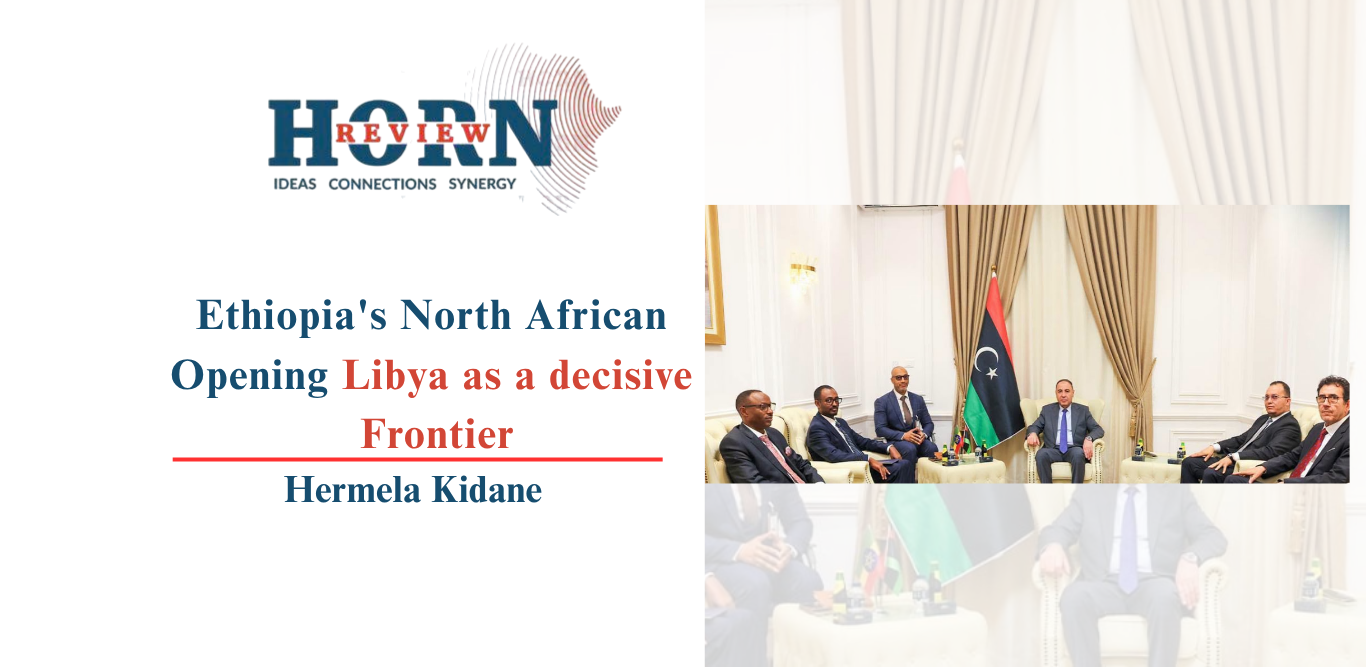
Recent high level contacts including Libyan Prime Minister Abdul Hamid Dbeibah’s visit to Addis Ababa and preparatory expert meetings held in Tripoli in late September 2026 demonstrate that the relationship is already emerging from dormancy. Discussions covered security, migration, investment, consular affairs and air transport with both sides agreeing to convene the second session of the Joint Ministerial Committee in Tripoli during the first half of 2027. Ethiopia has also extended support for Libya’s candidacy for a non permanent United Nations Security Council seat for the 2028 and 2029 term which is a low cost gesture that generates diplomatic goodwill.
The most immediate Ethiopian interest centers on its citizens. Ethiopians form a consistent component of the migrant population in Libya driven by economic pressures and displacement at home and using Libya as a principal departure point for Mediterranean crossings. Eastern Libyan authorities recent decision to restrict entry for Ethiopian nationals alongside those from Sudan, Eritrea and Somalia shows the vulnerability of this diaspora. Engagement with Tripoli on consular and migration frameworks converts a humanitarian concern into a structured bilateral priority creating channels for advocacy and the potential for orderly labor arrangements.
Security considerations supply deeper weight. The Sahel has emerged as a major theater of instability and Libya’s southern reaches serve as a northern terminus for trafficking routes carrying weapons, fighters and illicit finance across the Sahara. Sudan’s conflict has intensified these activities. Investigations have documented the use of facilities in eastern Libya particularly around Kufra and areas linked to Benghazi, as logistical nodes supporting arms and related flows connected to Sudan’s Rapid Support Forces. The Libya, Chad and Sudan border triangle functions as a zone of limited state authority. Historical patterns of weapons movement from Libyan territory into the Horn combined with contemporary reports of interconnected networks that can affect Ethiopian security and render these developments proximate rather than distant. Functional security channels with Libyan authorities offer potential mechanisms for intelligence sharing and interdiction coordination. Libya’s deep internal divisions necessarily limit the scope of what any external partner can achieve yet they also make nuanced and non exclusive engagement the only realistic approach.
Libya’s broader utility for Ethiopia lies in its position as a rare North African arena relatively free of the rivalries that constrain Ethiopian diplomacy. Ethiopia maintains limited presence in Algeria or Morocco. The substantial Ethiopian community already in Libya however creates a natural foundation for sustained interaction. By establishing itself as a constructive partner focused on migration management, counter trafficking and consular protection interests that align with the functional needs of Libyan authorities Ethiopia advances diversification without seeking to displace existing external actors.
This requires disciplined incrementalism. Ethiopia should approach the 2027 Joint Ministerial Committee with concrete deliverables with a bilateral consular framework to safeguard its nationals in which a memorandum on security cooperation centered on border monitoring and arms trafficking and investment protocols that position Ethiopian enterprises within Libya’s reconstruction economy. Parallel quiet channels to eastern actors remain advisable not as a hedge against Tripoli but as recognition that durable arrangements on migration and security require the acquiescence of those who control southern approaches. Fixed national interests like citizen welfare, containment of regional instability and diplomatic space must guide tactical flexibility.
Libya will not supplant the Horn of Africa as the core of Ethiopian foreign policy. It does however offer a space where interests can advance through cooperation rather than confrontation. The relationship that originated in revolutionary solidarity, collapsed in recrimination and lay dormant for decades now presents an opportunity for reconstruction on the foundation of mutual benefit. For a state that has too often been reacting to crises, the Libyan opening is a measured exercise in shaping its own periphery rather than just enduring it.
By Hermela Kidane, Researcher, Horn Review