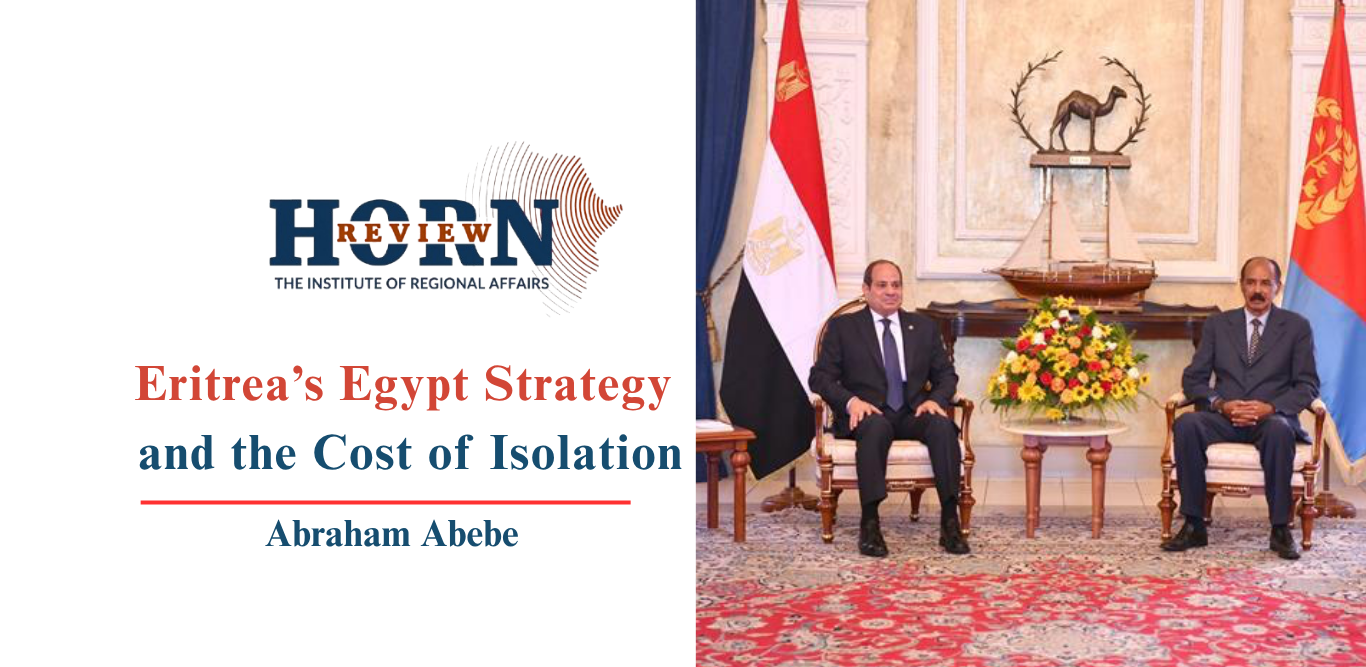
Why has Eritrea deepened its strategic partnership with Egypt while maintaining strained relations with Ethiopia, its most consequential potential economic partner? The contradiction becomes clearer when Eritrea’s foreign policy is examined through the distinction between the interests of the state and those of the ruling regime. Egypt’s engagement with Eritrea reflects the strategic value of its Red Sea coastline and the wider regional competition surrounding Ethiopia’s influence. Ethiopia, by contrast, offers proximity to a large market, substantial potential for bilateral trade and opportunities for broader economic integration. Yet the government of Isaias Afwerki has maintained a relationship with Ethiopia marked by strategic mistrust rather than sustained economic integration. This raises a deeper concern: the regime’s foreign policy advances Egypt’s strategic objectives while subordinating the economic development interests of the Eritrean people to the leadership’s immediate political calculations. By prioritising strategic alignment over economic cooperation with a neighbouring market, the regime risks prolonging Eritrea’s isolation.
Egypt’s engagement with Eritrea is shaped by its strategic competition with Ethiopia. The dispute over the Nile, intensified by the Grand Ethiopian Renaissance Dam (GERD), remains a central source of tension between Cairo and Addis Ababa. Ethiopia’s pursuit of maritime access has added another dimension to this rivalry, particularly following its January 2024 memorandum of understanding with Somaliland. Eritrea’s proximity to Ethiopia makes it a valuable partner for Egypt; Cairo assumes that closer relations with Asmara offer an additional avenue for regional influence amid its disputes with Addis Ababa.
Egypt’s commercial, investment and maritime initiatives in Eritrea should be examined for what they deliver, not what they promise. From an Ethiopian strategic perspective, these announcements risk functioning as political theatre, designed to attract Eritrean support and present Egypt as a development partner without demonstrating a credible pathway to transformative economic growth. Egypt has yet to establish a record of delivering strategic development infrastructure across the Horn of Africa comparable to the scale of its diplomatic ambitions. Cairo may calculate that cultivating partnerships with Ethiopia’s neighbours will complicate Addis Ababa’s regional relationships and expand Egypt’s strategic influence. Yet this approach overlooks the economic interdependence that underpins the region: Ethiopia’s large market, trade networks and economic importance make it an essential partner for its neighbours. Countries that allow political alignment with Egypt to undermine their economic relations with Ethiopia risk sacrificing substantial commercial opportunities, as Eritrea’s prolonged estrangement from Ethiopia illustrates.
The danger is that Eritrea’s ruling regime mistakes Egyptian diplomatic attention for a genuine development opportunity, while Eritrean citizens are offered promises rather than productive investment, employment and improved livelihoods. This gap between the regime’s external alignments and the country’s development interests is rooted partly in the political priorities that have shaped Eritrea since independence. After the 1998-2000 border war, Eritrea’s political system has been organised around external threats, prolonged national mobilisation and concentrated executive authority. Indefinite national service, restrictions on movement and information, the absence of parliamentary accountability and the non-implementation of the constitution have constrained political participation and economic life.
These domestic constraints are particularly consequential given the economic opportunities available through regional cooperation. Ethiopia’s position in the Horn of Africa is shaped by its economic scale, regional connectivity needs and dependence on reliable access to maritime trade. As a major landlocked economy with more than 130 million people, Ethiopia has a strong interest in securing predictable access to ports, expanding regional commerce and strengthening transport links with neighbouring countries. These interests also create opportunities for Eritrea. Improved relations could expand cross-border trade, attract investment, increase demand for port and logistics services, and support infrastructure cooperation that generates economic benefits on both sides. Yet this potential remains underdeveloped, while Eritrea’s growing strategic alignment with Egypt has not, by itself, demonstrated comparable benefits for the Eritrean economy.
One explanation lies in the political consequences of greater economic openness. Expanded trade creates commercial networks, investment depends on predictable conditions, and cross-border mobility exposes people to new opportunities and information. These developments could strengthen Eritrea’s economy without undermining its national interests. Yet they may also challenge a political system built around extensive control over movement, information and social life. The regime consequently perceive risks in economic integration that the country itself has strong reasons to pursue.
The economic consequences of this estrangement are not merely theoretical; they are also evident in the history of Ethiopia’s relationship with Assab and the subsequent development of the Ethiopia-Djibouti corridor. Assab once served as Ethiopia’s principal maritime outlet, handling about 85 per cent of the country’s foreign trade in the late 1980s. Ethiopia’s loss of access to the port following Eritrea’s separation and the subsequent deterioration of bilateral relations fundamentally altered the country’s trade geography. After the 1998-2000 war, Ethiopian maritime commerce shifted decisively towards Djibouti, which expanded its port infrastructure and transit services to accommodate growing Ethiopian demand. The Addis-Djibouti corridor consequently became indispensable to Ethiopia’s external trade, with more than 95 per cent of the country’s import-export trade by volume now passing through it. Djibouti turned this growing demand into a major economic asset, while Assab lost much of the Ethiopian trade that had sustained its commercial importance.
From Ethiopia’s perspective, the historical status of Assab and the circumstances surrounding the loss of access remain significant strategic concerns. Restoring Ethiopia’s maritime access through Assab could create economic opportunities extending beyond the port itself. Increased trade would generate demand for transport, warehousing, logistics and related services, creating opportunities for employment and investment across the wider region. Realising these benefits would require coordinated planning for port operations, customs, transit infrastructure and security, alongside commercially viable arrangements that support sustained trade.
The 2018 rapprochement offered an opportunity to begin translating the economic potential of renewed cooperation into practical outcomes. The two governments pledged to restore transport, trade and communications links, raising expectations of a wider economic opening. Yet the initial momentum did not develop into sustained bilateral integration, and the reopening of border crossings proved short-lived. The divergent approaches of the two governments help explain this outcome. Prime Minister Abiy Ahmed pursued reconciliation as a foundation for lasting peace, mutual economic benefit and regional stability. Isaias Afwerki, however, appeared more concerned with the political and security interests of his regime than with building a durable economic partnership with Ethiopia. This divergence became more apparent following the Pretoria Agreement of November 2022, which ended the war in northern Ethiopia. The failure to translate diplomatic normalisation into lasting cooperation therefore reflected more than inadequate economic arrangements; it also exposed the persistence of political mistrust and the limits of the Eritrean leadership’s commitment to regional integration.
For Eritrea, the implications are substantial; a foreign policy centred on strategic alignment may strengthen the regime’s external partnerships and reinforce its security calculations, but it cannot substitute for the economic foundations of national development. Egypt’s competition with Ethiopia serves Cairo’s regional objectives, while Eritrea bears the opportunity costs of a restricted economic relationship with its neighbour. When regime priorities take precedence over the country’s productive potential, isolation can become self-reinforcing: limited economic integration constrains growth opportunities, while persistent political and security tensions make regional cooperation more difficult.
Eritrea’s choice is not simply between Egypt and Ethiopia. The deeper question is whether its foreign policy will serve the immediate security priorities of the ruling regime and the strategic calculations of external partners, or the long-term development of the Eritrean state and its people. Egypt can remain an important partner, but its strategic interests cannot substitute for the economic opportunities available through constructive engagement with Ethiopia. Djibouti demonstrates the economic value of interdependence, while Assab illustrates the costs of prolonged estrangement. Unless the Isaias regime places national development alongside its survival concerns, it risks remaining strategically useful to Egypt while its population continues to bear the economic costs of isolation.
By Abraham Abebe, Researcher, Horn Review