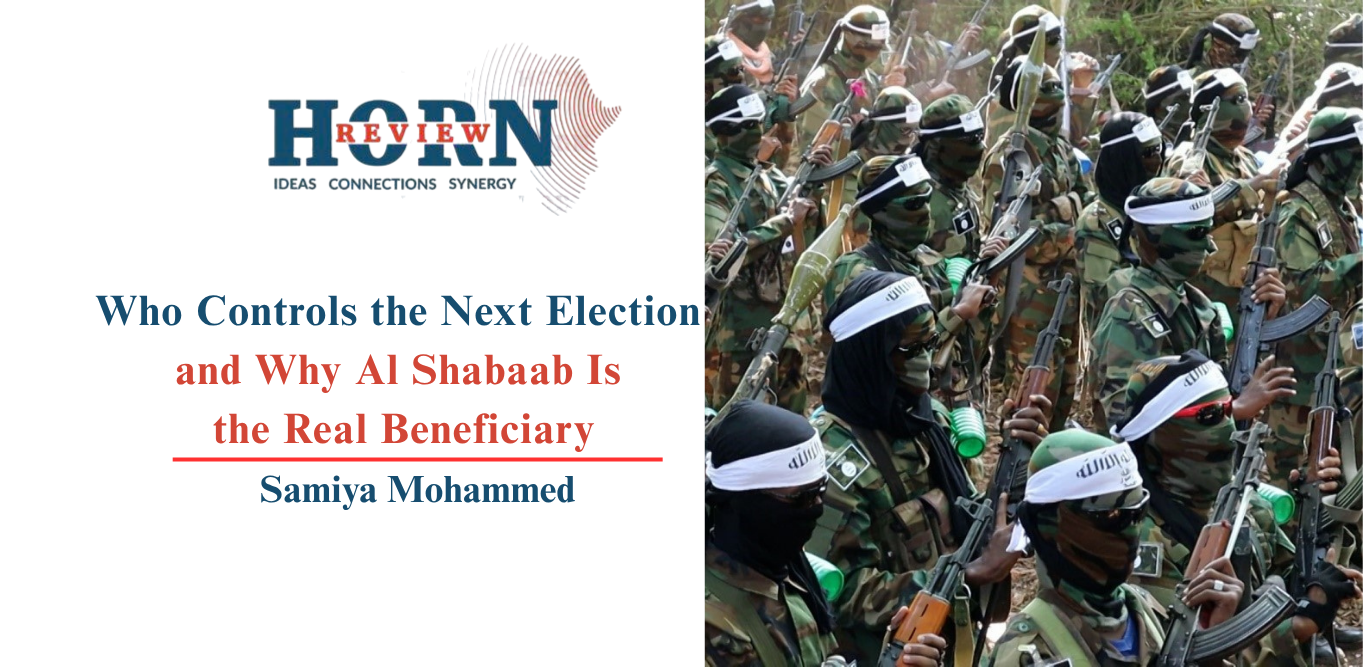
There is a dangerous comfort in the way Somalia’s security debate is currently devised. Every few months, a new training program is announced, a new contingent is pledged, a new bilateral security package is signed and the conversation shifts momentarily to logistics, equipment and troop numbers. The implicit assumption is that the war against Al Shabaab is a resource problem waiting to be solved by more of everything and that assumption is wrong. Right now, Al-Shabaab is winning the tempo war and it is winning it not because it has more fighters or better weapons but because it is fighting a coherent political war while the Somali politics is consumed by a narrower and more corrosive contest with who controls the next election.
Tempo in counterinsurgency is not simply about who conducts more raids or holds more ground at any given moment. It is about who sets the rhythm of events, who forces the other side to react and whose political arrangements are stable enough to convert military gains into durable authority. On that measure the insurgents are setting the pace. They choose when to mass, when to disperse, when to tax, when to intimidate and when to exploit a localized hardship. The government and its partners, are reactive, moving forces to wherever the latest pressure point emerges, announcing offensives that rarely consolidate and improvising alliances with local power brokers whose loyalty is contingent on the next political settlement rather than on the state itself.
The politics is busy arguing over who controls the next election rather than building the cohesion needed to reverse that. This is not a peripheral distraction however it is the central fact of the moment. Electoral activities in Mogadishu determines how security appointments are made, how resources are distributed, which clans and regions feel included and whether federal member states see the center as a partner or a threat. When those questions are unresolved every security decision becomes a political instrument. Commanders are chosen for loyalty rather than competence. Operations are calibrated to affect election outcomes rather than to degrade the insurgency. Local militias are mobilized as leverage in bargaining with the center rather than as components of a national campaign. Al Shabaab does not need to defeat such a system and it only needs to wait for it to exhaust itself.
Foreign partners are present and useful on the margins but they are not going to stay forever or fight the war for Somalia. This is not a criticism of their contribution so much as a recognition of its limits. External actors can provide air support, intelligence, training and enabling capabilities. They can disrupt insurgent logistics and pressure leadership networks. What they cannot do is supply the political legitimacy that a government needs in order to ask its citizens to fight and die for it. That legitimacy has to be produced domestically and it has to be produced before the security trend can be reversed. Every month spent debating the structure of the next election is a month in which the insurgency deepens its hold on taxation, recruitment and sanctuary.
The missing piece is not another training base or another contingent. It is whether any political settlement can actually produce a government that large parts of the country accept as legitimate enough to fight for. This is the question that the current debate avoids. It is easier to announce a new training program than to resolve the constitutional disputes between Mogadishu and the federal member states. It is easier to welcome a new foreign contingent than to build a national army whose command structure is accepted across clan and regional lines. It is easier to speak of defeating the insurgents than to explain why so many communities remain neutral in that fight not because they sympathize with Al Shabaab but because they do not see the state as a credible or fair alternative.
The core problem is the combination of a weak, contested center, persistent clan and regional power centers that do not accept Mogadishu’s rules and Al-Shabaab’s ability to exploit exactly those divisions for recruitment, taxation, and sanctuary. Each of those elements reinforces the others. A contested center cannot impose a unified command on security forces which means operations are fragmented and often locally negotiated. Regional and clan power centers that reject Mogadishu’s rules maintain their own armed structures which means the state’s monopoly on violence exists on paper but not in practice. Al-Shabaab inserts itself into the gaps, offering dispute resolution, taxation with a degree of predictability and a form of order that however brutal is at least consistent. For populations caught between an unreliable state and a ruthless insurgency, neutrality is not ideological and it is rational.
Adding more external actors such as Egypt’s contingent increases the number of agendas inside the country without solving the command, cohesion, or sustainability issues. This is the paradox of the current international posture. Each new partner brings capabilities but each also brings its own priorities, its own bilateral relationships with Somali power centers and its own conception of what the end state should look like. Turkey’s deep embedding is real but tied to its own economic and strategic interests and it has not prevented major SNA losses or territorial pressure. Egypt’s involvement is shaped by its own regional plans particularly over the Nile, which means its presence is read in Mogadishu and in the region through a lens that has little to do with counterinsurgency. The result is a security environment crowded with actors but thin on unified purpose.
Command and cohesion are the casualties of this crowding. When multiple partners train, equip, and mentor different units, the result is a patchwork of forces with different loyalties, different capabilities and different chains of accountability. When those forces are then deployed into a political environment where the center is contested, they become assets in internal bargaining rather than instruments of a national campaign. Sustainability suffers as well. Training programs produce soldiers but they do not produce the logistics, pay systems, medical support, and command structures that keep those soldiers in the field. Without those systems, gains are temporary and the insurgents simply wait for the external attention to shift elsewhere.
Political legitimacy and security are locked together. An election process rejected by major member states will not produce a government that can mobilize the whole country against Al Shabaab. Instead it risks turning security forces and local militias into instruments of political rivalry. This is not a hypothetical risk however it is the observable pattern. When electoral outcomes are contested, security appointments become prizes. When security appointments become prizes, competence is secondary. When competence is secondary, operations fail. When operations fail, local communities conclude that the state cannot protect them. When communities conclude that the state cannot protect them, they hedge and hedging creates the space in which the insurgency thrives. Al Shabaab benefits from every month of that distraction and it is benefiting now.
Breaking the equilibrium requires a political settlement that is accepted by large parts of the country and not simply announced in Mogadishu. It requires a center that is strong enough to command but restrained enough to be trusted. It requires federal member states and clan power centers to see their interests reflected in the national project rather than threatened by it. It requires an electoral process whose outcome is broadly accepted before the votes are counted, not contested afterward. None of that can be delivered by foreign troops or training programs, and none of it is currently being prioritized.
By Samiya Mohammed, Researcher, Horn Review