Washington’s decision to let sanctions on Eritrea’s leadership lapse has drawn an open letter from the Red Sea Afar Democratic Organization, addressed to the State Department, the Treasury’s Office of Foreign Assets Control, senior Africa advisor Massad Boulos and the US embassy in Addis Ababa. The letter registers RSADO’s concern that the move away from pressure on Asmara is proceeding without regard for the rights of Eritrean citizens, and in particular the Red Sea Afar of the Dankalia region. RSADO, as it stated, does not object to diplomatic engagement with Eritrea as such. Its complaint is that the recalibration appears driven by strategic calculation around the Red Sea rather than by any improvement in the conduct of the regime, a distinction the organisation says Washington has long claimed to observe but now risks abandoning.
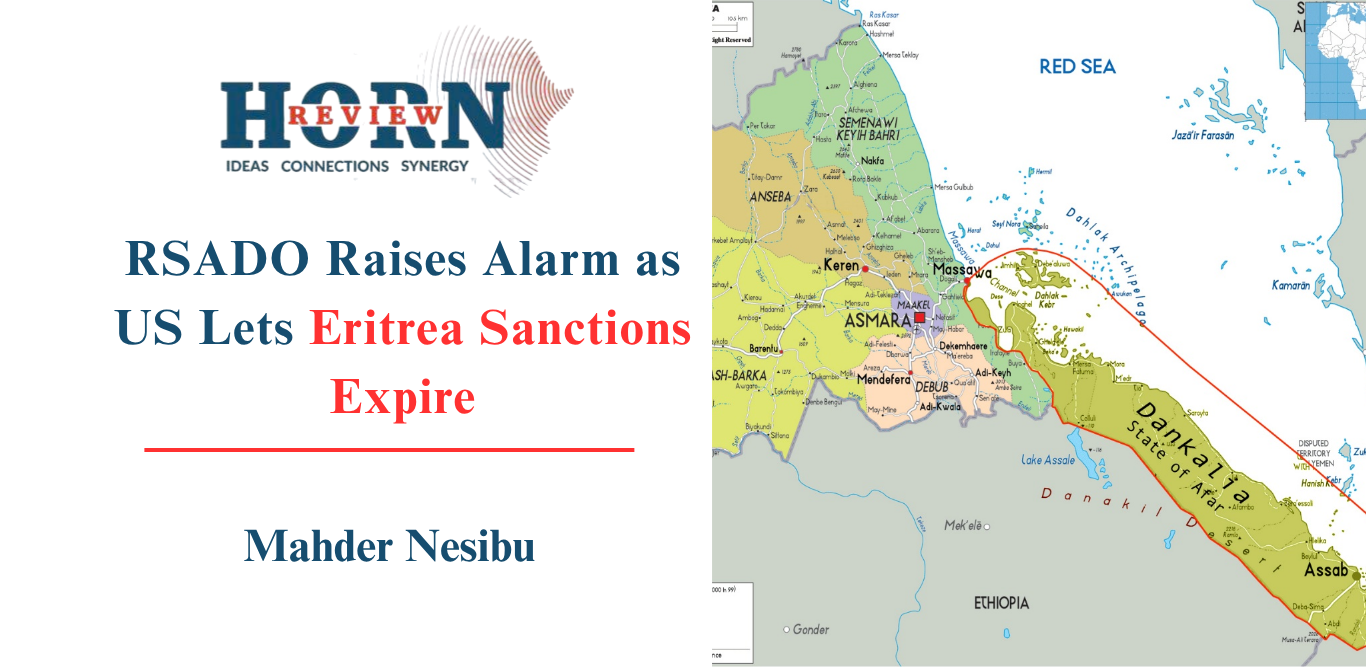
RSADO takes its name from the coastal Afar of Dankalia, a narrow, arid strip running along Eritrea’s Red Sea littoral. The PFDJ has treated the community as a standing security concern since Eritrea’s secession, a suspicion rooted less in anything the Afar have done than in what they are. Their kin sit across the border in Ethiopia’s Afar region and in Djibouti, and the community’s attachment to the secessionist nationalism the PFDJ built its legitimacy on has always been thin. That distance has been met with force. Afar advocacy groups and RSADO’s own reporting describe a pattern stretching back to the early 1990s of extrajudicial killings, enforced disappearances, mass arrest and the displacement of communities from their traditional lands and fishing grounds along the coast, carried out under a state apparatus that treats the Danakil as occupied rather than governed territory. In its letter, RSADO warned that lifting the sanctions risks feeding into precisely that apparatus, expanding the financial and operational room available to the security and military structures used against Eritrean citizens generally and the Red Sea Afar specifically.
The sanctions in question trace to Executive Order 14046, signed in September 2021 under the Biden administration in response to the conduct of Eritrean forces during the Tigray war. The designations covered the PFDJ, the Eritrean Defence Forces, the Red Sea Trading Corporation, the Hidri Trust and a number of senior officials, and were renewed annually. On 17 September the underlying national emergency was allowed to expire, and OFAC removed the affected names from its sanctions list. No parallel statement laid out the administration’s reasoning, an omission that stands out against the more typical practice of framing a policy shift, however modest, as a considered decision rather than an administrative lapse.
The Red Sea has become considerably more dangerous territory for shipping since 2021, and Houthi attacks on vessels transiting the corridor, compounded by disruption around the Strait of Hormuz amid the wider confrontation with Iran, have sharpened Washington’s interest in the security of the route. Eritrea controls close to a thousand kilometres of that coastline. A Washington that wants influence over what happens in the southern Red Sea has to find a way to talk to Asmara, and removing a standing sanctions designation is a low-cost way of signalling openness without committing to anything specific. The Trump administration’s broader posture toward authoritarian governments, which places far less weight on scrutinising internal conduct than its predecessors did, has made that opening easier to extend. Indefinite national service, which keeps much of the population on a permanent quasi-military footing and functions as a form of coerced labour for the state and its enterprises, has not featured as an obstacle.
The barrier between Washington and Asmara was never primarily a human rights barrier. Successive US administrations have made periodic diplomatic overtures toward Eritrea over the years with little to show for them, not because Washington insisted on reform as a precondition but because the regime itself has shown little appetite for engagement on terms it does not control, preferring narrower, transactional arrangements that let it manoeuvre between competing external patrons as circumstances demand. That posture has direct costs for regional stability, which is itself a matter of American concern. Eritrean troops remain present in Tigray, aligned with the TPLF in a partnership aimed at destabilising the government in Addis Ababa. In Sudan, the Eritrean Defence Forces have provided support to the Sudanese Armed Forces sustaining a civil war that Washington has struggled for two years to bring to a close. Removing sanctions changes the terms on which Washington can talk to Asmara. However, politics unchanged, they are unlikely to bring the variable outcome Washington is looking for.
Mahder Nesibu, Researcher, Horn Review