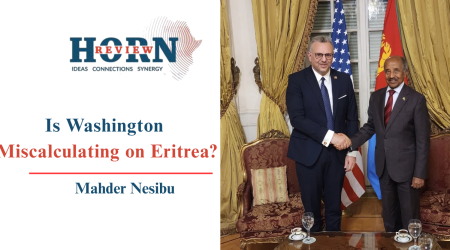
The Wall Street Journal’s recent reporting on a possible rapprochement between Eritrea and the United States, including the prospective easing or lifting of American sanctions on Asmara, has attracted considerable attention. That prospect seems to be moving closer to realisation. On May 5, Reuters reported, citing an internal U.S. government document, that Washington is set to rescind the executive order imposing those sanctions. The strategic logic animating Washington’s interest is not difficult to identify. According to U.S. officials cited by the Journal, the Red Sea region is too strategically important for the United States to forgo an attempt at reopening ties with Eritrea, whatever its human rights record. What is far less clear is what Washington would realistically obtain from such a normalisation, and whether Asmara is structurally capable of delivering it. The same obstacles that frustrated previous efforts remain in place. Examined against the record, the current initiative is likely to produce the same result.
This is not the first time the case has been made. In 2016, analyst Bronwyn Bruton published a widely read piece titled “Eritrea: Coming In from the Cold,” arguing that Washington should pursue engagement with Asmara. Bruton pointed to what she characterised as encouraging signals: an improvement in Eritrea’s relations with European countries, a stated interest in re-engaging with IGAD, and a willingness to allow aid organisations to operate inside the country. That argument found its moment around 2018, when Eritrea appeared to emerge from a prolonged isolation following its rapprochement with Ethiopia. The United Nations lifted its sanctions on Asmara, and Washington dispatched the then-Assistant Secretary of State for African Affairs, Tibor Nagy, to the Eritrean capital. Nagy recently recalled that discussions were positive, but that Asmara never followed up. The opening closed without producing anything institutionally durable. The Second Trump administration is now attempting the same manoeuvre in a considerably more volatile regional environment.
The immediate catalyst for the current effort is the Red Sea. Early last year, in a military campaign dubbed Operation Rough Rider, the United States had attacked Houthi positions in their stronghold in North Yemen, seeking to end attacks on commercial shipping along one of the world’s most critical maritime corridors. The Houthis appeared, for a period, to stand down. The outbreak of direct military confrontation between the United States and Israel against Iran in February this year, has altered the calculus. The Houthis, operating as a component of Iran’s horizontal warfare strategy, now present a sustained threat to the Bab el-Mandeb, a chokepoint of comparable strategic weight to the Strait of Hormuz. Eritrea’s position on the western shore of the strait thus increasingly places it at the centre of Washington’s Red Sea concerns.
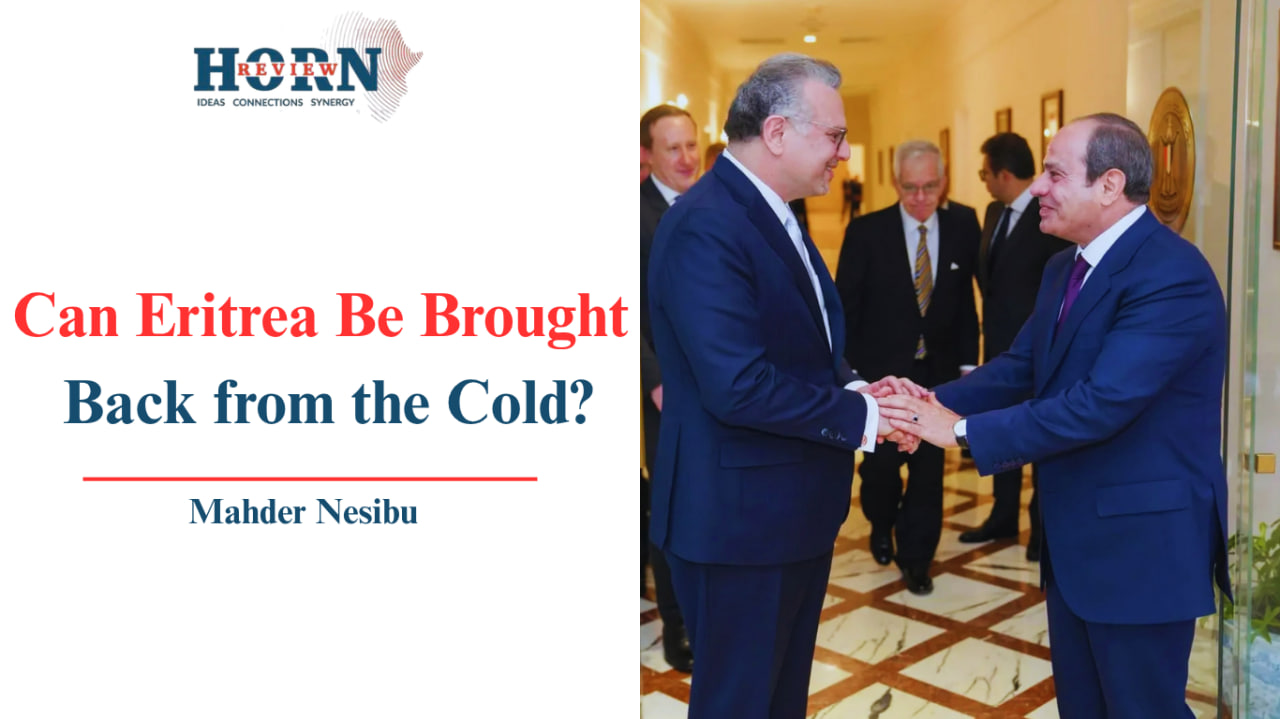
American diplomatic activity preceded the Iran war. Massad Boulos, the Trump administration’s senior advisor for the Middle East and Africa, met Eritrean Foreign Minister Osman Saleh on the side-lines of the UN General Assembly in September last year. According to the Wall Street Journal, Boulos also met President Isaias Afewerki in Cairo, most likely during an official five-day visit Isaias made to Egypt in early November.
Isaias has expressed his own interest in a reset, though his terms reveal the scale of the problem. He has said publicly that his disappointment with the First Trump administration stemmed from its failure to address what he described as Washington’s “misguided policies” in the Horn of Africa, rather than engaging on narrower bilateral questions. His position has not shifted. “Our engagement with the United States,” he stated further, “is not limited to bilateral matters; it is primarily focused on our wider neighbourhood.” What Asmara wants, in effect, is a less demanding Washington: one willing to set aside Eritrea’s human rights record, disengage from the liberal order architecture Isaias holds responsible for Eritrea’s isolation, and engage on purely transactional terms. Isaias reads the current administration’s instincts as an opening for precisely that arrangement. The asymmetry is considerable. Washington is seeking a strategic foothold; Asmara is seeking a geopolitical rehabilitation on its own conditions.
The geographical logic that makes Eritrea attractive to Washington today once applied to Ethiopia. Before Eritrea’s secession in 1993, Ethiopia’s geographic location and its Red Sea coastline was central to the American strategic calculus in the Horn. Since then, Washington’s engagement with the region has contracted steadily, and under the current administration it has contracted further. What remains of American influence in the Horn is under strain. The Quad mediation mechanism, led by Boulos, has made no measurable progress on Sudan’s civil war, in part because its own members, similar to Eritrea, actively support one of the warring parties. The pressure campaign against the Houthis, despite the scale of Operation Rough Rider, failed to neutralise the threat to Red Sea shipping. Washington is attempting to extend its reach in the region from a position of diminished presence and institutional thinness.
Cairo’s role in engineering the current diplomatic moment is revealing. The WSJ stated that it was Egyptian President Abdel Fattah el-Sisi who has been facilitating dialogue between Boulos and Isaias at the leadership level. That facilitation serves Egyptian interests in ways Washington appears not to have fully reckoned with. Eritrea is the most valuable pressure point in Egypt’s strategic architecture against Ethiopia, its principal regional rival. A U.S.-Eritrea normalisation would consolidate a Red Sea alignment that works against Addis Ababa’s interests, as Ethiopia has been actively pursuing a return to Red Sea access, an effort for which American support is considered essential. A Washington that has drawn closer to Asmara is a Washington less positioned to support that pursuit. On the Nile, where the dispute over the Grand Ethiopian Renaissance Dam (GERD) remains unresolved, an Eritrea operating with greater international legitimacy becomes a more effective instrument of Egyptian pressure on Ethiopia’s northern flank, forcing Addis Ababa to manage compounding security demands simultaneously. Washington risks being drawn into a regional rivalry it did not intend to enter, through a channel designed by one of its parties. The second- and third-order consequences of that position, in a region already carrying considerable instability, are ones the current diplomatic activity shows little sign of having anticipated.
The historical record offers little basis for optimism. Every American administration has attempted some form of engagement with Asmara. None has produced a durable outcome. The 2018 episode under the First Trump administration is the most recent illustration. Similarly, the rocky Ethiopia-Eritrea relationship provides the deeper structural case.
Following Eritrea’s secession, the two countries concluded agreements aimed at economic and political integration. Those arrangements failed to materialise and the relationship collapsed into war by 1998. The 2018 rapprochement produced the Jeddah Peace Agreement, celebrated at the time as a historic opening. It suffered the same fate: no implementation followed, the framework dissolved, and the two countries are again in open antagonism.
The opacity is an instrument of statecraft. It allows Asmara to move between alignments without being bound by prior commitments, and the record bears this out with some consistency: Israel and Iran, Qatar and the UAE, and Saudi Arabia have each served as Eritrea’s primary external patron in relatively short succession. Asmara’s oscillation between them is the signature of a foreign policy designed to preserve maximum room for manoeuvre, at the cost of any durable bilateral architecture. Washington should not expect to be treated differently.
The structural barriers also run deeper. Eritreans live under one of the most closed systems of governance in the world, one sustained by mechanisms that are incompatible with the transparency and accountability any meaningful partnership with Washington typically requires. For the regime to sustain itself, those mechanisms must remain intact. They are also precisely what prevents Asmara from constructing a genuine relationship with any external partner that holds it to account.
The personality of Isaias compounds every structural problem. His foreign policy instincts are opaque, his tolerance for institutional constraint minimal, and his conditions for engagement with Washington are fundamentally misaligned with what the United States would need from a reliable partner. Eritrea may be seeking, in rhetoric, a reset. The structural conditions for one, however, do not exist.
The more strategically sound investment for Washington lies elsewhere. The Eritrean regime’s structures of governance are decaying, and the question of what follows Isaias is one Washington has not adequately prepared for. A durable American relationship with Eritrea must be oriented toward the range of possible post-Isaias trajectories, rather than toward the current dispensation. That means building substantive engagement with diaspora communities and with organised opposition formations, principally the Eritrean Blue Revolution Front, a diaspora-based political body with an active presence in Washington. Engaging the EBRF is directed at the Eritrea that will eventually emerge from the current period. Washington should resist the temptation to trade that longer investment for short-term Red Sea positioning, at the cost of its broader posture in the Horn and its credibility with the actors most likely to shape what comes next.
By Mahder Nesibu, Researcher, Horn Review




Comments (3)
Excellent analysis. Thank you!
Excellent analysis. Thank you!
[…] Successive US administrations have made periodic diplomatic overtures toward Eritrea over the years with little to show for them, not because Washington insisted on reform as a precondition but because the regime itself has […]