
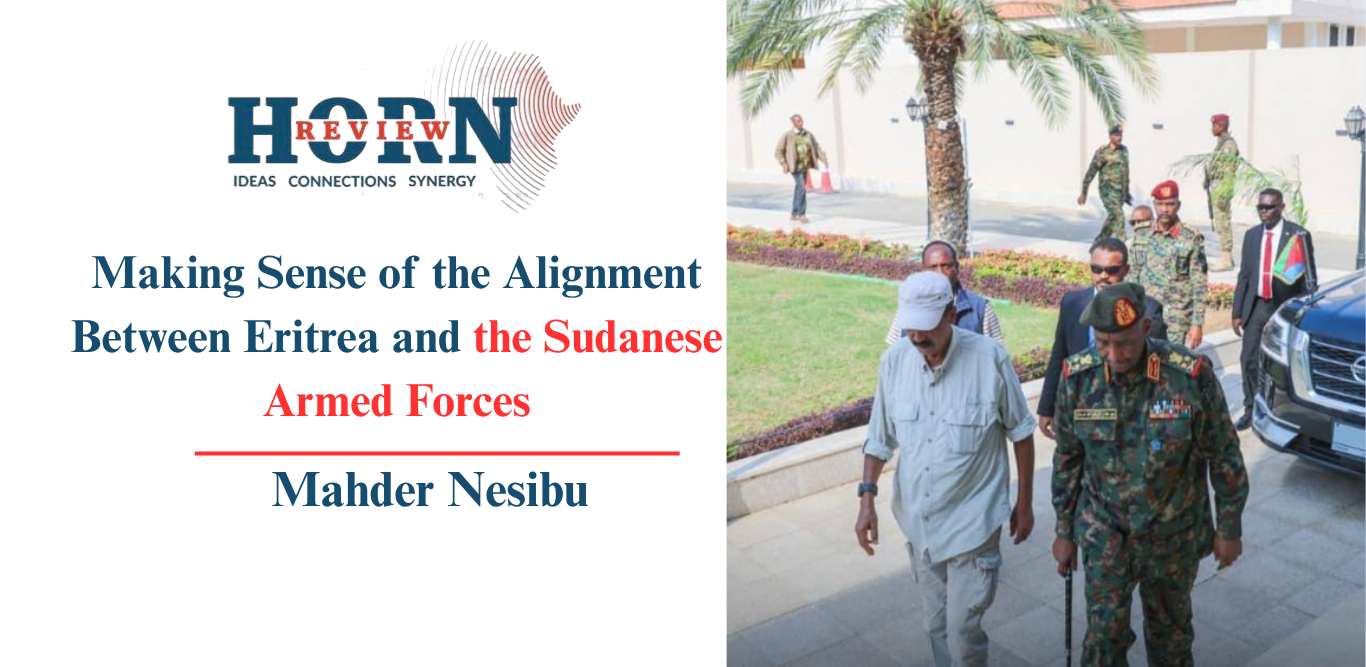
Making Sense of the Alignment Between Eritrea and the Sudanese Armed Forces
Among the alliances shaping the geopolitics of the Horn of Africa today, the one between the Sudanese Armed Forces (SAF), its commander General Abdel Fattah al-Burhan, and Eritrea’s president Isaias Afwerki stands as one of the most consequential. Since the outbreak of Sudan’s civil war between the SAF and the Rapid Support Forces (RSF) in 2023, Eritrea has exerted significant influence over the conflict by extending support to the Army. In step with the broader externalisation of the Sudanese war, Asmara has capitalised on that dynamic to extend its own reach across the region’s geopolitics.
Eritrea’s backing of the SAF assumes multiple forms and has expanded over time. Following the solidification of their alignment around 2024, President Isaias has extended vital support to the SAF, support that General al-Burhan, shortly after retaking Khartoum in March 2025, described as “substantial.” Eritrea’s longstanding influence over border communities straddling the two states is likely to have been the first manifestation of that support. Once used as a pressure point against Bashir-era Khartoum during the turbulent years that preceded the outbreak of fighting, armed groups within the Beja and Beni Amer communities are now mobilised under President Isaias’s influence. These groups form a critical component of the Sudanese Armed Forces’ fight against the Rapid Support Forces and its allies in the east of the country, along the border with Eritrea and Ethiopia.
Signs of direct military solidarity were on display when, in 2024, Asmara dispatched several of its naval vessels to Port Sudan, by then the wartime capital of the Sudanese Armed Forces. Reports also emerged in mid-2025 that several of the Army’s warplanes had been stationed inside Eritrea, at a time when heavy RSF bombardment reached as far as Port Sudan, on the shores of the Red Sea. More recently, the Eritrean Defence Forces (EDF) have taken on a more direct role in the fighting. They first established installations to train border militias, over which Asmara holds considerable sway, before extending that role to SAF units and aligned forces more broadly. The EDF has also engages the RSF and its allies directly in clashes. In the battle that saw the Sudanese Army retake the strategic town of Kurmuk in the east of the country in July, the EDF, alongside mercenaries from Ethiopia’s Tigray region, came under an RSF drone strike that caused several casualties.
The Middle Eastern geopolitics surrounding Eritrea and the SAF is most clearly illustrated by the supply chains sustaining al-Burhan’s fight against the RSF, itself propped up by its own external backers along similar regional fault lines. Eritrea’s role here has been substantial. At a time when Sudanese skies have been dominated by RSF drone capabilities, which have at times bombarded Port Sudan, Eritrea’s airports and seaports have proved instrumental in the transfer of weapons from the Army’s Middle Eastern backers. Most recently, open-source intelligence indicates that this pattern has continued, with shipments from the Army’s suppliers, including Iran and Turkiye, making their way to Sudan via Eritrean territory.
The emergence of this transactional relationship came amid a rapidly shifting landscape in both the Middle East and the Horn of Africa. Political changes in Ethiopia and Sudan had already upended the region by the late 2010s. In 2018, President Isaias saw the emergence of Abiy Ahmed and efforts to mend the relationship between Ethiopia and Eritrea, frozen in conflict for close to two decades. This process saw heavy involvement from the Gulf powers Saudi Arabia and the UAE, who by then viewed an expanded reach in the Horn of Africa as critical to their interests. That presence was already visible in 2015, when, as Saudi Arabia and its allies launched their war against the Houthis, the Emiratis installed a base in the Eritrean port of Assab. Handed over on a thirty-year lease, it served, among other things, as a launchpad for airstrikes against the Houthis across the sea.
Brokered primarily by the UAE, the rapprochement between Ethiopia and Eritrea would prove decisive in putting down a rebellion by Ethiopia’s Tigray People’s Liberation Front (TPLF), in a conflict that lasted two years and ended in November 2022. At the same time, backed by then allies Saudi Arabia and the UAE, a revolution took place in Sudan in 2019, ending Omar al-Bashir’s near three-decade rule. The two military institutions, the SAF and RSF, with which the Gulf powers had closer ties than with the civilian actors in the transitional arrangement, later seized power for themselves, ousting the civilian coalition led by Prime Minister Abdalla Hamdok.
Overarching Gulf power, exercised through the UAE-Saudi partnership, established a regional order for a period, one that would fracture quickly and set the stage for the present alignments, including the SAF-Eritrea convergence.
First was the friction between Ethiopia and Eritrea, caused largely by the post-conflict order established by the peace agreement ending the conflict between the Ethiopian government and the TPLF. Although the UAE dismantled its military installation in Assab in early 2021, President Isaias’s antagonism towards the country surfaced around 2023, when he equated Ethiopia’s demand for direct access to the sea with UAE foreign policy in the region. He consequently aligned himself with Saudi Arabia, whose divergence from its Gulf partner was growing concurrently. At the same time, in Sudan, growing friction between RSF leader Mohamed Hamdan Dagalo and Abdel Fattah al-Burhan in Khartoum resulted in war breaking out in April 2023. This war saw the Saudi-UAE fracture widen further, with each side ultimately choosing sides based on its strategic interests in Sudan, namely Abu Dhabi with the Rapid Support Forces and Riyadh with the Sudanese Army.
Amid these shifts, President Isaias took the strategic step — driven largely by his split with Addis Ababa and the shifting position of Gulf power in the Horn of Africa — of aligning himself with the Sudanese Armed Forces. Although the president balanced between the RSF and the SAF in the early days of 2023, his alignment became clear that September, when a show of solidarity with al-Burhan culminated in the opening of the Sudan-Eritrea border, paving the way for Asmara’s entry into the conflict.
The relationship, grounded in geopolitical rationale, rests on a convergence of interests between both parties. For Eritrea, the calculus is multifaceted. First, in his antagonism with Ethiopia, President Isaias sees his support for the Army as part of a broader position against his southern neighbour. General al-Burhan, for his part, had already been at odds with the Ethiopian government, both for his support of the TPLF during the Tigray conflict, which he subsequently came to rely on in the war against the RSF, as well as his forceful occupation of al-Fashaga, a territory disputed between Sudan and Ethiopia, during the same period. Isaias, who had in parallel mended ties with the TPLF in Tigray following the peace agreement, saw a convergence between Eritrea and these two actors, alongside other insurgencies that sprang up in Ethiopia around the same time, namely the ethno-nationalist armed groups operating under the Fano banner. For Asmara, this constellation of forces presents a united front against Ethiopia, whose security establishment vastly outweighs Eritrea’s smaller and more limited military. More broadly, the internationalisation of the conflict and the deep involvement of Middle Eastern powers mean that President Isaias has access to actors whose positions can be exploited to meet his own strategic ends. Notably, his falling out with the UAE was offset by an alignment with Saudi Arabia, strengthened in turn by the kingdom’s support for the Army.
For al-Burhan, Eritrea’s entry in support of his forces proved pivotal. The SAF has manoeuvred strategically within its space of external backing to strengthen the war effort against the RSF, going as far as courting Ukraine and later moving towards a relationship with Moscow. This extends to President Isaias, with al-Burhan’s alliance resting on immediate wartime goals rather than any long-term convergence with his country.
Both the Sudanese Armed Forces and Eritrea complicate the already layered order in the Middle East. Rather than falling squarely within the broader UAE-Saudi rivalry, their position has drawn in an array of interests that sit uneasily within any single regional picture.
Egypt, another major actor in the Horn of Africa, is a case in point. For the SAF, Cairo provides strong support. Alongside military backing through the facilitation of equipment, and even direct air strikes against the RSF, Cairo lobbies on the Army’s behalf across African and Middle Eastern diplomatic circles. The SAF, in turn, has enabled the return of strong Egyptian influence in Sudanese politics, largely lost during the Bashir era. In addition, the SAF’s antagonism towards Ethiopia serves as a strategic input into the central driver of Egypt’s Horn of Africa policy, namely its dispute with Ethiopia over the Nile Basin and, by extension, the balance of power in the Red Sea.
The same holds for Eritrea. Beyond its position behind the SAF, Eritrea’s own antagonism towards Ethiopia has brought about a convergence with Cairo. Egyptian backing has elevated Eritrea’s geopolitical significance, and Asmara now effectively serves as a frontline state for Egypt in its rivalry with Addis Ababa.
However, Egypt’s own strategic interests in the Horn, combined with its severe financial and economic dependence on the UAE, leave it sitting uneasily alongside the interests of Saudi Arabia. The kingdom, which maintains a strong relationship with Ethiopia and views its involvement in Sudan largely as a counter to the UAE’s position and a defence of the Sudanese state’s integrity, supposedly represented by the Army, diverges in interest from both Cairo and Asmara.
The supply lines feeding the SAF’s war effort, including those running through Eritrean territory, further complicate the picture. Turkiye, a major source of firepower for the Army, maintains a stronger relationship with Ethiopia than Saudi Arabia does. Its balancing act between Egypt and Ethiopia sits uneasily with the antagonistic position held by Egypt, Eritrea and the SAF.
Iran, which has continued to provide logistical support to the Army, complicates the picture further. This stems from strategic interest, such as a naval presence along the Red Sea through Sudan, and ideological alignment with the strong currents of political Islam within the Sudanese Armed Forces. The Islamic Republic, however, in its ongoing confrontation with the United States, has treated the Gulf monarchies, including Saudi Arabia, as legitimate targets, striking the kingdom and choking its oil exports through the Strait of Hormuz. The Eritrea-Iran relationship is notable too, extending beyond the facilitation of Iranian weapons transfers through its territory. Asmara has chosen to align more closely with the Islamic Republic, taking, among other positions, an anti-Israel stance on issues such as the war in Gaza.
These alignments, in some sense, make the position of Eritrea and the SAF subject to shifts in Middle Eastern geopolitics. However, Eritrea’s own strategic calculations, alongside the divergent calculus it and the Sudanese Armed Forces are each managing, further complicate both the Middle Eastern order and the conflicts of the Horn of Africa.
By Mahder Nesibu, Researcher, Horn Review

Leave a Reply Cancel reply
RELATED
Posts
19
Oct
Eritrea's Incursion and Ethiopia’s Right to Self-Defense: Where Does the Law Stand?
Ethiopia’s recent letter to the United Nations Security Council...
19
Oct
Eritrea’s Garrison State and Its Crisis-Exporting Strategy
The Eritrean People’s Liberation Front did not simply inherit a...
19
Oct
How Egypt's Opening Could Take Shape in Southwest Somalia
Federal authority in the Bay region is contracting in...
18
Oct
Is Eastern Sudan Becoming a Fortified Base for the Next Regional War?
General Abdel Fattah al-Burhan's recent inspection of the 11th...
18
Oct
The Legal Paradoxes in Eritrea’s AU Complaint to ReInstate its Mission
Ethiopia’s expulsion of ten Eritrean diplomats from Addis Ababa marked...
17
Oct
Russia’s Mediation Offer Between Ethiopia and Eritrea
Russia’s decision to offer a platform for contacts between Ethiopia...
15
Oct
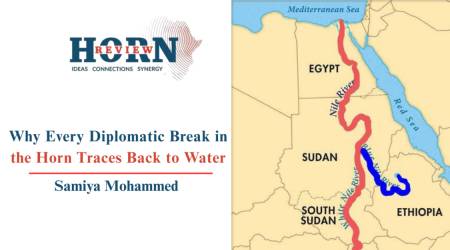
Why Every Diplomatic Break in the Horn Traces Back to Water
Analysis of instability in the Horn of Africa and...
15
Oct
The AU’s Uneven Geography of Urgency
Since Mahmoud Ali Youssouf assumed leadership of the African Union...
15
Oct
The Aswan Dam and Ethiopia’s Longstanding Rejection of Egypt’s Nile Veto
On 29 May 1956, before construction of the Aswan High...
15
Oct
Why Somalia’s Hedge between Ethiopia and Egypt Cannot Last
The public position articulated by Somalia’s Deputy Foreign Minister Hassan...
Comments (3)
[…] problems, without those actors forming anything like a coordinated bloc. SAF is deepening a military relationship with Eritrea. Fighters and networks tied to Ethiopia’s Tigray conflict are active on Sudanese soil. […]
[…] to play a major role in the conflict, backing the Sudanese Armed Forces, one side of the fighting, on various fronts. It trains troops fighting under the SAF inside Eritrea and has deployed some of its own forces […]
[…] Washington’s stated goal is to press the warring parties toward ending the fighting, Eritrea is one of the principal backers of the Sudanese Armed Forces, supplying training and personnel and serving as a key corridor for weapons shipments, including […]