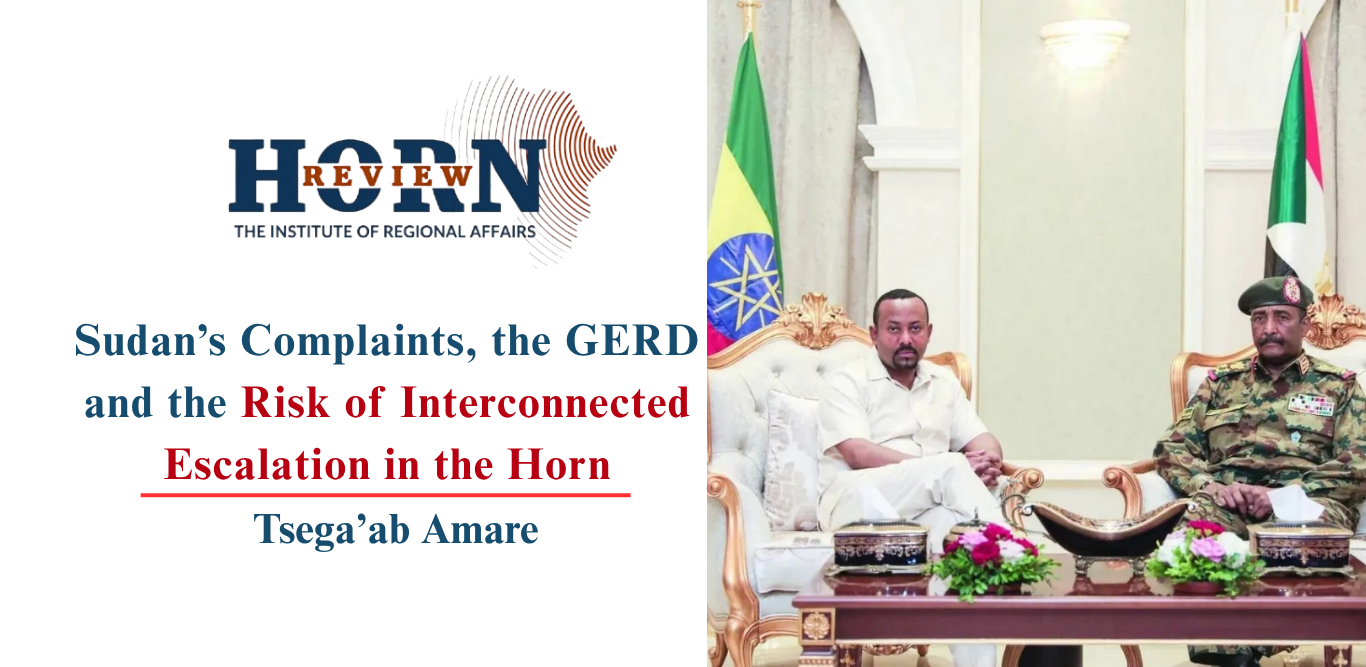
The joint statement issued in Cairo on 2 November after the third round of Egypt-Sudan 2+2 consultations changes the diplomatic terms of the Nile Basin and the Horn of Africa. It combines Sudan’s allegations of drone launches from Ethiopian territory with long-standing legal opposition to the Grand Ethiopian Renaissance Dam, and it adds Egypt’s declared readiness to act under international law and the two countries’ joint defense agreement. The result narrows the distinction between downstream water diplomacy and military deterrence. For Khartoum the text marks a calculated albeit fragile repositioning within the basin. For Addis Ababa it gives new weight to a concern voiced for years, that regional rivals exploit Ethiopia’s domestic instability to build a posture of strategic encirclement.
The case assembled by the SAF military apparatus shows how a battlefield record can be converted into a framework for future international arbitration. The Sovereignty Council’s report, released with complaints filed on 1 November at the UN Security Council and the African Union Peace and Security Council, rests on a flight-control unit recovered near Damazin, serial-numbered components attributed to Turkish-made Akinci drones, and a log of 70 attacks involving 187 drones between February and October. Each element carries limited weight on the question that matters most, which is where the drones launched and who directed them. A serial number identifies a manufacturer’s customer and a supply chain, and a recovered component shows where a drone came down. The portions of the report made public do not appear to include ground-station data, full flight-path reconstruction or a chain-of-custody record, so the report bridges the gap largely through inference.
The alleged launch positions lie close to the GERD, which Ethiopia treats as its most critical strategic asset and a multi-billion-dollar project of existential national importance. A state that has invested so heavily in the dam’s security would gain nothing from drone traffic in the airspace above it, and any such activity would multiply the risks of accident, misidentification and retaliation at the very site it most needs to protect. This consideration does not settle attribution by itself, but it leaves the report’s central claim without a credible motive. It also points to explanations that deserve examination before any state is named, including misattributed or manipulated telemetry and the activity of the several armed actors operating in the Blue Nile borderlands. If the documents are read as legal groundwork, they appear to serve Sudan’s interest in building a record for a later claim of self-defense, in explaining damage to power and fuel infrastructure, and in mobilizing diplomatic support.
This positioning becomes intelligible when set against Ethiopia’s internal security landscape, above all the volatile north. The TPLF and six other armed movements, including the Fano militia from Amhara, announced their Alliance for Survival on 20 September with the declared aim of removing the federal government. On 1 October Addis Ababa closed its embassy in Asmara and expelled ten Eritrean diplomats, after which Eritrea severed relations. Ethiopian officials have accused Asmara of backing the alliance and of keeping soldiers on Ethiopian soil, an allegation that media reports have supported, and they have charged that Sudan’s army arms and trains TPLF-linked fighters, which Khartoum rejects. Army chief Birhanu Jula has named Eritrea, Sudan and Egypt as supporters of the alliance. In October the Ethiopian military presented captured artillery, drones and communication equipment to foreign ambassadors and military attachés, and officials say the items carry foreign serial codes and shipping labels. None of these claims has been independently verified, which places both sides’ allegations in the same evidentiary position.
Against this backdrop Khartoum’s naming of Bahir Dar targets an international spotlight on the logistical hub of the Ethiopian National Defense Force’s northern operations and imposes a diplomatic and reputational cost on Ethiopian air operations while the federal government fights on several fronts. Bahir Dar lies around 685 km from Khartoum, and Sudan is stretched by its own civil war, so a cross-border military escalation sits beyond what Khartoum can sustain. The invocation of self-defense therefore functions best as strategic signaling that serves Egyptian preferences. Cairo’s statement of readiness under the joint defense agreement reinforces the same message from a stronger military position, and the two capitals appear to form part of a coordinated downstream posture.
The convergence is most visible on the water track, where the revival of the 1959 Nile Waters Agreement reflects the cyclical character of downstream diplomacy. That agreement divided the river between Egypt at 55.5 billion cubic meters and Sudan at 18.5 billion, with no role for Ethiopia. Addis Ababa has long rejected the pact as a colonial-era arrangement that cannot bind a non-signatory, and it regards the dam as an exercise of sovereign development that corrects an old asymmetry. Sudan’s return to the Egyptian legal position marks a retreat from its pragmatism of January 2023, when Burhan told Abiy Ahmed in Khartoum that the two countries were aligned on the dam, which offered Sudan flood regulation, sedimentation control and inexpensive electricity. By October 2025 Burhan was telling Sisi that the two states held one position, and the recent statement renews that stance. The reversal shows how acute domestic insecurity can lead a state to trade long-term economic interests for immediate external military guarantees.
The way out lies in separating the two tracks that the Cairo statement joined, and in applying one standard of proof to both. On the security question, Ethiopia is well placed to take the initiative by issuing a standing invitation to the African Union Commission to appoint an independent technical panel, with a protocol agreed in advance and reported to both councils. Its mandate should be reciprocal from the outset. It would examine Sudan’s drone allegations, and it would also examine Ethiopian officials’ charge that the Sudanese army arms and trains TPLF-linked fighters, including the captured artillery, drones and communication equipment, bearing foreign serial codes and shipping labels, that Addis Ababa showed to foreign diplomats in October. Khartoum rejects that charge, and a neutral panel is the proper way to test it.
In its first phase the panel would establish chain of custody for the Damazin flight-control unit, request export and end-user records for the serial-numbered components from the relevant manufacturer and its licensing state, and reconstruct launch signatures from datalink, ground-station and radar records. A second phase could use the existing African Union Border Programme and the Ethiopia-Sudan border commission machinery for reciprocal field verification, covering the sites Sudan names and the areas and supply routes through which, according to Ethiopian officials, hostile armed groups are equipped, with Eritrean coordination as well.
The water question belongs back in the African Union-led trilateral framework anchored in the 2015 Declaration of Principles, which all three capitals signed in Khartoum. Ethiopia has consistently framed the dam as an exercise of sovereign development that corrects an old asymmetry. Sudan stood to gain from it in flood regulation, reduced sedimentation and cheap electricity, which is why Burhan endorsed it in 2023. A real-time data-sharing protocol on reservoir operations during the flood season would put those benefits back on the table and give Sudan something concrete to weigh against Cairo’s legal maximalism. Sudan’s return to the 1959 agreement, a pact that excluded Ethiopia entirely, is a retreat from that pragmatism, and it serves Egypt more than Sudan. Cairo has found in a weakened Khartoum a useful instrument, one that lends a riparian voice to Egypt’s long-standing opposition to the dam and carries the pressure on Ethiopia that Egypt cannot apply openly itself.
Ending external support for armed movements seeking to remove the federal government, or at least submitting the allegation to neutral scrutiny, is a precondition for any durable settlement. Without this insulation, the fragilities of Sudan and Ethiopia will continue to act as communicating vessels, with escalation on one side feeding the other, and civilians in Blue Nile, Khartoum and along the northern front will bear the cost.
By Tsega’ab Amare, Researcher, Horn Review