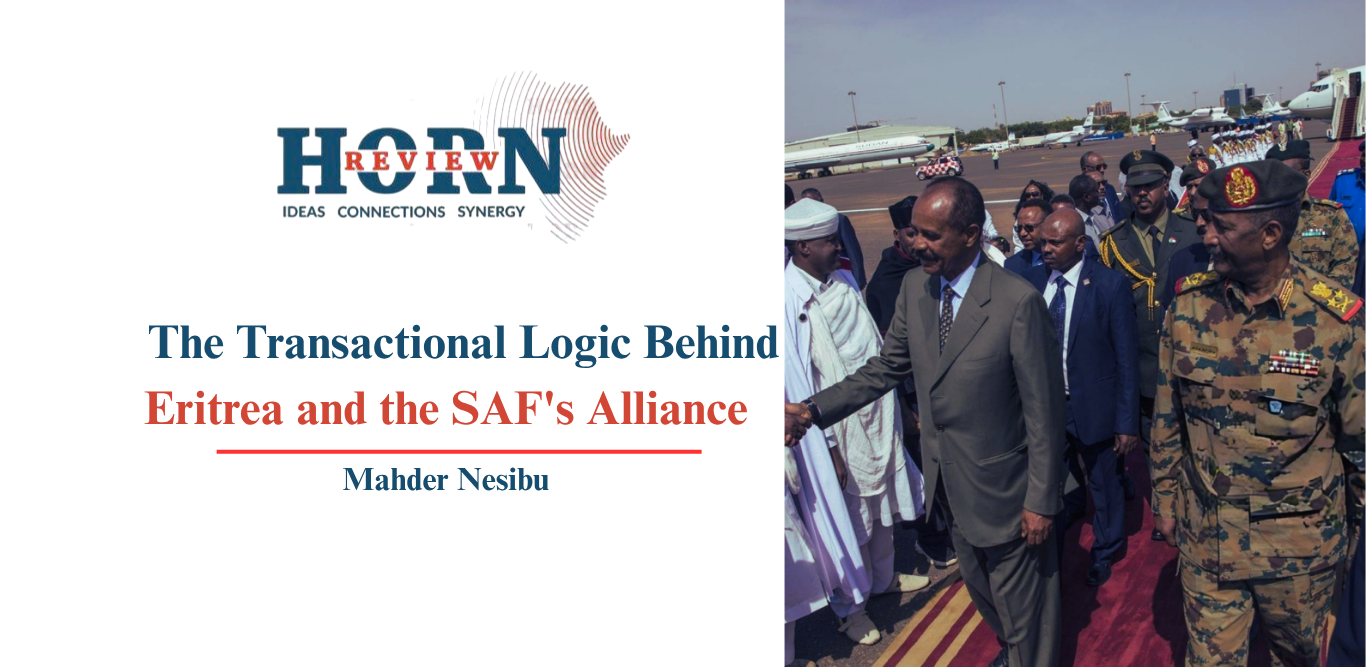
Among the shifting alliances that define the Horn of Africa’s current moment, the alignment between Isaias Afwerki’s Eritrea and the Sudanese Armed Forces stands out as one of the more consequential. Its effects are already visible in the trajectory of Sudan’s civil war, and its implications extend further, feeding into a broader regional realignment whose tensions are increasingly difficult to contain. That this alliance exists at all is, in one sense, surprising. In another, it is entirely consistent with how political relationships in the Horn of Africa have always worked.
The region operates on a logic that makes permanent alliances structurally improbable. State actors in the Horn align and realign in response to immediate strategic pressures, forming partnerships whose foundations are transactional rather than ideological, and whose shelf life is determined by the calculus of the moment rather than by any durable convergence of interest. The alliance between President Isaias and General Al-Burhan’s SAF is a product of this logic, brought into being by a specific configuration of regional pressures and carrying within it the contradictions that will, in time, pull it apart.
The history of relations between Eritrea and Sudan’s military establishment makes this plain. Sudan was, in the formative years of the Eritrean insurgency, the territory through which the movement developed. The Eritrean Liberation Front’s founding figure, Idris Mohammed Adam, came from the Beja, Muslim lowlanders whose communities straddle the Eritrean-Sudanese borderlands, and the ELF drew its earliest external support through Sudan and the broader Arab nationalist current that Gamal Abdel Nasser had set in motion across the region. Sudan under Nimeiri served as the corridor through which Arab backing reached the rebels, and Khartoum’s own antagonism with Addis Ababa, rooted in Ethiopia’s support for southern Sudanese rebel groups and in the ideological polarities of the Cold War, made the arrangement mutually useful.
Nimeiri’s foreign policy was, however, a study in perpetual repositioning. As he moved from pan-Arabism to alignment with the United States alongside Sadat, and then toward Islamism and the installation of Sharia law shortly before his removal in 1985, his posture toward the Eritrean fronts and the Ethiopian government shifted accordingly. Support for the ELF and later the EPLF was extended, withdrawn, and extended again as Khartoum’s strategic priorities rotated. The relationship between Sudan’s military and the Eritrean insurgency was thus from its earliest phase transactional, useful when circumstances aligned and expendable when they did not.
The strongman who followed Nimeiri, Omar al-Bashir, backed by the National Islamic Front under al-Turabi, came to power in 1989 with Sudan’s position oriented toward the Eritrean rebels, who by then were advancing alongside their Tigrayan counterparts toward a victory that would end the Derg’s rule. The timing proved significant. When Eritrea achieved statehood in 1991, the international context had shifted entirely. The Soviet collapse had removed the Cold War architecture that had structured Horn politics for decades, and the United States, now the singular global power, was orienting its Horn policy around the threat of political Islam. For Washington, and for Israel, Eritrea and Ethiopia were frontline states against the Islamist current that Bashir and the NIF represented in Khartoum. Isaias, freshly arrived in the community of states after years of operating outside it, found himself well positioned within this new configuration.
The relationship with Sudan deteriorated accordingly. In late 1993, Eritrea accused Bashir’s regime of facilitating attacks by Islamist militants on Eritrean territory and of actively supporting opposition movements, among them the Eritrean Islamic Jihad. Isaias responded by turning Eritrea into a staging ground for Sudanese opposition groups, reversing the logic of the earlier period in which Sudan had hosted the Eritrean rebels. Through the mid to late 1990s, Eritrea’s antagonism toward Khartoum ran in parallel with a relationship with Washington that remained warm and full of potential.
The war Isaias chose to fight with Ethiopia in 1998 altered his position fundamentally. As Ethiopia became the anchor of western strategy in the Horn and Isaias came to be read as a destabilising force, his isolation deepened. The convergence with Bashir that followed was a product of that shared exclusion. Two leaders shunned by the international community and operating at the margins of regional legitimacy found in each other a pragmatic utility, and the uneasy partnership that took shape through the 2000s held, with all its underlying tensions intact, until Bashir’s fall in 2019.
The period that followed reshuffled the regional order again. Eritrea was by then aligned with Ethiopia against the Tigray Peoples Liberation Front (TPLF), while the Sudanese military, drawing on its longstanding ties with Tigrayan commanders, positioned itself on the opposite side. Tensions between Asmara and Khartoum resurfaced, managed by Isaias through the duration of the Tigray conflict. Once that conflict ended, the regional alignments began their next rotation. Isaias, whose relationship with Addis Ababa had by then deteriorated significantly, moved toward the SAF, lending his support to the army he had been at odds with only shortly before. The current alignment was the result, drawing Isaias and Al-Burhan into a constellation of actors whose collective posture is increasingly oriented against Ethiopia.
The structural tensions beneath this alliance are considerable. Sudan’s military has never been free of Islamist currents, a legacy running from the NIF’s consolidation of power through Bashir’s long rule and into the present composition of the SAF’s ranks. For Isaias, Islamic-oriented opposition has been a consistent source of anxiety since the early years of statehood, whether in the form of the ELF’s legacy movements, the Eritrean Islamic Jihad, or the potential for new formations drawing on Islamist networks in Sudan. The border the two countries share is itself a source of structural insecurity. The communities that straddle it have historically been tools of leverage, used by each side to pressure the other, and Isaias’s current support to the SAF is in part mediated through his influence over these border populations. That instrument cuts in both directions, and Khartoum’s military establishment has applied the same leverage against Asmara before.
What sustains the alliance for now is the convergence of immediate pressures, Isaias’s need for regional partners as his antagonism with Ethiopia deepens, and the SAF’s need for support in a civil war whose outcome remains genuinely uncertain. Both Al-Burhan and Isaias are operators in the fullest sense, willing to set aside irreconcilable differences when the strategic moment demands it and equally willing to abandon arrangements that have served their purpose. The current alignment reflects a specific moment in the Horn’s trajectory, one in which tensions are building toward something that may produce confrontation before the next round of realignment. Whether the alliance holds long enough to shape that confrontation, or fractures under the weight of its own contradictions first, will depend on the same transactional calculations that brought it into being.
By Mahder Nesibu, Researcher, Horn Review