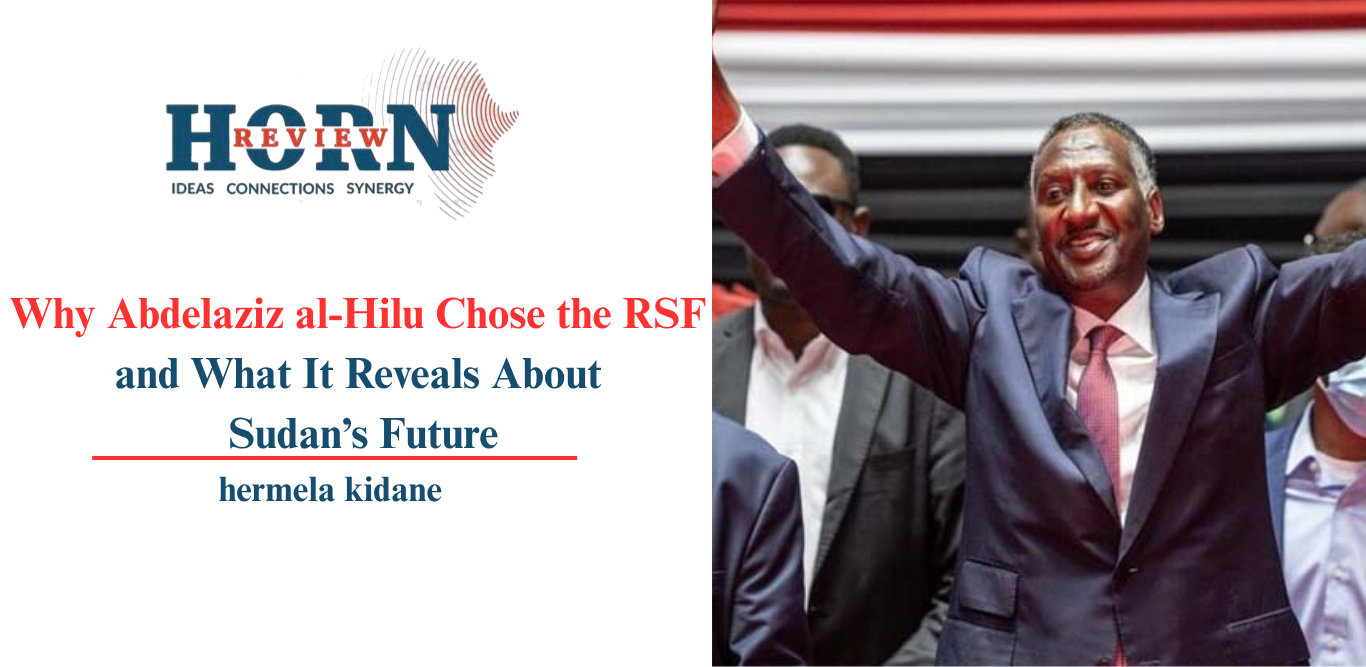
In the annals of Sudan’s long and troubled revolutionary history, few figures embody the complexities of the nation’s fragmentation as starkly as Abdelaziz al-Hilu and Malik Agar. Both emerged from the same crucible, the Sudan People’s Liberation Movement under the legendary John Garang, and both inherited Garang’s vision of a New Sudan, a secular democratic and inclusive state that would transcend the racial and religious hierarchies imposed by successive Khartoum regimes. Yet when Sudan descended into its latest devastating civil war in April 2023, these two revolutionary brothers found themselves on opposite sides of the trenches. Malik Agar stood with the Sudanese Armed Forces, accepting a position as a leader in the Sovereignty Council allied with General Abdel Fattah al-Burhan. Abdelaziz al-Hilu, by contrast, aligned his formidable Sudan People’s Liberation Movement North faction with the paramilitary Rapid Support Forces of General Mohamed Hamdan Hemedti Dagalo.
This divergence is not just footnote in the current conflict but rather the central ideological fault line of Sudans war. Al-Hilu’s alignment with the RSF, despite its record of atrocities, is not just opportunism. It stems from his lifelong commitment to a secular state, the marginalization of the Nuba people after the 2005 peace deal, the failure of the Hamdok era, and his belief that al-Burhan’s alliance with Islamists poses an existential threat to his vision. The choice of the RSF was not an endorsement of the paramilitias behavior but a calculated if fraught strategic decision born of the conviction that the SAF represents the very same theocratic centralism that al-Hilu has spent over 40 years fighting to dismantle.
To understand al-Hilus current alignment one must first revisit the ideological foundation of his struggle. When John Garang launched the SPLM in 1983 he broke decisively with earlier southern movements that sought only secession. Garangs manifesto was radical for its time as he envisioned a united secular and socialist Sudan where peripheral regions like the Nuba Mountains and the Blue Nile would enjoy equal citizenship alongside the Arab riverine center. Abdelaziz al-Hilu, an economist by training who joined the movement after graduating from the University of Khartoum, became one of Garangs most capable commanders and deeply internalized this vision of a state divorced from religious identity.
The Comprehensive Peace Agreement of 2005 which ended the Second Sudanese Civil War represented a catastrophic betrayal of that vision from the perspective of northern rebels like al-Hilu. The CPA granted the southern regions the right to self-determination, a path that led to South Sudans independence in 2011, but it denied the same right to the Nuba Mountains and Blue Nile. Under the so-called Popular Consultation protocols these marginalized northern areas were offered mere administrative autonomy rather than the fundamental right to secede from a system they viewed as fundamentally oppressive. John Young, a scholar of Sudanese militias, notes that many Nuba fighters felt profoundly abandoned by the SPLM leadership which had prioritized southern independence over the New Sudan project. Abdelaziz al-Hilu shared this sentiment bitterly. When South Sudan seceded al-Hilu did not relocate to Juba to seek a comfortable post in Salva Kiirs government but instead stayed behind in the Nuba Mountains, regrouping the northern wing of the SPLM-N to continue the fight against Omar al-Bashirs Islamist regime. For al-Hilu the struggle was never about carving out an ethnically pure enclave but about refusing to accept a Sudanese state defined by religious supremacy.
The 2019 revolution that toppled Omar al-Bashir opened a rare window of possibility as the transitional civilian government led by Prime Minister Abdalla Hamdok. Sought to address the grievances that had fueled decades of rebellion . In the negotiations with al-Hilus faction Hamdok attempted to resolve the two core demands that the Comprehensive Peace Agreement had ignored namely secularism and the political future of the Two Areas of South Kordofan and Blue Nile.
In September 2020 the Hamdok government and al-Hilu reached a landmark framework agreement. For the first time in Sudans modern history a sitting government formally agreed to separate religion from the state, ending the decades long imposition of Islamic law that had alienated non-Muslim and peripheral communities. However, on the question of self-determination for the Nuba Mountains Hamdok drew a firm line which was tolerable by Al hilu considering his first priority was a united but secular Sudan. While he offered a path for the people of the Two Areas to govern themselves through a federal system with significant local autonomy and a single professional national army, he stopped short of granting them the legal right to secede.
Hamdok’s offer represented a significant concession as a framework for a decentralized secular civil state. From al-Hilus vantage point however it was an insufficient guarantee.without the leverage of secession , he reasoned what would prevent a future Khartoum government from reneging on its secular promises. His doubt was rooted in historical precedent. The Islamists maintained deep roots within the Sudanese security apparatus and al-Hilu regarded the absence of a binding mechanism for self-determination as a fatal flaw that left his people vulnerable to the whims of the riverine elite.
The Hamdok era was shattered by the military coup of October 2021 led by General Abdel Fattah al-Burhan. For al-Hilu the coup confirmed his darkest suspicions. Al-Burhan presented himself internationally as a pragmatic soldier, but from al-Hilu’s vantage point this facade concealed the reemergence of the Kizan, the Islamist cadres who had sustained the Bashir regime. Evidence for this assessment is substantial. Since the outbreak of the 2023 war analysts have documented the deep integration of Islamist militias such as the Al-Baraa bin Malik Brigade into the SAFs command structure .many high ranking figures from the Bashir era including ahmed Haroun, al-Hilus old rival accused of war crimes in Darfur, were released from prison early in the war and have rejoined the states security apparatus.
This nexus between al-Burhan and the Muslim Brotherhood created an existential threat for al-Hilu. His core demand is the total dismantling of the Islamist system, the military legal and financial architecture that excludes religious and ethnic minorities from full citizenship. As he stated in his speeches regarding the Tasees or Sudan Founding Alliance, al-Hilu views the current SAF not as a national army but as a vehicle for the restoration of political Islam. In his calculation a victory for al-Burhan would not be a return to the prewar status quo but rather the consolidation of a theocratic military state that would permanently close the door on secularism and likely crush the SPLM-N in the Nuba Mountains.
If al-Burhan represents the enemy of secular governance then the RSF despite its well documented record of violence looting and ethnic cleansing in Darfur emerged in al-Hilus strategic vision as the lesser evil or perhaps more accurately the necessary ally of convenience. This alignment did not occur in a vacuum. By February 2025 al-Hilus SPLM-N had officially supported the RSFs attempts to form a parallel government in Nairobi Kenya under the umbrella of the Sudan Founding Alliance known as Tasees.
There is a coherent logic to this alliance though it is a logic born of desperation. First the RSF being a loosely organized Arab militia from the peripheries of Darfur and Kordofan does not carry the ideological baggage of Islamist centralism. While Hemedti is no liberal democrat his forces are not fighting to impose sharia law but rather for political and economic survival against the traditional Nile Valley oligarchy that has long excluded peripheral figures like himself from genuine state power. Second al-Hilu likely calculated that the RSFs insurgency would create a power vacuum in the west that would prevent al-Burhan from consolidating forces to crush the SPLM-N in the south. By aligning with the RSF al-Hilu ensures that the SAF remains bogged down on multiple fronts. Third the Tasees charter explicitly calls for a secular federal and democratic Sudan that decisively separates religion from the state, and this represents al-Hilus long sought constitutional rupture.
Of course, this alliance is fraught with moral hazard. The RSF has been accused of genocide and systematic sexual violence and al-Hilu is aware of the risk that his movement could be tarnished by association. However, he appears to believe that the RSF is a fading storm which can be politically contained after the fall of the Islamist SAF whereas an SAF victory would entrench his ideological enemies in power for another generation.
The divergence between Malik Agar and Abdelaziz al-Hilu is ultimately a divergence of risk assessment. Agar now a general in the Sovereignty Council has chosen to work within the existing military framework perhaps hoping to reform the army from within or to protect his constituency from the worst of the war. Al-Hilu has rejected this path entirely. His alignment with the RSF is not born of a belief in the paramilitary’s virtue but from a cold analytical conclusion that the threat of the Islamist military state is so absolute it justifies an alliance with any force willing to fight it.
The lesson here is uncomfortable. The war in Sudan is just a power struggle between two greedy generals but a war over the soul of the state. As long as the SAF affiliated to the Islamist project of the Muslim Brotherhood rebels like al-Hilu will have no incentive to lay down their arms. They will align with devils if necessary to prevent the return of theocracy. Any sustainable peace agreement must therefore address the root cause of the conflict that has haunted Sudan since independence namely the rejection of secular pluralistic governance. If the world fails to force a separation of religion and state figures like Abdelaziz al-Hilu will continue to fight not for land but for the very definition of what it means to be Sudanese.
By hermela kidane, Researcher, Horn Review