
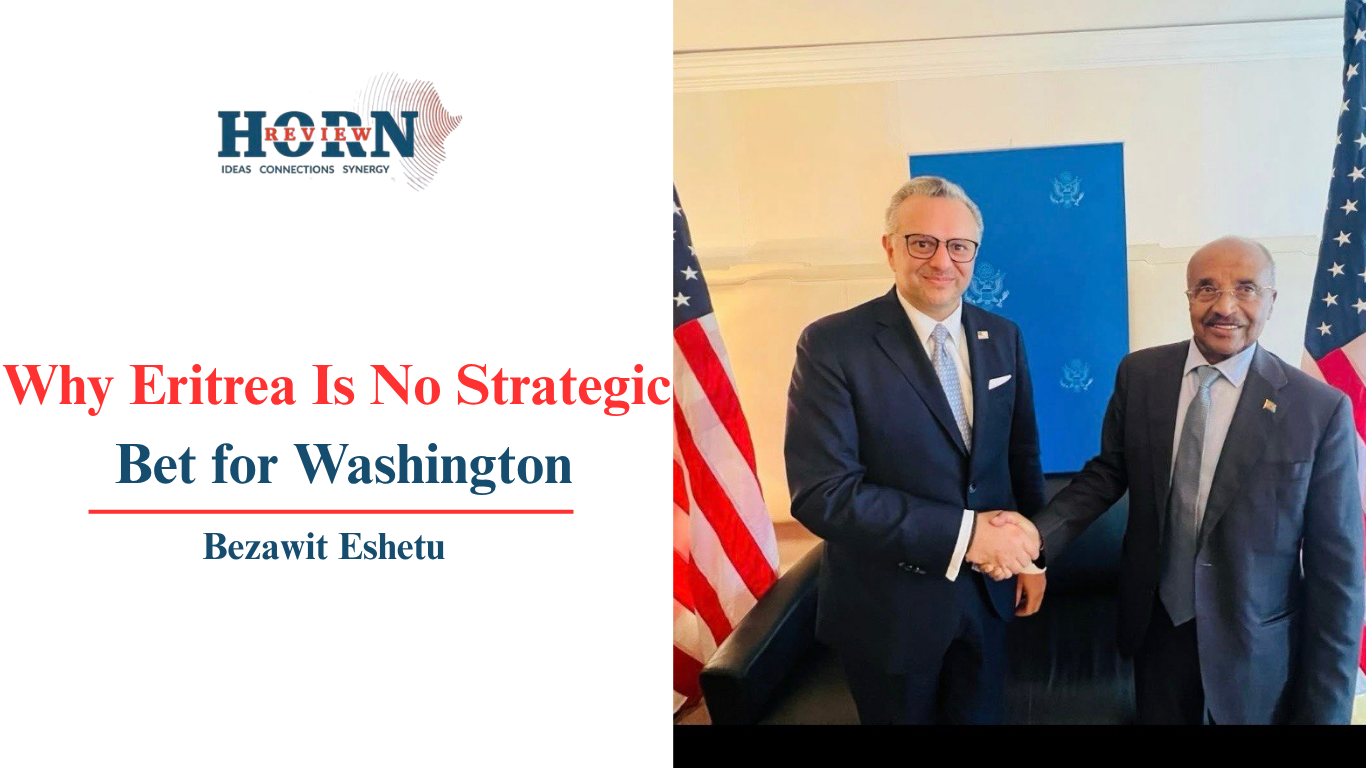
Why Eritrea Is No Strategic Bet for Washington
Analytical claims circulating in strategic circles, especially those advanced in “Securing the Strait and Choking the Vacuum: Why the US Must Break the Ice with Asmara” by David Yah in The Moseb Journal, call for an immediate and sweeping recalibration of U.S. policy in the Horn of Africa. Their core argument is that, in an era of great-power rivalry and Red Sea instability, isolating Eritrea is a strategic indulgence Washington can no longer afford. They portray disengagement as an outdated habit that merely creates room for adversaries to move in, and argue that pragmatism demands a diplomatic thaw. Yet this thesis collapses under serious geopolitical scrutiny because it confuses geographic exposure with real strategic value. In the Horn of Africa’s highly volatile environment, treating an institutionally hollow and unstable regime as a reliable commercial anchor is not realism; it is strategic naivety that risks deepening regional instability.
The case for a shift to Asmara is structurally unsound because it rests on a simplistic faith in maritime geography. The standard argument assumes that Eritrea’s 1,000-kilometer Red Sea coastline automatically gives it the capacity to safeguard the shipping lanes that pass through the Bab el-Mandeb. But geography is only an asset when the state in question has the institutional depth, technological capacity, and operational competence to convert location into security. The threats shaping the Red Sea corridor today are asymmetric and technologically sophisticated, involving anti-ship ballistic missiles and cheap drones. Countering them requires advanced radar, integrated electronic warfare systems, and highly professional maritime forces. Eritrea has none of these. What it does have is a primitive, conscript-heavy military designed chiefly for internal control and domestic surveillance.
That material weakness is compounded by a legal contradiction that makes cooperation with Eritrea even less coherent. The Western coalition operating in the Red Sea is built around defending a rules-based maritime order and preserving freedom of navigation. Eritrea, by contrast, remains a striking outlier in maritime governance, having refused to sign or ratify the United Nations Convention on the Law of the Sea. That refusal is not a technicality; it is a deliberate choice to stand outside the legal architecture governing territorial waters, transit passage, and exclusive economic zones. To secure a corridor through which roughly a trillion dollars in annual global trade passes by relying on a state that rejects the treaty framework underlying international waters is self-defeating and, in effect, legitimizes a zone of non-compliance.
Supporters of normalization often dismiss these weaknesses by invoking the familiar myth of the strategic vacuum, warning that if the West does not move quickly to end sanctions, rival powers will permanently entrench themselves on the Eritrean coast. But this argument wrongly assumes that Western concessions can buy exclusive alignment from a regime whose survival strategy depends on polycentric hedging. Since secession, Asmara has repeatedly played outside powers against one another to extract short-term rents. Even the periodic contacts with Moscow over possible naval logistics facilities in Massawa are best understood as bargaining leverage, not signs of genuine realignment. Isaias Afwerki’s deep paranoia and devotion to self-reliance make it highly unlikely that he would ever permit a lasting foreign military presence capable of diluting his total control over the state.
The risks of ignoring Eritrea’s transactional volatility are sharply illustrated by the Gulf’s experience in Yemen. In 2015, the UAE and Saudi Arabia secured military access to Assab. But the arrangement proved inherently unstable. Eritrea has long played multiple sides: prior to the Gulf deal, it allowed Iran to funnel weapons through its territory to Houthi rebels. During the 2017 Gulf crisis, Eritrea hedged to preserve ties with Qatar despite its alignment with the UAE, a stance that helped trigger a renewed border confrontation with Djibouti. Ultimately, once Asmara’s unreliability became clear, the UAE abandoned Assab in favor of Somaliland.
For the United States, this history is a direct warning about the likely consequences of any diplomatic normalization. If the Gulf was outmaneuvered by Eritrea’s opportunism, Washington could face a similar fate, especially if an Eritrean regime secretly aligns with Iran even while presenting a more cooperative posture. This concern is heightened amid escalating U.S.-Iran tensions, including the recent U.S. arrest of Iranian broker Shamim Mafi for smuggling millions of dollars in drones and ammunition to the Sudanese Armed Forces. As analyst Surafel Tesfaye argues, Washington should not reset relations while ignoring this “Mafi trail.”
The decisive question is not merely what is claimed on paper, but whether Eritrea’s opaque ports and Red Sea coastline are actively facilitating the movement of Iranian weapons into Sudan. Before any diplomatic thaw, the U.S. must trace the physical cargo, verifying the supply chain in practice. Otherwise, Washington risks repeating the Gulf’s mistake: empowering a regime that may function as a conduit for Iranian military proliferation and contribute to further regional destabilization.
Despite these warnings, current policy debates still assume that isolation and regional change have moderated Eritrea’s behavior and made it suitable for institutional integration. Recent events point in the opposite direction. In December 2025, Eritrea abruptly withdrew from the Intergovernmental Authority on Development, the region’s main diplomatic and security bloc, only two years after its much-publicized return.
The move, driven by its refusal to engage in collective mediation and its hostility to institutional oversight, confirms an enduring preference for isolation and zero-sum diplomacy. A state that actively undermines the principal diplomatic framework of its own neighborhood cannot reasonably be expected to become a dependable partner in a complex maritime security arrangement, especially when its survival depends on keeping its external environment permanently unstable.
Beyond the regime’s external unreliability lies a deeper and more serious geopolitical risk that Western advocates of normalization conveniently ignore: the fragility of Eritrea’s internal political order. The claim that demands for basic governance standards are merely outdated ideological niceties overlooks a central fact of highly centralized autocracies: institutional emptiness is itself a major geopolitical liability.
Eritrea is a classic personalist dictatorship built around an octogenarian ruler, with no implemented constitution, no functioning parliament, and no institutionalized mechanism for succession. Its economy is heavily militarized and dominated by illicit command networks controlled by fragmented military actors. When the current leadership becomes incapacitated or dies, the absence of a clear succession plan creates a substantial likelihood of rapid fragmentation and internal conflict, as rival factions compete for control over localized fiefdoms, potentially turning the coastline into a sanctuary for regional chaos.
The most immediate and catastrophic consequence of a premature Western opening to Eritrea, however, would be the destabilization of the wider Horn of Africa through the implicit endorsement of an aggressive anti-Ethiopian alignment. Over the past two years, the regional balance of power has shifted sharply, culminating in a tripartite security arrangement linking Egypt, Somalia, and Eritrea. Forged at the Asmara Summit and reinforced through subsequent high-level defense meetings, this axis is not a benign cooperation framework.
It is an explicit militarized containment strategy aimed at isolating Ethiopia, exploiting downstream fears surrounding the Grand Ethiopian Renaissance Dam, and obstructing Addis Ababa’s legitimate, development-driven pursuit of secure maritime access through its Memorandum of Understanding with Somaliland. If Western powers now signal their intent to lift bilateral sanctions and normalize ties with Asmara, they would not simply adjust diplomatic posture; they would alter the regional equilibrium, embolden a revisionist bloc, and inject fuel into volatile tensions that could easily escalate into interstate war.
The underlying claim driving this reckless shift—that Ethiopia is a failing state and Eritrea a usable strategic hedge—collapses under even basic analysis of leverage and institutional resilience. The assumption that the United States can replace East Africa’s geopolitical anchor with a peripheral coastal state ignores hard demographic and macroeconomic realities.
World Bank and IMF data place Ethiopia’s nominal GDP at $125.7 billion and its purchasing-power-parity economy at more than $530 billion, supporting a population of over 120 million. Even amid active internal security operations, Ethiopia’s 2026 High-Level Investment Forum secured $13.1 billion in foreign direct investment commitments, including a $10 billion anchor investment from Ming Yang in renewable energy, green hydrogen, and manufacturing infrastructure. By contrast, Eritrea is a depopulated, autarkic command economy generating only about $2.7 billion annually—less than a quarter of Ethiopia’s incoming infrastructure capital.
To describe Ethiopia as systemically brittle is to confuse conflict-driven political transition with sultanistic fragility. The Ethiopian federal state remains highly elastic: it continues to collect substantial tax revenue, expand a power grid that exports electricity to Kenya and Djibouti, and operate Africa’s largest and most profitable carrier, Ethiopian Airlines. Eritrea, by comparison, is a textbook sultanistic regime dependent on an aging dictator who effectively declared the 1997 constitution dead. With no legislature, no independent judiciary, and no institutional succession blueprint, the probability of a catastrophic vacuum in Asmara upon Isaias Afwerki’s death is near absolute. Betting on Eritrea as a long-term strategic asset is analytically equivalent to investing in a company already headed for liquidation.
Beyond these domestic realities, the idea that a transactional relationship with Eritrea would provide necessary diversification ignores the basic logic of regional security complex theory and misreads Ethiopia’s foreign policy behavior. Critics often portray Addis Ababa’s diplomatic choices, especially its entry into BRICS and the Somaliland Maritime Memorandum of Understanding as erratic or inherently anti-Western. That reading mistakes the structural imperatives of a landlocked middle power for defection. Engaging the New Development Bank to access alternative capital during acute foreign-exchange shortages, while simultaneously negotiating macroeconomic reform packages with the IMF, is classic strategic hedging: a multi-alignment survival strategy practiced by major U.S. partners such as Egypt and the UAE. Likewise, for a country of over 130 million people overwhelmingly dependent on a single port in Djibouti for international trade, secure sovereign access to the sea is not a temporary preference but an existential structural necessity designed to eliminate a permanent choke point. Punishing Ethiopia for pursuing that necessity while rewarding Eritrea creates a dangerous moral hazard, especially in light of official diplomatic correspondence documenting Eritrean military incursions across Ethiopia’s northern border and Asmara’s long-standing reliance on armed proxy groups to weaken its neighbors internally. In the Horn’s deeply integrated zero-sum security environment, an overt U.S. shift toward Asmara will not diversify Washington’s options. It could instead unsettle the regional balance and, in a worst-case scenario, encourage Addis Ababa to reassess its external partnerships and seek broader strategic assurances from other global actors.
Thus, the case for shifting away from Ethiopia in favor of an untested maritime alternative fails basic structural analysis. Ethiopia is indeed under significant domestic strain, yet its modern history shows a state capable of absorbing major shocks including the fall of the Derg and the 1991 transition without disintegrating. Likewise, the two-year war in Tigray did not culminate in state collapse, but in a negotiated ceasefire, which further highlights Ethiopia’s resilience under pressure. In this context, treating Eritrea as a solution to the “Ethiopian question” becomes a dangerous tactical illusion: it trades a complex but indispensable partnership for an institutional void that is already moving toward an inevitable succession crisis. Strategic realism therefore requires recognizing that durable regional security cannot be built on the hollow foundation of an isolated autocracy; it must be anchored in Ethiopia’s enduring demographic and economic gravity.
By Bezawit Eshetu, Researcher, Horn Review

RELATED
Posts
9
Oct
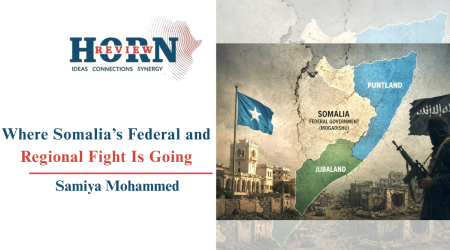
Where Somalia’s Federal and Regional Fight Is Going
The 2012 federal settlement was less a constitutional order...

9
Oct
Eritrea’s Post-Pretoria Strategy and the Escalation in Ethiopia
Our latest report examines Eritrea’s post-Pretoria trajectory and how selective...
8
Oct
The Houthi-al-Shabaab Nexus and the Emerging Security Architecture of the Gulf of Aden
The growing relationship between Yemen’s Houthi movement and Somalia’s al-Shabaab...
7
Oct
“Decaffeinated Sovereignty”: Eritrea’s One-Way Street with Ethiopia
There is a peculiar contradiction at the heart of Eritrea’s...
7
Oct
Leaked Documents Allege Sudanese Army Weapons Pipeline to TPLF-Aligned Forces as Tigray War Reignites
Leaked documents alleging a Sudanese army weapons pipeline to TPLF-aligned...
7
Oct
Eritrea Has Officially Invaded Ethiopia, Says Government Communication
Ethiopian Government Formally Condemns Eritrean Territorial Incursion as Its Forces...
7
Oct
Turkey, Somalia and the Transactional Reading of Alamein
The Alamein Declaration functions less as a coherent framework...
7
Oct
Somalia's Alamein Signature and the Costs of Diplomatic Alignment
The Alamein Declaration between Egypt, Sudan, Eritrea and Somalia...
6
Oct
Egypt's Nile for All, the Red Sea for Some - Except Ethiopia
The contradiction was laid out almost perfectly at El Alamein....
6
Oct
Isaias Afwerki has Long Wanted to Rule Ethiopia, Why He will Never
President Isaias Afwerki is among the most enduring figures in...