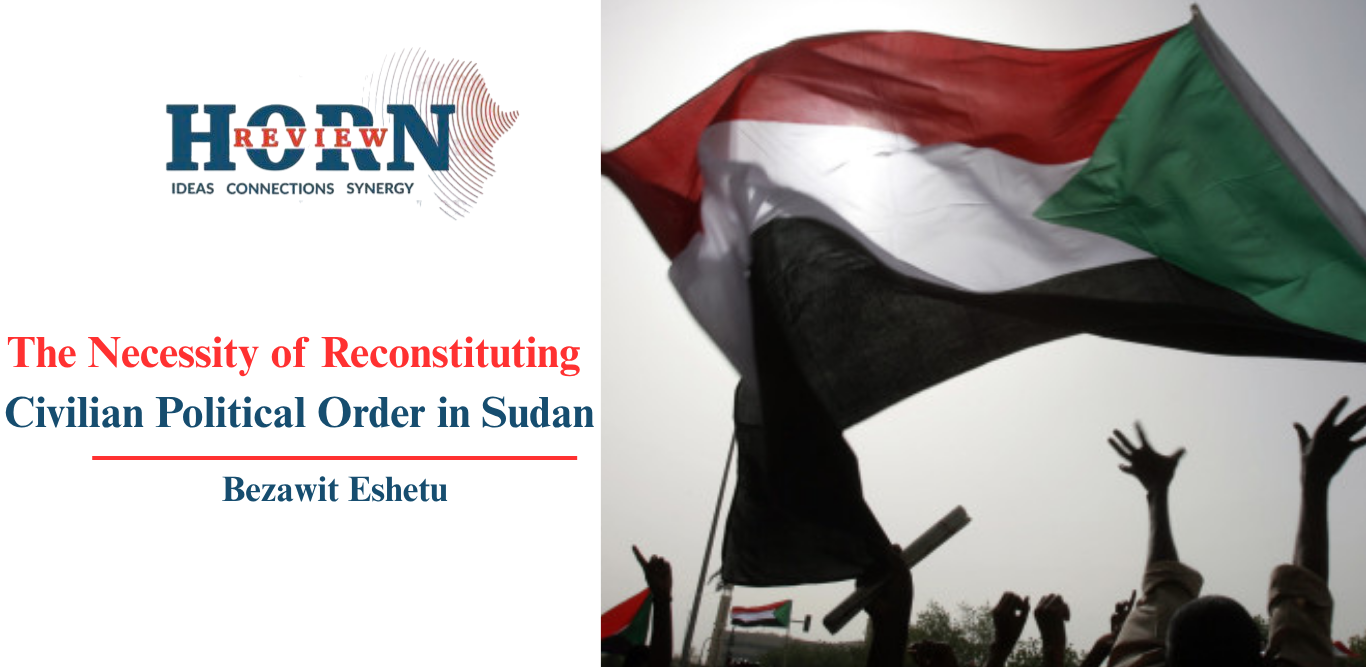
The Necessity of Reconstituting Civilian Political Order in Sudan
The conventional foreign policy frame casts Sudan’s war as a duel between General Abdel Fattah al-Burhan of the Sudanese Armed Forces (SAF) and Mohamed Hamdan Dagalo of the Rapid Support Forces (RSF). That framing is convenient but incomplete: it treats the conflict as a rivalry of personalities when it is actually the unraveling of a militarized political order that governed Sudan through coercion, patronage, and institutional exclusion.
The war is not merely a top-level contest for power; it is the visible collapse of a state structure that repeatedly reproduced itself through force. From this perspective, neither faction can credibly claim to be a guardian of national stability. Both are competing expressions of the same long-term political decay. Sudan’s exit therefore depends on civilian rule not as an aspiration but as a structural requirement for rebuilding legitimate authority.
The strongest argument against civilian governance in Sudan rests on undeniable realities: the country is deeply fragmented, heavily armed, and scarred by decades of authoritarian rule and peripheral conflicts. Critics contend that only a strong-armed center can hold the nation together and preserve territorial unity. Yet this view fundamentally misreads Sudan’s political history. Rather than resolving fragmentation, successive military regimes actively managed and institutionalized it. They governed through coercive control, selective incorporation of elites, and the systematic exclusion of others. These tactics prioritized dominance over genuine integration.
Far from restoring lasting order, the central state’s repeated interventions only deepened the very inequalities and resentments that fuel instability. Each claim of “bringing order” further entrenched divisions instead of neutralizing them. In this light, Sudan’s fragmentation does not weaken the case for civilian rule; it strengthens it. Overcoming the cycle of violence and disintegration sustained by militarized governance requires rebuilding citizenship, accountable institutions, and inclusive political processes. These are precisely the tasks that civilian rule is better equipped to undertake.
This pattern is rooted in Sudan’s formation. At independence the country inherited a highly centralized apparatus shaped by colonial governance, designed to extract resources from the periphery, regulate populations through hierarchy, and maintain order through local divisions. Mahmood Mamdani’s analysis helps explain how colonial rule turned difference into an instrument of administration and control. Postcolonial regimes adapted that structure instead of dismantling it. Military governments preserved the center-periphery logic, governing through unequal access, ethnicized mediation, and the management of competing local blocs rather than through national integration or civic inclusion.
The National Islamic Front (NIF) and Hassan al-Turabi intensified this inheritance. The 1989 coup that brought Omar al-Bashir fused coercive authority with ideological capture. Bashir provided the apparatus of force while the Islamist network supplied a doctrine and a method of tamkeen, or empowerment. Through tamkeen the regime purged professionals, restructured institutions, and tied advancement in the military, police, and civil service to political loyalty instead of competence or accountability. The result was an Islamist security deep state designed to survive leadership transitions, defend regime continuity, and suppress dissent through proxy violence. In that system civilians were not political constituents but objects of control.
The late 2018 uprising exposed the limits of that order. It generated broad civic mobilization among neighborhood resistance committees, professional associations, and ordinary citizens who demanded the transfer of sovereignty away from the security state. That demand challenged not only Bashir but the political logic that sustained him. Yet when the military removed Bashir in April 2019, it did so to preserve the underlying coercive network rather than to dismantle it. The palace coup functioned as regime preservation: Bashir was sacrificed while the machinery of domination remained intact. The civilian revolution was acknowledged formally but contained substantively.
The RSF itself emerged from this environment. Rather than an external disruption, it is one form through which the state outsourced violence. Originating in Darfuri Janjaweed militias and later formalized as a paramilitary force, the RSF developed an autonomous military and economic base outside regular army command. Access to gold extraction and external patrons reinforced that autonomy. Its tactics including territorial capture, coercion, and systematic targeting of civilians through ethnic violence, sexual abuse, and forced displacement are not accidental excesses; they are central to the RSF’s strategy for consolidating control. The force is therefore best understood not as a deviation from the state but as one of its products: privatized violence institutionalized.
The SAF, however, is not a principled alternative. Since full-scale war began in April 2023, SAF leadership under General al-Burhan has increasingly converged with resurgent Islamist networks and old-regime elements to sustain military campaigns. The prominent role of the Al-Baraa bin Malik Brigade, an ideological Islamist-aligned auxiliary descended from Bashir-era Popular Defense Forces, shows how the regular army depends on loyalists who view the war as an opportunity to restore influence and reclaim economic monopolies. The SAF’s wartime coalition is shaped by transactional pragmatism rather than a coherent national doctrine, so disparate actors align with the army as the lesser danger in a landscape of collapsing protection.
This explains why several former Darfur rebel movements and Juba Peace Agreement signatories, including the Justice and Equality Movement led by Gibril Ibrahim, Minni Minawi’s Sudan Liberation Movement, and Mustafa Tambour’s SLM faction, have sided with historical oppressors. Facing an aggressive RSF advance in Darfur and Kordofan, these groups judged the paramilitary an existential threat to non-Arab communities and to their regional leverage, choosing the army as a structural shield. Similar calculations drive the Eastern Battalion under Mousa Mohamed, SPLM-N factions under Malik Agar, and Mustanfareen resistance battalions to mobilize with the SAF out of local defensive urgency or in pursuit of localized formal authority. Their participation does not signal a restored national consensus but a wartime scramble for protection, influence, and survival inside a fractured political order.
The RSF’s coalition reflects a parallel logic. By manufacturing an anti-center narrative that portrays the conflict as a campaign against the northern riverine elite, the RSF has mobilized Arab tribal networks and opportunistic splinter groups such as Tamazuj in Darfur and South Kordofan. Even politically distinct actors, including the SPLM-N faction led by Abdelaziz al-Hilu which controls territory in the Nuba Mountains, have entered tactical arrangements with the RSF, choosing temporary pacts with a ruthless paramilitary in the hope of permanently shattering the old political center. These alignments create a market for protection and temporary authority that deepens fragmentation rather than resolving it.
The international environment compounds this market. Foreign states treat Sudan as a vacuum for regional influence rather than a sovereign political community and inject material resources that directly subsidize the slaughter. Egypt and Iran have supplied the SAF with drones, weaponry, and diplomatic cover, while the United Arab Emirates have reinforced RSF logistics and finance. By underwriting the war economy, external patrons remove incentives for the generals to negotiate in good faith. The conflict thus becomes a profitable proxy war, with resources extracted and civilians terrorized to serve external strategic aims.
Because both sides are rooted in the same political economy of coercion, the SAF-RSF war is not a break with Sudan’s past but its continuation through armed fragmentation. They are rival claimants to a broken order, not rival paths to legitimate governance. The central question is whether Sudan will continue to be governed through armed domination or be reconstituted on civilian foundations.
A civilian administration is necessary because it offers the only political form capable of redefining sovereignty in Sudan. Military regimes view populations as security objects: recruits, informants, clients, or threats. Civilian governance, in principle, orients institutions toward citizenship, accountability, and rights. That distinction is institutional, not symbolic, and it determines whether the state reproduces exclusion or begins to overcome it. A civilian administration can rebuild a social contract precisely because it is not structurally dependent on permanent war, coercive hierarchy, or identity manipulation for survival. It offers the only credible framework to replace militarized rule with an order where citizens, not armed actors, are the source of legitimate authority.
International law reinforces the case for withdrawing legitimacy from the warring factions. Francis Mading Deng’s doctrine of sovereignty as responsibility asserts that sovereignty is conditioned by the duty to protect populations. When a polity bombs residential areas, obstructs humanitarian relief, and presides over mass displacement, it fails that duty and forfeits moral and legal claims to exclusive authority. Thus, the international test of legitimacy should be accountability to civilians rather than control of territory or superior firepower. On that basis legitimacy rests with civilian coalitions, not generals or militias.
The practical objection, how can unarmed civilians govern while armed actors hold territory, rests on a narrow view of power. Civilian authority must be built through layered political, diplomatic, and material support. That includes formal recognition before full territorial consolidation because recognition weakens the narrative that armed actors alone are effective authorities. It also requires direct funding for civilian administrative capacity and protection of humanitarian corridors, since governance cannot be deferred until an ideal peace agreement arrives.
Neighborhood resistance committees and civic networks matter because, even in wartime, they coordinate local life, sustain clinics, distribute relief, and generate bottom-up legitimacy. They are not substitutes for a formal state but the strongest existing foundation for a political order formed through civic participation rather than armed domination.
International engagement should therefore bypass predatory military bureaucracies and channel assistance to civilian structures while shielding them from coercion and capture. Policy must deny the dividends of domination by refusing diplomatic normalization for warlords, imposing targeted sanctions on military-commercial networks, disrupting illicit arms flows, and backing a civilian transition authority without equivocation. Anything less risks reproducing the political economy that makes renewed war likely.
Sudan’s tragedy isn’t that civilians are incapable; it’s that armed elites and ambiguous foreign actors treat weakness as simply not having weapons. That definition is not neutral; it is part of the political problem itself, because it licenses permanent militarization as the only “realistic” form of rule. A system that survives only by destroying the public it claims to govern has no legitimacy, even if it controls territory.
A civilian‑led administration therefore must not be treated as a distant endpoint of transition. It is the necessary starting point for any durable peace, the only credible path to reclaim the state for its people, and the only way to dismantle the political economy in which international actors and local warlords’ profit from the deliberate denial of civilian power.
By Bezawit Eshetu, Researcher, Horn Review

RELATED
Posts
21
Oct
Egyptian Offer of Troops to Saudi Arabia: Why Now?
When President Abdel Fattah el-Sisi asked Egypt's parliament on 18...
21
Oct
Where Would Eritrea’s Future Lie in a War with Ethiopia?
After a succession of escalations, the armies of Ethiopia and...
21
Oct
The Sodere Initiative and Ethiopia’s Role in Somali State-Building
Ethiopia’s initiative at Sodere brought Somalia’s rival factions into a...
21
Oct
Khartoum's Conditional Peace Offer and the Egyptian Shadow over Ethiopia-Sudan Relations
Sudan's Foreign Minister, Mohi-Eddin Salem, told French Special Envoy...
21
Oct
Egypt's Strategic Desperation Reaches Djibouti
Egypt's expanding involvement in Djibouti's maritime infrastructure has acquired renewed...
21
Oct
Somalia's Misattribution of Security Failure and the fonts of Federal Overreach
The federal government of Somalia under Hassan Sheikh Mohamud faces...
21
Oct
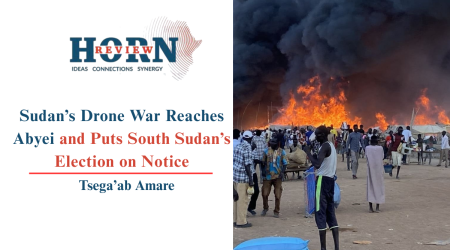
Sudan’s Drone War Reaches Abyei and Puts South Sudan’s Election on Notice
The drone strike on the Amiet market inside the disputed...
21
Oct
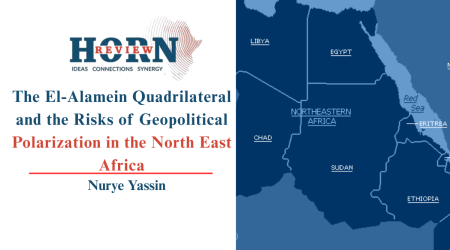
The El-Alamein Quadrilateral and the Risks of Geopolitical Polarization in the North East Africa
The rapid changes that are taking place in the North...