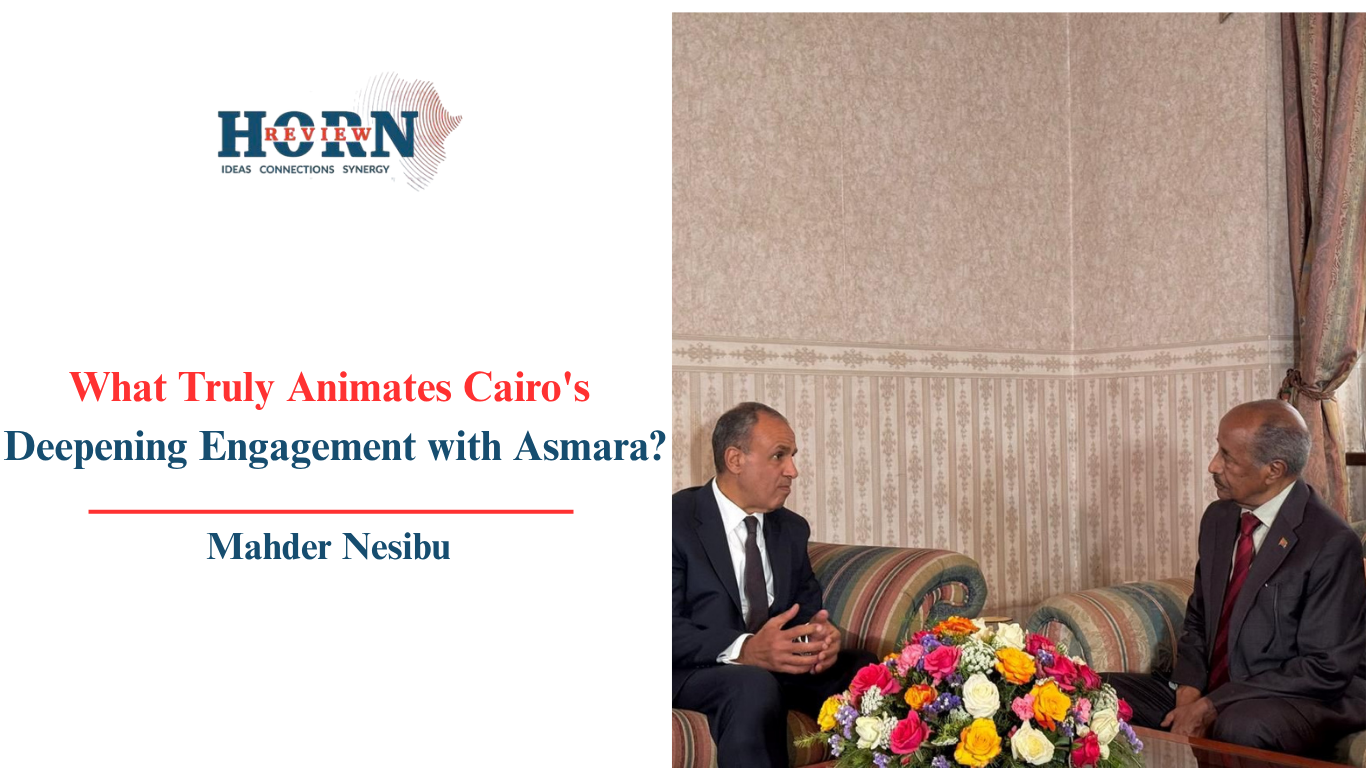
On April 16 and 17, Egyptian Foreign Minister Badr Abdelatty arrived in Asmara at what he stated to be the direct instruction of President Abdel Fattah al-Sisi. The delegation he led was substantial: alongside him came Egypt’s Minister of Transport and representatives of more than eight Egyptian companies operating across agriculture, mining, manufacturing, pharmaceuticals, and maritime transport. Several agreements were signed. Abdelatty told Eritrean media that a “qualitative leap” in Egypt-Eritrea relations was the goal. President Isaias Afwerki, for his part, told Egyptian media that he and al-Sisi could together “solve” the Horn of Africa’s instability.
Those are striking claims for a relationship that, until recently, moved in the quieter registers of regional alignment. Their ambition becomes legible only against the sequence of engagements that preceded them. In mid-April, a senior Eritrean delegation led by Hagos Gebrehiwet, Head of Economic Affairs of the PFDJ and the principal economic architect of the Isaias administration, had travelled to Cairo for a three-day programme spanning, amongst other things, foreign affairs, investment, trade. That visit produced no formal agreement. Its function was primarily one of strategic signalling, directed as much at Addis Ababa as at either capital’s domestic audience, that Asmara’s external orientation was consolidating within Cairo’s orbit. The Abdelatty visit, reciprocal in form and formalised through signed instruments, is the continuation of what Hagos’s Cairo trip initiated.
What is driving that acceleration, however, is not Red Sea security, the frame in which both sides have chosen to present it. It is the Nile.
In late March, Ethiopia had announced plans to construct three additional dams on the Abbay, Karadobi, Mabil, and Mendaya, each projected at $3.5 billion, compounding the strategic blow already delivered by the Grand Ethiopian Renaissance Dam’s inauguration in September 2025. The GERD, financed entirely through domestic bonds and public contributions in deliberate defiance of sustained Egyptian pressure that had for decades successfully blocked international financing, represented something Cairo has struggled to absorb: that Ethiopia’s upstream ambitions are structurally immune to bilateral leverage. Every Egyptian effort to draw the dam into a multilateral framework that would constrain Addis Ababa’s sovereign control over the Abbay failed. The announcement of a further cascade of infrastructure confirmed what those failures already implied: Ethiopia has no intention of returning to a negotiating table on terms Cairo would find acceptable.
The Egyptian approach to the Horn of Africa has been, at its foundation, an approach to the Nile. Everything else, the Red Sea framing, the port agreements, the economic delegations, flows from that core. Having exhausted the direct diplomatic track with Ethiopia, Cairo has shifted to a strategy of escalation by other means, assembling a regional pressure architecture through Ethiopia’s neighbours, deepening alignments that raise the cost of Addis Ababa’s position without requiring Egypt to engage it directly. Eritrea is the most consequential node in that architecture, and the Abdelatty visit is a measure of how seriously Cairo is now investing in it.
The visit was framed extensively in the language of Red Sea security, and Egypt’s interests in the maritime corridor are real enough to make that framing credible on the surface. The Suez Canal makes Cairo a direct beneficiary of route stability, and the Houthi disruptions of 2023 to 2025 cost Egypt an estimated $6 billion in canal revenues, resulting in immediate fiscal damage for an economy already under strain. Cairo has long held that the Red Sea belongs within a constellation of states aligned with Egyptian interests, a disposition with deep historical roots. Egypt’s patronage of Eritrean liberation movements during the armed struggle period was motivated in significant part by the desire to establish dominance over the corridor and degrade Ethiopia’s capacity to maintain a coastal presence. The ruling party in Asmara was partly shaped by that patronage, and the current alignment draws on those same foundations.
The actual insecurity afflicting the maritime route, however, is Houthi and Gulf of Aden piracy problem, well beyond the reach of Egypt-Eritrea bilateral cooperation to address. The “littoral states” framing that animated the Abdelatty visit has little operational relevance to the route’s vulnerabilities. Its target is something more specific: Ethiopia’s ambition to recover sovereign maritime access, with Ethiopia sees as an “existential” national interest. That ambition is the pressure point Cairo is working. In late 2025, Egypt concluded agreements to upgrade Eritrea’s Assab port and Djibouti’s Doraleh facility, providing for naval berths, refuelling infrastructure for Egypt’s southern fleet, and the option to deploy military contingents. Assab is the port Ethiopia has most openly identified as a potential route back to the sea; Doraleh handles the vast majority of Ethiopian trade. Egyptian positioning at both constitutes a deliberate encirclement of Ethiopia’s commercial access to the maritime corridor, a chokehold that derives its coercive value precisely from the depth of Addis Ababa’s maritime ambitions.
On the contrary, reports emerged in early this year that Egypt had signalled a willingness to facilitate Ethiopia’s commercial Red Sea access, conditional on Nile concessions and the abandonment of any military coastal ambition. In a way, Egypt was indirectly offering to moderate a constraint it itself was intensifying, in exchange for concessions it had been unable to extract through negotiation. The Red Sea, in this architecture, is not a policy objective. It is a card, and its value to Cairo lies primarily in its centrality to Ethiopian national interest.
The economic content of the Abdelatty visit, the sectoral agreements, the company delegations, the language of investment and trade expansion, deserves scrutiny, because the conditions for genuine commercial engagement between Egypt and Eritrea are largely absent. Eritrea’s economy is among the most structurally insular in the world, operating at the margins of regional supply chains, with limited capacity to absorb foreign commercial activity of the kind the visit’s optics suggested. Egypt’s own financial position makes the prospect of capital flows from Cairo to Asmara even more remote. Having emerged from a severe balance-of-payments crisis primarily through a $35 billion UAE sovereign investment in the Ras al-Hekma development zone and a $22 billion multilateral package from the IMF, the European Union, and the World Bank, Egypt carries external debt service obligations of $27 billion this year alone, with interest payments absorbing 87 percent of tax revenues. An economy of that profile does not become a source of productive foreign investment. The agreements signed in Asmara perform the relationship; their value rather, is political, not commercial.
The real substance of the escalation strategy lies in Cairo’s systematic effort to elevate Eritrea’s regional and international standing as a diplomatic counterweight to Ethiopia. The Saudi dimension illustrates the pattern. Eritrea’s growing significance in Riyadh owes much to Egyptian regional strategy and to Asmara’s own exploitation of Horn instability and Red Sea security debates to acquire relevance in the Gulf. Egypt has served as a facilitating presence in that repositioning, integrating Eritrea into the network of relationships Cairo maintains with Gulf states whose own interests in the Horn are growing.
The Washington dimension carries greater weight still. During President Isaias’s five-day working visit to Cairo in late October last year, al-Sisi brokered a meeting between Isaias and Massad Boulos, the White House Senior Advisor for Arab and African Affairs. The meeting, first reported by the Wall Street Journal, placed Egypt in the role of diplomatic intermediary between Asmara and Washington. The United States is now attempting to cautiously re-engage with Eritrea, with the question of lifting sanctions imposed in 2021 under active consideration. The immediate driver is Red Sea security, sharpened by the Hormuz crisis and the broader reassessment of maritime chokepoint vulnerability it produced across Washington’s strategic calculus. The longer-term consideration is the Horn’s architecture, and Washington’s historically anchor-state relationship with Ethiopia is itself under strategic considerations.
Into that American recalibration, Egypt has inserted itself as the enabling intermediary. President Trump’s is considered to be sympathetic with Egypt’s position on the GERD, which has made Addis Ababa deliberately cautious in its engagement with his mediation overtures. By brokering Eritrea’s re-entry into American diplomatic networks, Cairo is simultaneously deepening Asmara’s integration into Egyptian-mediated relationships and shaping the terms on which Washington reads the Horn. The risk, from Washington’s vantage point, is that it is being drawn into a regional rivalry whose primary axis is the Nile, through a Red Sea security frame that obscures that axis rather than illuminating it.
The most consequential dimension of what the Abdelatty visit signals may be what it reveals about the direction of Eritrean foreign policy itself, because what is now visible represents a meaningful departure from how Asmara has historically operated.
Isaias Afwerki has, across four decades in power, maintained a strong aversion to deep, sustained alignment with any single external power. Eritrean foreign policy has prioritized the capacity to manoeuvre across competing alignments, to avoid the dependencies that accompany sustained embedding within another state’s regional vision. A small, economically isolated, and diplomatically constrained state has sustained regional significance precisely because it could not be taken for granted by any patron. Isaias has built his political identity on that refusal, and on the calculated exploitation of regional instability to extract leverage from larger actors on his own terms.
The accumulation of high-level visits, formalised agreements, the Egypt-mediated introduction to senior American officials, the convergence in Sudan behind the Sudanese Armed Forces and General Abdel Fattah al-Burhan, and the shared Red Sea framing all point toward an Eritrea inserting itself progressively deeper into Egypt’s broader regional vision.
Egypt, however, treats Eritrea as one instrument among several in a pressure architecture ultimately oriented toward the Nile. The support it extends to Asmara is calibrated to that valuation, not to Eritrea’s own strategic interests, and as the alignment deepens, the room Asmara has to recalibrate, to shift when Egyptian priorities shift or when the terms of the relationship become inconvenient, is narrowing. The deeper the alignment, the more Eritrea’s external orientation is shaped by Egyptian strategic priorities, and the further Asmara drifts from the position of manoeuvrability that has defined it. Isaias has spent a political lifetime refusing the condition of dependency. The Cairo-Asmara axis, as it is currently developing, is gradually constructing precisely that.
By Mahder Nesibu, Researcher, Horn Review




Comment (1)
[…] web of alignments rests on an overlapping and often distinct set of calculations for each actor. The Egypt-Eritrea relationship rests on several grounds. Cairo, locked since the completion of the Grand Ethiopian Renaissance Dam in an escalating […]