
Eastern Sudan: The Blind Spot That Could Rewire Horn Geopolitics
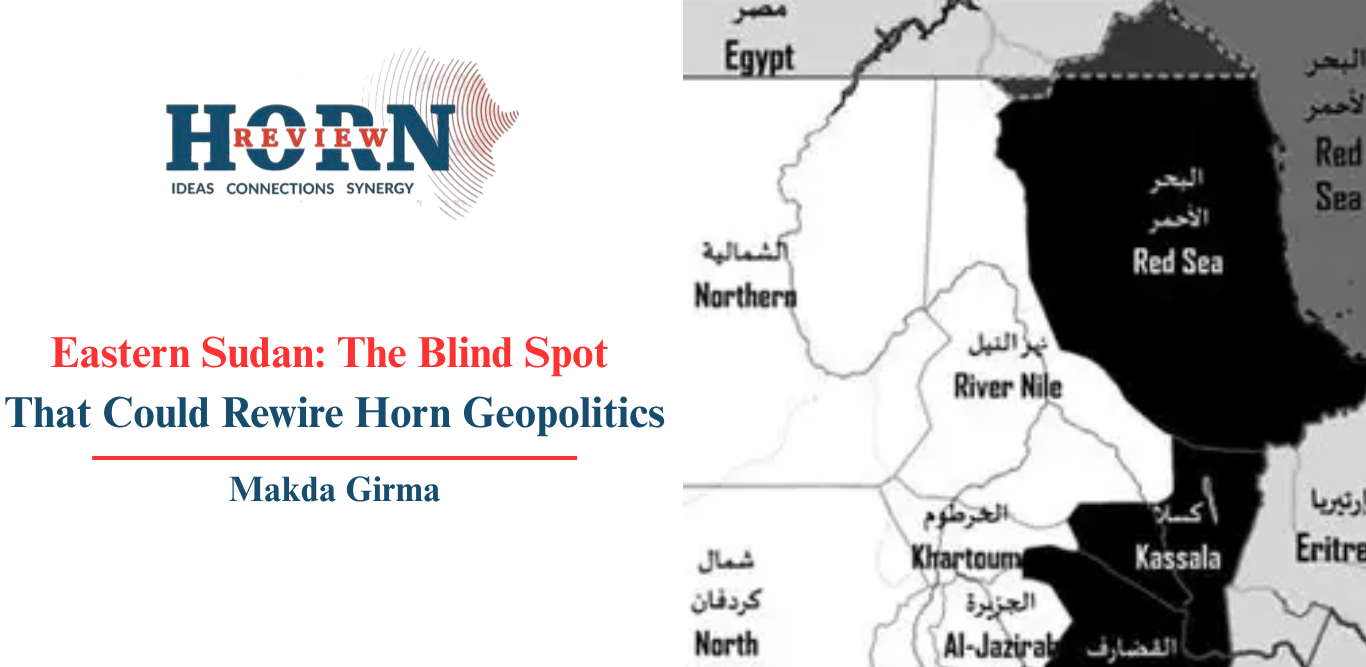
For much of Sudan’s war, the world has looked westward and inward. Khartoum became the symbol of state collapse, Darfur became the symbol of atrocity, and Kordofan became one of the most violent military theaters. Eastern Sudan, by contrast, often appeared to sit outside the center of the storm. That appearance was misleading. The east was never just a quiet rear area. It was the place where Sudan’s remaining state authority, its main maritime outlet, its humanitarian lifeline, and its most sensitive borders converged. As the war has stretched on, Port Sudan, Kassala, Gedaref, and the Red Sea corridor have become central to the survival of the army aligned authorities and to the calculations of Eritrea, Ethiopia, Egypt, the Gulf states, Turkey, and Iran. Eastern Sudan is no longer a margin. It is becoming one of the most consequential fault lines in the Greater Horn.
The danger is that this transformation is still underappreciated. Analysts often describe Sudan through the familiar geography of Khartoum, Darfur, and the Nile Valley, while treating the east as a refuge from the war rather than a theater shaped by it. Yet the east carries a strategic weight that exceeds its visibility. Port Sudan is Sudan’s main maritime gateway and became the de facto administrative center for the army aligned government after Khartoum descended into war. Aid agencies, diplomats, displaced families, military officials, and commercial networks all shifted toward the Red Sea coast because the city seemed more stable than the capital. That stability was never absolute. It depended on the assumption that the war would remain geographically contained. The drone attacks that struck Port Sudan in May 2025 shattered that assumption. Reports show that strikes hit key infrastructure including fuel depots, the container terminal, an electricity substation, and areas near the presidential residence, causing fires, power disruption, and fears over aid delivery.
Those attacks were important not only because of the damage they caused, but because of what they revealed. The RSF, which had long been strongest in Darfur and parts of central Sudan, showed that it could project violence deep into what had been considered the army’s secure eastern space. In practical terms, the attacks threatened fuel, electricity, transport, aid logistics, and the psychology of safety that had allowed Port Sudan to function as Sudan’s substitute capital. In political terms, they signaled that the eastern corridor could no longer be separated from the wider war. If drones can reach Port Sudan, then the Red Sea is not an external arena next to Sudan’s war. It is part of the war’s geography.
This matters because Port Sudan is more than a city. It is a hinge between Sudan’s internal conflict and the wider region. Whoever influences Port Sudan gains leverage over humanitarian routes, wartime diplomacy, maritime access, fuel flows, South Sudanese oil exports, and Sudan’s remaining channels to the outside world. The city’s role as a logistical and administrative hub means that even limited disruption there can have national consequences. A strike on fuel infrastructure in Darfur affects a battlefield. A strike on fuel infrastructure in Port Sudan can affect aid operations, electricity, imports, diplomatic activity, and the operating capacity of the army aligned state. That is why Eastern Sudan’s instability would not remain local. It would travel through ports, roads, refugee routes, oil pipelines, and foreign policy alignments.
The local roots of the problem are older than the current war. Eastern Sudan has long carried grievances around marginalization, unequal development, land questions, and weak representation in central power. The Beja and other communities in the east have repeatedly argued that the region’s wealth, especially its port and strategic location, has not translated into political inclusion or local development. The 2021 blockade by Beja protesters showed how powerful those grievances could become. Reuters reported at the time that Beja groups blocked roads and forced Red Sea ports to close in protest over political and economic marginalization, creating shortages of medicine, fuel, and wheat.
That episode is central to understanding the current risk. Eastern Sudan does not need a full war to become strategically disruptive. A blockade, militia standoff, drone strike, or dispute over local representation can produce national consequences because the region controls the arteries through which Sudan breathes. The port is not just a commercial facility. It is a political pressure point. The roads into and out of the east are not just transport corridors. They are instruments through which local actors can force the center to listen. In a stable state, such disputes might be negotiated through political institutions. In a fragmented wartime state, they can be militarized, externalized, and absorbed into regional rivalries.
The war has made these local tensions more dangerous. Eastern Sudan has absorbed large numbers of displaced people, and humanitarian systems in Kassala, Gedaref, and Red Sea states have been stretched by the movement of families fleeing violence elsewhere. The European Union Agency for Asylum has treated eastern Sudan as less intensely violent than the main war zones, but it also identifies the east as a region affected by displacement, armed actor activity, and the wider security crisis. Relative calm can therefore be deceptive. A place can be less violent than Darfur and still be deeply fragile. In fact, eastern Sudan’s very role as a refuge increases its vulnerability. Displaced populations need food, shelter, water, security, and administrative support. Host communities already facing poverty and exclusion may see the burden as another sign that the center extracts from the east but does not protect it. If armed groups then enter this environment, local grievances can become a recruiting ground.
This is where Eritrea enters the picture. For Asmara, Eastern Sudan is not an abstract neighboring region. It is a security buffer along Eritrea’s western frontier. Eritrea has strong reasons to fear disorder on that border: refugee pressure, smuggling networks, hostile armed groups, Islamist networks, and rival external actors. Crisis Group noted in 2026 that Eritrea has come to see the Sudanese army, which controls much of Sudan’s center and east, as the best available ally for managing uncertainty along its border. The more precise argument is that Eritrea seeks to shape the eastern Sudanese security environment in ways that protect Asmara’s interests.
Reports of Eritrean links to eastern Sudanese armed groups should be understood within that logic. For Eritrea, a friendly or dependent security structure in eastern Sudan can provide depth, intelligence, leverage, and insulation. It can also give Asmara influence over Sudanese politics and over wider alignments involving Ethiopia and Egypt. But this strategy carries a dangerous contradiction. A buffer built through militias may reduce short term uncertainty while increasing long term instability. Armed clients do not always remain obedient. Local grievances do not disappear because an external actor finds them useful. The more eastern Sudanese politics becomes organized through armed formations, the more likely it becomes that local disputes will be settled by force rather than negotiation.
Ethiopia views the same region through a different but equally anxious lens. For Addis Ababa, Eastern Sudan is tied to the western frontier, the Al Fashaga dispute, refugee flows, the security of Benishangul Gumuz, and the geopolitical pressure created by Egypt and Eritrea. Ethiopia cannot treat Sudan’s east as distant because Gedaref and Kassala sit close to Ethiopia’s borderlands, while Sudan’s war has already generated allegations, counter allegations, and fears of spillover. In February 2026, Reuters reported claims that Ethiopia had built a camp in Benishangul Gumuz to train fighters for the RSF, with alleged UAE support. Ethiopia’s government rejected related accusations, but the report underscored how Sudan’s war is increasingly entangled with Ethiopia’s western security environment.
For Ethiopia, the strategic fear is not only that Sudan collapses. It is that Sudan’s collapse becomes organized against Ethiopian interests. If Port Sudan becomes more closely aligned with Eritrea and Egypt, Addis Ababa may see the eastern Sudanese theater as part of a broader containment structure. If armed groups hostile to Ethiopia operate through Sudanese territory, the threat becomes more immediate. If the RSF or other actors gain influence near the border, Sudan’s war could become a proxy conflict along Ethiopia’s vulnerable western flank. This does not mean Ethiopia benefits from escalation. On the contrary, the worst outcome for Addis Ababa would be a militarized belt running from Eritrea through Eastern Sudan to the Sudan Ethiopia border, where every local incident is interpreted through regional rivalry.
Egypt’s role adds another layer. Cairo has long viewed Sudan through the lenses of Nile security, southern border stability, Red Sea access, and the balance against Ethiopia. Egypt’s support for the Sudanese army is therefore not simply about Sudan’s internal politics. It is connected to Cairo’s desire for a predictable partner in Khartoum or Port Sudan, especially as the dispute over the Nile and the Grand Ethiopian Renaissance Dam continues to shape Egyptian threat perceptions. In February 2026 that Egypt had deployed Turkish made Akinci drones near the Sudan border, a move that raised the stakes of the war and showed Cairo’s deepening security involvement.
Eastern Sudan matters to Egypt because it is where several Egyptian concerns meet. A Sudanese army stronghold in the east provides Cairo with a partner that is territorially connected to the Red Sea and politically opposed to RSF dominance. It also offers Egypt a way to maintain influence over Sudan’s wartime center of gravity without necessarily controlling events in Darfur or Kordofan. Yet Egypt faces the same dilemma as Eritrea. A strategy built mainly on military alignment may preserve short term influence but deepen Sudan’s fragmentation. If the east becomes a fortress for one side rather than a platform for national settlement, Egypt may help create the very instability it fears: a divided Sudan, militarized borders, and a Red Sea coast vulnerable to outside manipulation.
The Gulf states, Turkey, and Iran further complicate the picture. Sudan’s war has become part of a wider contest over ports, drones, logistics, food security, and influence along the Red Sea and the Horn of Africa. There has been allegations that the UAE has supported the RSF, which Abu Dhabi denies, while Iran has reportedly supplied drones that strengthened the army’s battlefield position. Turkey’s interest in Sudan’s Red Sea coast has older roots, including previous attention to Suakin and port related diplomacy. These actors do not all want the same thing, but they all understand the same fact: in a fractured Sudan, access to Port Sudan and the eastern corridor can be a substitute for influence over the whole country.
This is what makes Eastern Sudan so dangerous. It is not one conflict, but several conflicts stacked on top of each other. At the local level, there are Beja grievances, land issues, economic exclusion, displacement pressures, and competition among eastern elites. At the national level, the army needs Port Sudan to preserve the image and function of the state, while the RSF has incentives to show that no army held space is beyond reach. At the regional level, Eritrea wants a buffer, Ethiopia wants frontier security, and Egypt wants a stable Sudanese partner aligned with its Nile and Red Sea interests. At the international level, Gulf powers, Turkey, and Iran see Sudan’s coast and military alignments as part of wider strategic competition. Each layer intensifies the next.
The expansion of drone warfare is the clearest sign that this layered danger is becoming operational. In May 2026, the United Nations human rights chief warned that drone attacks were driving a surge in civilian deaths in Sudan, with drone strikes accounting for a large share of conflict related civilian fatalities in the first months of the year. The warning emphasized that drone use could intensify fighting, block humanitarian access, and worsen displacement and famine risks. This trend matters especially for Eastern Sudan because drones reduce the protection once provided by distance. Port Sudan does not need to be invaded to be destabilized. Airports, fuel depots, power infrastructure, government buildings, and port facilities can all be targeted from afar. A city that functions as a wartime capital can be made insecure without a conventional battle.
If Eastern Sudan becomes a second front, it may not look like the wars people are used to watching. It may begin as repeated strikes on infrastructure, followed by militia deployments around Kassala and Gedaref, followed by local disputes over representation and security, followed by accusations between Sudan, Ethiopia, Eritrea, and Egypt. It may not produce one dramatic turning point. Instead, the east could gradually become a militarized corridor where humanitarian logistics, border politics, and Red Sea strategy are all held hostage by armed actors. That is the more realistic danger. Eastern Sudan may not explode all at once. It may harden slowly.
The most stable scenario is managed militarization. In this outcome, the army keeps Port Sudan and the eastern states under control, aid operations continue, and regional actors avoid direct confrontation. But even this scenario is not fully reassuring. If stability depends on arming local auxiliaries and postponing political grievances, then the east will be calm only on the surface. The weapons will remain. The grievances will remain. The external relationships will remain. Sudan has seen this pattern before: the center uses local armed actors to manage a peripheral region, only to create future centers of violence that become difficult to control.
A more dangerous scenario is proxy entrenchment. In that outcome, Eastern Sudan becomes a structured zone of influence. Eritrea deepens ties with eastern armed groups and the Sudanese army. Egypt expands security cooperation with army aligned authorities. Ethiopia responds by hardening its western frontier and seeking counter leverage. Gulf actors continue to shape the balance through money, arms, or diplomatic sponsorship. Turkey and Iran pursue their own access through port diplomacy and military supply channels. The east does not necessarily collapse, but it becomes less Sudanese in political terms. Its security order becomes a product of external bargaining.
The worst scenario is open destabilization. In that case, drone strikes repeatedly disrupt Port Sudan, local militias clash in Kassala or Gedaref, Beja grievances are folded into armed politics, refugee pressure overwhelms host communities, and Sudan’s accusations against neighboring states become more direct. Humanitarian routes would suffer first. Then commercial flows would be affected. South Sudan’s oil interests could be exposed. Red Sea security calculations would shift. Ethiopia, Eritrea, and Egypt would each interpret the crisis through their own threat perceptions. A local eastern breakdown would become a Greater Horn crisis.
Avoiding that outcome requires treating Eastern Sudan as a political theater, not simply a security rear base. Sudanese actors need to recognize that the east cannot be governed only through military command from Port Sudan. A durable settlement must address representation, land, local revenue, port governance, and the inclusion of eastern communities in any national peace process. If Beja and other eastern constituencies are treated as obstacles rather than stakeholders, they will continue to have incentives to use the port, roads, and armed mobilization as bargaining tools.
Regional actors also need restraint. Ethiopia’s interest should be border insulation, not proxy competition. Addis Ababa has real security concerns, especially around Al Fashaga, Benishangul Gumuz, refugees, and Eritrean Egyptian alignment, but using Sudan’s war as a counterpressure arena would only invite blowback. Eritrea should recognize that influence built through armed eastern networks may produce instability along its own border. Egypt should avoid reducing Sudan to an Ethiopia containment file, because a permanently militarized Eastern Sudan would threaten the very Red Sea and Nile stability Cairo wants to preserve. The Gulf states, Turkey, and Iran should be pressured to separate humanitarian access and commercial port arrangements from military escalation.
For the AU and IGAD, Eastern Sudan should become a specific monitoring priority. Regional diplomacy often speaks about Sudan as a national crisis, but the east deserves its own focus because of its unique combination of port infrastructure, borders, armed groups, displacement, and external involvement. A monitoring framework for Red Sea, Kassala, and Gedaref states could track attacks on infrastructure, militia deployments, refugee pressures, and cross border incidents. It would not solve the war, but it would make the blind spot more visible before it becomes unmanageable.
Eastern Sudan’s danger lies in the fact that it still appears quieter than other parts of Sudan. That quiet has encouraged complacency. Yet the region is carrying more strategic weight than at any time in recent memory. Port Sudan is the army aligned state’s window to the world. Kassala and Gedaref connect the war to Eritrea and Ethiopia. The Red Sea coast connects Sudan’s collapse to maritime security and Gulf competition. Local grievances connect the present war to decades of marginalization. Drone warfare connects distant battlefields to infrastructure once considered safe.
This is why Eastern Sudan could rewire Horn geopolitics. It is the place where Sudan’s civil war touches Ethiopia’s frontier anxieties, Eritrea’s buffer strategy, Egypt’s Nile calculations, Gulf rivalries, Turkish and Iranian ambitions, and the humanitarian survival of millions. If the region holds, it may preserve a narrow pathway for aid, diplomacy, and eventual reconstruction. If it breaks, Sudan’s war will no longer be understood mainly as a battle between the SAF and RSF. It will become a wider regional crisis centered on the Red Sea, borderlands, ports, and proxies. The east is not peripheral. It is the hinge. And in the Horn of Africa, hinges often decide the direction of the whole door.
By Makda Girma, Researcher, Horn Review

RELATED
Posts
9
Oct
Where Somalia’s Federal and Regional Fight Is Going
The 2012 federal settlement was less a constitutional order...

9
Oct
Eritrea’s Post-Pretoria Strategy and the Escalation in Ethiopia
Our latest report examines Eritrea’s post-Pretoria trajectory and how selective...
8
Oct
The Houthi-al-Shabaab Nexus and the Emerging Security Architecture of the Gulf of Aden
The growing relationship between Yemen’s Houthi movement and Somalia’s al-Shabaab...
7
Oct
“Decaffeinated Sovereignty”: Eritrea’s One-Way Street with Ethiopia
There is a peculiar contradiction at the heart of Eritrea’s...
7
Oct
Leaked Documents Allege Sudanese Army Weapons Pipeline to TPLF-Aligned Forces as Tigray War Reignites
Leaked documents alleging a Sudanese army weapons pipeline to TPLF-aligned...
7
Oct
Eritrea Has Officially Invaded Ethiopia, Says Government Communication
Ethiopian Government Formally Condemns Eritrean Territorial Incursion as Its Forces...
7
Oct
Turkey, Somalia and the Transactional Reading of Alamein
The Alamein Declaration functions less as a coherent framework...
7
Oct
Somalia's Alamein Signature and the Costs of Diplomatic Alignment
The Alamein Declaration between Egypt, Sudan, Eritrea and Somalia...
6
Oct
Egypt's Nile for All, the Red Sea for Some - Except Ethiopia
The contradiction was laid out almost perfectly at El Alamein....
6
Oct
Isaias Afwerki has Long Wanted to Rule Ethiopia, Why He will Never
President Isaias Afwerki is among the most enduring figures in...