
15
May
Can Federalism Stabilize Sudan, and What Form of Federalism Could Preserve Its Unity?
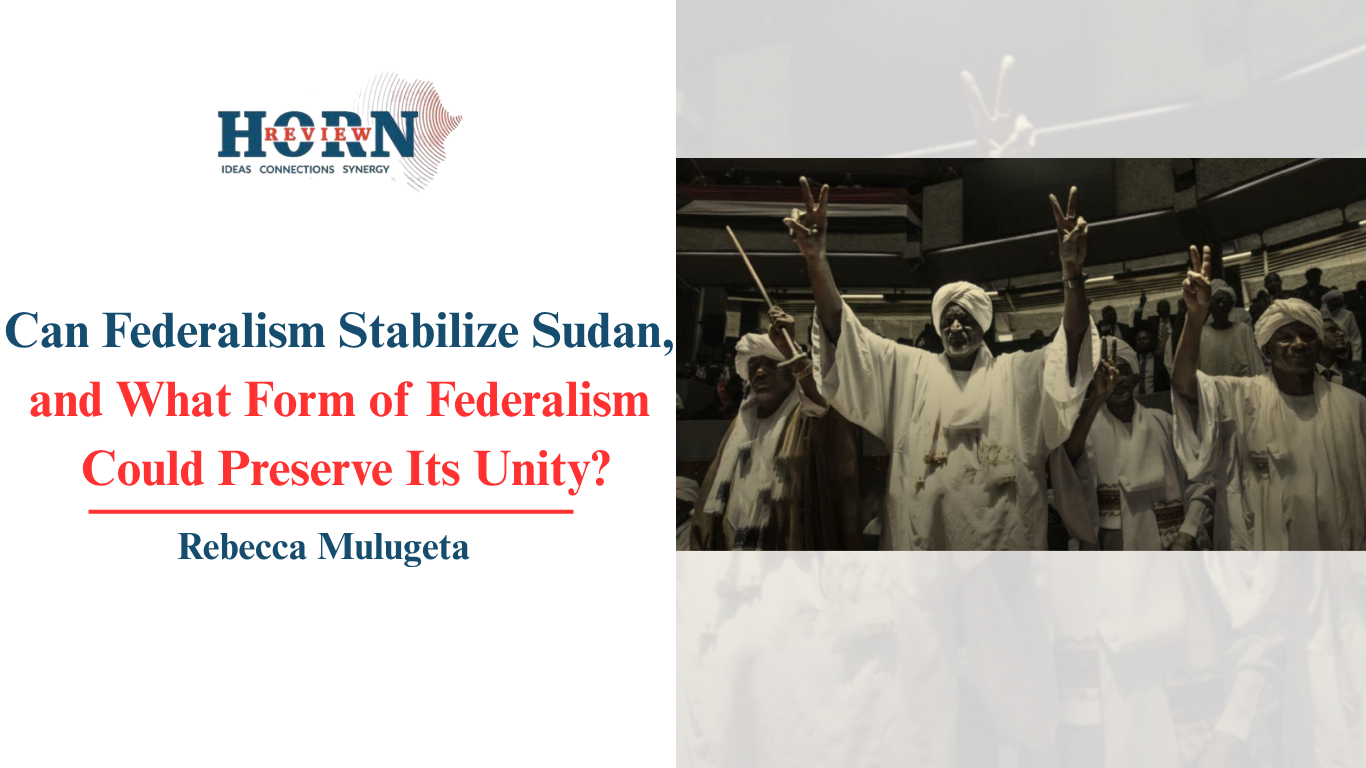
In Sudan, the war is no longer just about who wins between the Sudanese Armed Forces and the Rapid Support Forces; it has become the moment where the country’s entire political design is being tested and found wanting. What is collapsing is not only authority in Khartoum, but the long assumption that a deeply diverse and uneven society could be held together through central control, selective inclusion, and repeated military bargains. The conflict has pushed Sudan into a point where the real question is no longer who governs, but whether the idea of a single governing centre still holds meaning at all in a country where regions like Darfur, South Kordofan, and Blue Nile have repeatedly experienced the state not as a shared institution, but as a contested and uneven presence.
This is why the debate surrounding federalism has become increasingly urgent. Sudan is now confronting a question that many states only face after prolonged institutional breakdown: can the country still be governed through a centralized political system, or has the war already fragmented Sudan beyond the limits of centralized rule?
The answer is deeply uncomfortable for all sides of the political spectrum. Sudan’s old centralized model has clearly failed, yet federalism itself carries enormous risks in a country already fractured by war, displacement, militarization, and collapsing national trust. Sudan therefore finds itself trapped between two dangerous realities: the centralized state no longer possesses enough legitimacy to sustain national cohesion, but decentralization without functioning structured institutions could accelerate fragmentation even further.
What makes the current moment in Sudan so alarming is that the country is trying to rethink the future of the state while the foundations of that state are already weakening. Sudan spent years presenting itself as a federal republic, but the reality looked very different. While regional governments and state institutions formally existed, real political and military power remained concentrated in the central, where major decisions over security, resources, development, and governance were controlled by a small circle of central elites. For many regions, federalism never felt like genuine power-sharing, but rather a centralized system operating behind a federal label.
This imbalance became one of the structural drivers of Sudan’s recurring wars. Peripheral regions such as Darfur, South Kordofan, Blue Nile, and eastern Sudan repeatedly accused the state of political exclusion, unequal citizenship, economic marginalization, and cultural domination. Over time, armed rebellion became one of the few mechanisms available through which marginalized communities could force negotiations with the center. Violence increasingly replaced institutional politics as the language through which Sudan managed national contradictions.
The current war isn’t the root of Sudan’s crisis; it is the explosion of decades of structural tensions that previous governments chose to ignore rather than resolve. Today, those cracks have become chasms. Communities once held together by shared institutions are now being pulled apart by clashing wartime experiences and conflicting political narratives. As refugees settle across Egypt, Chad, South Sudan, and Ethiopia, they are beginning to view the conflict through the lens of their new, vastly different environments.
This matters enormously because federal systems require at least a minimal level of shared national belonging. Sudan currently suffers from a severe collapse of political trust not only between citizens and the state, but increasingly between communities themselves.
This is why simplistic calls either for “strong federalism” or “strong centralization” fail to capture the depth of Sudan’s crisis. Some Sudanese political actors argue that only a strong centralized military state can preserve national unity and prevent total fragmentation. Others insist that meaningful federalism is the only remaining mechanism capable of keeping Sudan together after decades of exclusionary governance. Yet both positions underestimate the complexity of the current moment.
The centralized state has already lost much of its governing capacity. At the same time, federalism introduced into a fragmented and militarized environment carries dangers. The core issue is that Sudan is no longer fragmented only politically. The fragmentation is now territorial, military, economic, institutional, and psychological. Large sections of the country are increasingly governed through localized security structures and informal wartime economies. Political loyalties are becoming more regionalized. Armed actors exercise authority in ways that often bypass national institutions entirely.
Under such conditions, federalism could either become a framework for renegotiating national coexistence or evolve into institutionalized fragmentation.
This depends largely on what type of federalism emerges and who controls the transition process. One of the most dangerous assumptions circulating in Sudanese debates is the belief that ethnic federalism offers a straightforward solution. Sudan contains more than 150 ethnic groups living across highly overlapping social, tribal, religious, pastoral, and urban spaces. Unlike states where major ethnic groups are territorially consolidated, Sudan’s demographic landscape is deeply intermixed. Attempting to reorganize the country strictly along ethnic lines after a catastrophic civil war could intensify border disputes, demographic fears, land conflicts, and resource competition.
More dangerously, rigid ethnic federalism in an already militarized environment could transform armed movements into permanent regional authorities. Instead of producing democratic decentralization, Sudan could gradually evolve into multiple militarized enclaves competing under the loose label of federalism.
This is why copying external federal models mechanically would likely fail. At the same time, returning to the previous centralized order is equally unrealistic. The old model did not preserve unity. It delayed fragmentation through coercive control while deepening regional resentment beneath the surface. Sudan’s repeated conflicts demonstrate that excessive concentration of political and military power in the center consistently produced instability rather than sustainable national cohesion.
The future of Sudan may therefore require a hybrid asymmetrical federal system built around territorial decentralization rather than rigid ethnic partition. Such a system would allow regions meaningful authority over governance, development planning, education, healthcare, cultural affairs, and local administration while preserving centralized control over national defense, monetary policy, foreign affairs, and strategic sovereignty. Revenue-sharing mechanisms would need constitutional guarantees to prevent the re-emergence of historical economic exclusion.
Yet even this model faces enormous challenges because Sudan’s crisis is not only about institutions. It is also about who controls political legitimacy.
Neither the Sudanese Armed Forces nor the Rapid Support Forces possess the legitimacy to oversee a federal reconstruction, as both are products of a militarized system focused on power accumulation rather than inclusive state-building. This creates Sudan’s central contradiction: a successful federal transition demands institutional trust and civilian legitimacy, yet the dominant actors remain military formations rooted in coercive force. Unlike more cohesive regional models like Egypt, Sudan’s security landscape is deeply fragmented with the SAF split by internal ideologies and the RSF operating through tribal and paramilitary networks making a genuine transition to civilian-led governance structurally improbable as local militias and armed groups increasingly hollow out the state’s authority.
Egypt’s military system historically developed through highly centralized institutional consolidation where the military became the dominant organizing pillar of the state itself. Sudan’s political history evolved differently. Despite repeated coups and authoritarian periods, Sudan maintained a far more pluralistic and contested political environment. Political parties, Islamist movements, unions, professional associations, tribal actors, armed groups, and civilian coalitions consistently remained active within public life. Even under military dominance, Sudan never fully transformed into a rigid single-party military republic.
While regional actors like Egypt push for centralized military rule to ensure strategic stability over border and Nile interests, this vision increasingly ignores the reality that Sudan’s old order is no longer governable. The political landscape has already shifted toward a messy, organic decentralization driven by new civilian alliances, local committees, and emerging formations like Tasis, making a return to the old Khartoum-centric model practically impossible. However, the path to a civilian-led future is blocked by internal fragmentation and the lingering influence of Islamist networks, who fear that federalism will dilute national identity and erode their traditional grip on the state. Ultimately, Sudan is caught in a high-stakes collision between external demands for a “manageable” military center and an internal explosion of regional and ideological diversity that refuses to be ignored.
The collapse of Islamist dominance has created a unique opening for negotiated decentralization, as no single faction can now claim total control. However, federalism is no magic fix; it will fail without genuine civilian leadership and a massive effort to rebuild the economy and social trust. This war marks the end of the old centralized military model that tried to force unity while ignoring the periphery; the center is now simply too weak and untrusted to lead.
Sudan’s historic transition requires a total redesign of national coexistence, testing whether a federal framework can convince fractured communities that staying together is better than splitting apart. But time is the enemy. As the war persists, localized power and war economies become more entrenched, risking a future where Sudan exists only as a name on a map while the actual state dissolves into permanent, irreversible fragments. Moving toward a civilian-led federal system is no longer just an ideological choice; it is a survival necessity.
This is why a civilian-led federal transition may become less a political choice and more a necessity for Sudan’s survival. Not because federalism automatically creates stability, but because the old centralized system has already broken down, and military rule alone can no longer keep the country together. A geopolitical form of federalism, built through civilian negotiations rather than military domination, could offer Sudan a chance to manage its deep regional divisions without pushing the state toward further collapse. But achieving that in the current phase of war is extremely difficult. If the competing actors remain unwilling to sit together and negotiate seriously, even federalism itself may not be enough to prevent deeper fragmentation.
By Rebecca Mulugeta, Researcher, Horn Review

RELATED
Posts
2
Sep
Drought, Flood, and War: The Greater Horn’s Narrowing Room for Failure
A moderate to strong El Niño is now settling over...
2
Sep
AQAP Mediation and the Normalization of Cross Sectarian Jihadi Logistics
The relationship between the Houthi movement in Yemen and...
2
Sep
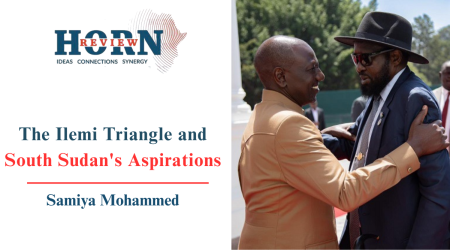
The Ilemi Triangle and South Sudan's Aspirations
The recent pronouncements by South Sudan's Vice President Taban...
2
Sep
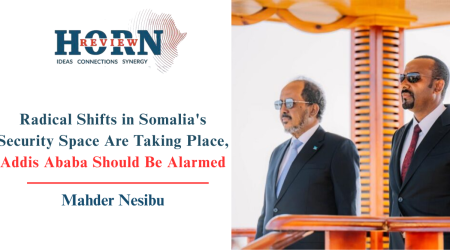
Radical Shifts in Somalia's Security Space Are Taking Place, Addis Ababa Should Be Alarmed
The presidency of Hassan Sheikh Mohamud, who returned to Villa...
31
Aug
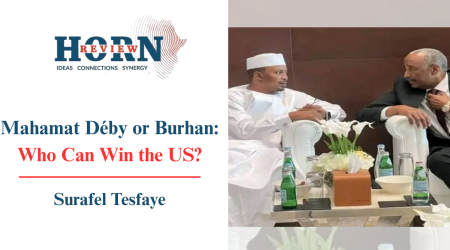
Mahamat Déby or Burhan: Who Can Win the US?
On August 20, 2026, Sudanese warplanes and drones pursued a...
31
Aug
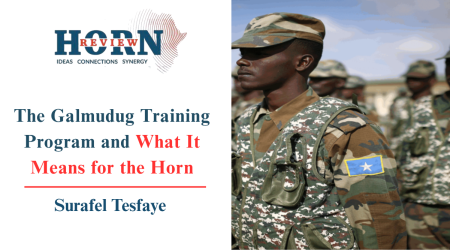
The Galmudug Training Program and What It Means for the Horn
In August 2026, approximately 3,000 Somali soldiers graduated from the...
31
Aug
Saudi Arabia's Recalibrated Engagement in Sudan and the Red Sea
The presentation of diplomatic credentials is ordinarily a procedural formality...
31
Aug
The Eritrean Regime’s Human-Trafficking Industry
For more than two decades, Isayas Afeworki’s regime has presented...
30
Aug
The Red Sea Transformation and Ethiopia’s Maritime Renaissance
The formation of the Horn of Africa is undergoing a...