The Practical Recognition of Somaliland in U.S. Foreign Policy
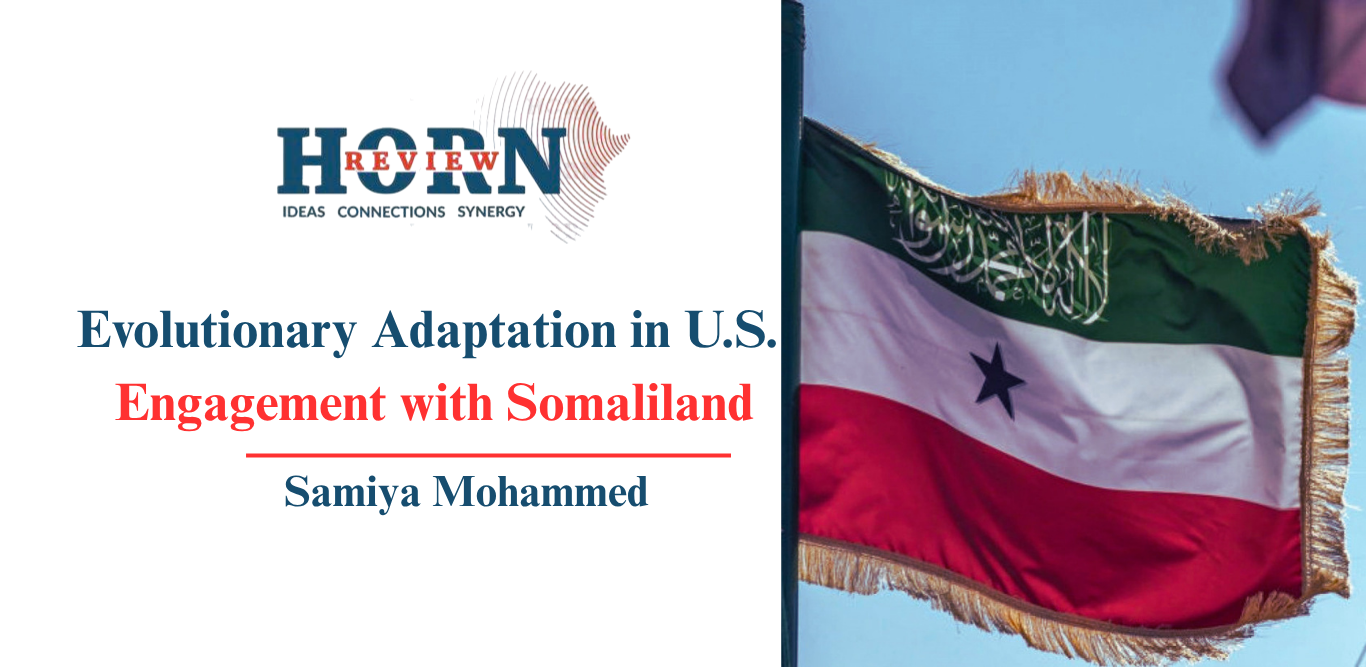
Recent policy discussions and assessments reveal a subtle but increasing shift in how the United States evaluates Somaliland’s regional role. While official American policy continues to affirm Somalia’s territorial integrity and sovereignty, developing policy language, references and practical engagement patterns suggest a growing recognition of Somaliland’s functional value as a reliable security and economic partner. This evolution does not form a revolutionary departure from U.S. policy nor does it imply imminent diplomatic recognition but it reflects an incremental and practical recalibration in which Somaliland’s demonstrated stability, governance capacity and geography are receiving greater attention.
The importance of this development rests not in formal legal recognition but in the gradual distinction appearing between legal doctrine and operational practice. The document under consideration contributes to this surfacing narrative by presenting Somaliland not as a diplomatic anomaly but as a practical asset. It highlights Berbera in positive terms describing its potential role as an alternative to congested regional facilities and accentuating its value as a trade and transportation space. Such language is relevant because infrastructure assessments often reveal underlying priorities more clearly than explicit political statements.
Importantly however the document does not advocate a radical transformation of U.S. policy. Its language remains cautious, measured and deliberately conservative. This restraint reflects an awareness of the diplomatic sensitivities surrounding Somaliland’s status. Any abrupt shift toward recognition would risk generating tensions with the Federal Government of Somalia in Mogadishu while potentially complicating broader American objectives in the region. This balancing act is perhaps the most revealing aspect of the emerging policy approach. Rather than choosing between full recognition and complete diplomatic neglect, it increasingly appears to be pursuing a middle path. Under this Somaliland’s practical contributions can be acknowledged, supported and incorporated into regional planning while the formal legal position remains unchanged.
The distinction between formal recognition and functional engagement is particularly important because it highlights the evolutionary rather than revolutionary nature of current developments. Evolutionary change occurs through gradual adjustments in policy emphasis, operational cooperation, and assessment. It is often reflected in how institutions allocate attention, resources and political capital rather than in public announcements. The document shows this phenomenon by incrementally elevating Somaliland’s relevance without fundamentally altering the legal framework within which U.S. policy operates.
This evolution also reflects trends in contemporary international relations. Increasingly, states evaluate partners based on performance, reliability and utility rather than solely on formal diplomatic status. In regions usually in governance challenges and security threats, practical effectiveness often becomes a critical factor in determining engagement priorities. Somaliland’s relative success in maintaining stability, supporting counterterrorism objectives and facilitating economic activity positions it favourably within such.
Nevertheless, the document simultaneously conveys an important cautionary message for Somaliland itself. While geography remains an advantage, location alone is insufficient to guarantee sustained international engagement or political advancement. Relevance must be actively leveraged through deeper political, economic and security alignment with external partners. The value of Berbera’s location for example derives not just from its physical position but from the institutional, commercial, and security frameworks that enable it to function as a reliable region.
In this regard the document implicitly suggests that Somaliland’s future influence will depend not only on where it is located but also on how effectively it continues to demonstrate governance competence, economic openness and reliability. International actors are increasingly willing to engage capable partners but such engagement is ultimately contingent upon sustained performance. geography may create opportunities but institutional effectiveness determines whether those opportunities can be translated into lasting political and economic gains.
Another implication of the document concerns regional competition. It indirectly increases pressure on neighbouring states and facilities to maintain their competitive advantages. This is particularly relevant for Djibouti, in which the recognition of alternative infrastructure and access points does not diminish Djibouti’s importance but it does signal a growing interest in diversification. The resulting policy posture is therefore best understood as one of deliberate practicality. The United States appears increasingly willing to engage Somaliland as a functional partner in areas where interests align particularly in matters related to security, trade, transportation and regional stability. At the same time continues to preserve the legal fiction or more precisely the diplomatic framework of Somalia unity in order to avoid destabilizing regional relationships and established international norms. This duality allows to reconcile practical realities with diplomatic constraints.
The document supports a narrative of rising American pragmatism toward Somaliland’s value. It does so not through explicit political declarations but through the implications of priorities and framing. The positive assessment of Berbera, the recognition of Somaliland’s relative stability and the emphasis on practical utility all point toward an increasingly consequential role for Somaliland within American thinking. However this shift remains carefully calibrated, evolutionary rather than revolutionary and deliberately designed to avoid diplomatic rupture with Somalia.
This approach should not be underestimated. While formal recognition remains absent practical recognition of capability and reliability is becoming increasingly evident. U.S. policy appears to be moving toward a position in which Somaliland is treated less as a peripheral political question and more as a relevant actor whose contributions to regional security and economic development deserve serious consideration. Such a transformation may not alter legal realities in the immediate future but it does suggest a growing convergence between necessity and policy practice. In that sense the document presents not as policy breakthrough but an important marker of an evolving American understanding of Somaliland’s place within the geopolitics of the Horn.
By Samiya Mohammed, Researcher, Horn Review