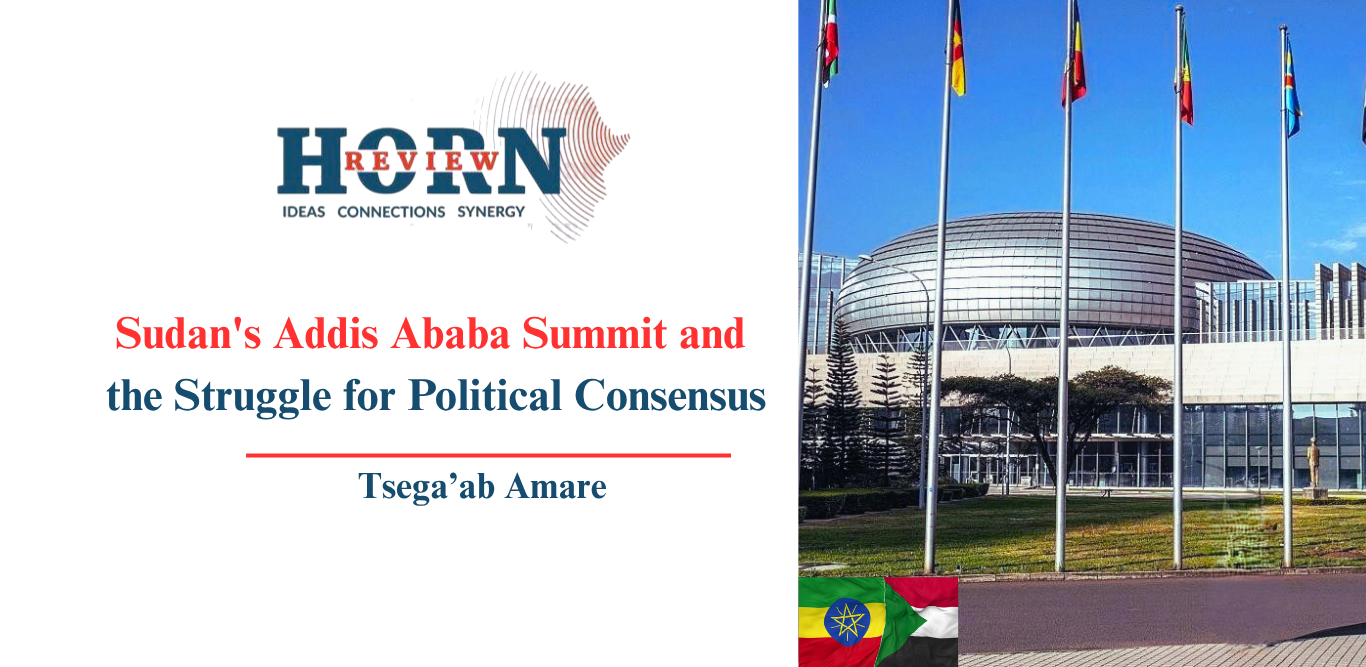
The dialogue that opened in Addis Ababa on Wednesday under the auspices of the quintet mechanism are already more complicated than their format suggests. After months of consultations and a near postponement triggered by disputes over delegate composition, the five-party international body has managed to seat representatives from groups aligned with both the SAF and the RSF-affiliated Tasis alliance, for a two-day diplomatic summit. Civilian opposition movements are also present. At the center of the Addis Ababa discussions is the effort to create a joint preparatory committee that can serve as an institutional bridge toward an inclusive Sudanese-led peace process, with responsibility for organizing subsequent national negotiations.
By the standards of Sudan’s diplomatic moves over the past three years, this can be taken as a notable threshold. Most previous initiatives have either excluded one of the armed camps or collapsed before reaching meaningful engagement. What makes the present moment analytically significant is not only that these parties are present but also that they very nearly were not.
The nature of this summit should be specified clearly as it is important to distinguish between the summit’s orientation of political dialogue and ceasefire negotiations. The language of a “preparatory committee” signals that the objective is to build a framework for future talks rather than immediately resolve military arrangements. That distinction matters because it shapes how the outcome should be assessed.. If the committee forms and receives a credible mandate, the summit will have contributed something structurally durable. If it produces a joint statement without institutional follow through, the meeting will be absorbed into the long list of Sudanese peace efforts that generated documentation without transformation.
The structural problem underlying all of this remains unchanged. Neither the SAF nor the RSF has reached the point of battlefield exhaustion that typically makes armed actors willing to accept genuine compromise. External support continues to sustain both sides militarily and financially. Political talks that proceed while military commanders believe they can still achieve their objectives tend to function as parallel tracks rather than genuine negotiations. The political representatives in Addis Ababa and the generals directing operations inside Sudan occupy different strategic universes. Bridging that gap is the central challenge that no summit format, however inclusive, can resolve by itself.
The pre-conference dynamics revealed the depth of the challenge ahead. According to Sudan Tribune, the African Union, IGAD, and the Arab League raised objections in the days before the meeting over the composition of participating groups and the allocation of delegates, briefly threatening to delay the process. The Somoud alliance, led by former Prime Minister Abdalla Hamdok, was separately accused by the ‘Civil Front to Stop the War and Restore Democracy’ of pressuring organizers to limit recognized blocs to three formations and exclude other political actors. The Civil Front subsequently announced a boycott. That disputes of this magnitude emerged before the conference had even convened illustrates how deeply contested the architecture of participation remains.
The fissures within the Democratic Bloc were equally revealing. On the eve of the talks, a faction within the alliance announced a boycott in protest over the inclusion of the RSF-linked Tasis alliance and broader concerns regarding the structure of the process. Nevertheless, a delegation arrived in Addis Ababa with the approval of bloc leadership, including chairman Jafar al-Mirghani and Minni Arko Minnawi. The participating delegation left little ambiguity about its position on Tasis. Mubarak Ardol, speaking ahead of the opening session, said the bloc’s rejection of the alliance stemmed from the violations committed in Sudan and ruled out any political engagement with it. Sally Zaki, another bloc representative, argued that dialogue should ultimately take place inside Sudan and criticized the proliferation of initiatives that, in her view, has complicated rather than resolved the crisis.
The Tasis question is perhaps the clearest illustration of the dilemma confronting the Addis process. As a political coalition aligned with the RSF and its allies, Tasis embodies the Quintet’s effort to ensure that constituencies associated with both sides of the conflict are represented in the dialogue. Yet the very logic of inclusion that makes Tasis central to the process also makes it one of its most controversial elements. For its opponents, participation alongside the alliance risks normalizing a political actor closely associated with one of the principal belligerents. For the organizers, excluding it would undermine claims that the process is sufficiently representative of Sudan’s fragmented political landscape.
The dispute therefore extends beyond disagreement over a single coalition. It reflects a deeper and more consequential question confronting every major Sudanese peace initiative since the outbreak of war: who possesses the legitimacy to participate in shaping a future political settlement? The challenge is no longer simply persuading actors to attend negotiations. It is determining which actors are entitled to be recognized as legitimate stakeholders in the first place. The controversy surrounding Tasis demonstrates that no consensus yet exists on that question.
The debate over participation is further complicated by competing understandings of ownership and legitimacy. Critics of externally hosted initiatives frequently argue that negotiations conducted abroad empower political elites detached from realities inside Sudan. Yet the security environment currently makes a nationwide political dialogue of this scale virtually impossible to organize domestically. This has created a persistent paradox at the heart of Sudan’s peace efforts: nearly every political actor endorses the principle of Sudanese ownership, while the conditions created by the war prevent such a process from taking place inside the country. Recognizing these constraints, the Quintet mechanism has framed the Addis meetings as the opening stage of a longer political track, with a second round scheduled for July 8–9 in Addis Ababa and additional sessions expected to follow.
Viewed collectively, these disputes suggest that the principal challenge facing the Addis process is not merely reconciling competing visions for Sudan’s future. It is establishing agreement on the rules of participation themselves. Before substantive questions of governance, security arrangements, or constitutional design can be addressed, Sudan’s political actors must first resolve a more immediate question: who has the authority and legitimacy to negotiate on behalf of the country’s fractured political landscape. The controversies surrounding representation, delegate allocation, and the inclusion of Tasis indicate that this foundational issue remains far from settled.
Ethiopia’s decision to host the process is significant beyond Sudan’s immediate crisis. By convening the dialogue in Addis Ababa under African institutional sponsorship, the organizers are attempting to anchor the initiative within a regional framework rather than an externally driven one. The repeated emphasis on a “Sudanese-led dialogue process” reflects an implicit recognition that previous initiatives have often struggled to secure sufficient domestic legitimacy. Whether this process can overcome that challenge remains uncertain. At the same time, Ethiopia’s own reading of the crisis in Sudan underscores its wider concern with regional stability in the Horn, where political fragmentation in Khartoum is seen as inseparable from the broader security and diplomatic equilibrium of the neighborhood.
The most important metrics for evaluating this summit will not emerge from the conference hall. The questions that matter are whether the preparatory committee actually forms, whether its composition commands broad legitimacy, and whether it survives the period between this conference and the next. Interim mechanisms are most vulnerable in the gaps between high-profile meetings, when political momentum fades and military incentives reassert themselves.
For the broader region, the stakes extend well beyond Sudan’s internal dynamics. A fragmented and ungoverned Sudan creates cascading pressures across the Horn and the Nile Basin, disrupting trade, generating refugee flows, and creating operational space for actors whose interests are not aligned with regional stability. The Red Sea corridor’s strategic calculus shifts with every month that Sudan’s state capacity continues to erode.
Whether this summit becomes a turning point or another entry in the diplomatic record will depend on decisions made in the weeks that follow. The real test has now moved from whether Sudan’s factions can be brought into the same room, but whether they can agree on who has the authority to speak for Sudan’s future once they arrive.
By Tsega’ab Amare, Researcher, Horn Review