
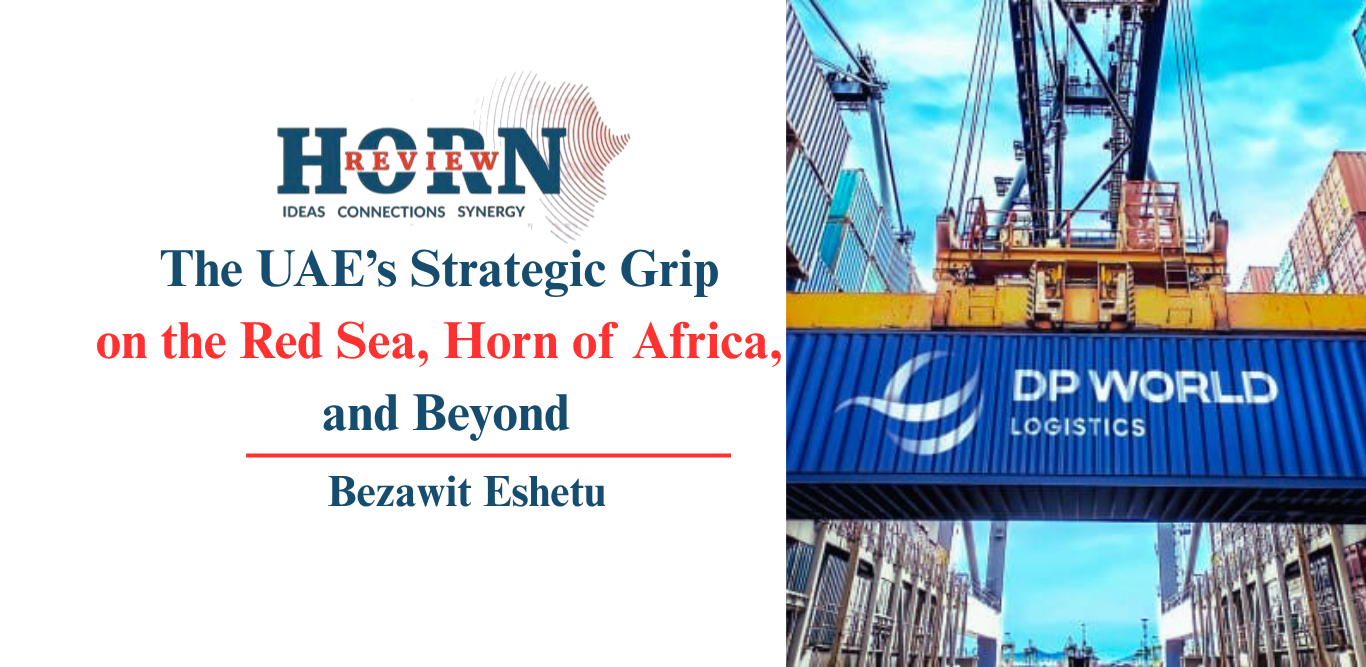
The UAE’s Strategic Grip on the Red Sea, Horn of Africa, and Beyond
The United Arab Emirates’ systematic acquisition of maritime infrastructure along the Red Sea, the Mediterranean, and the Horn of Africa represents a strategic breakout from its native geographical constraints. Geographically confined to the shallow waters of the Persian Gulf and structurally dependent on the vulnerable Strait of Hormuz, a maritime chokepoint exposed to Iranian military posturing, Abu Dhabi has deployed state-backed capital to assemble a contiguous virtual coastline. This expansive strategy goes beyond accumulating commercial seaport assets.
It leverages logistics to project power, insulate critical supply chains, and alter the regional balance of power. By embedding entities like DP World, AD Ports Group, and the sovereign wealth fund ADQ into the domestic infrastructure of neighboring states, the UAE ensures that global capital, military assets, and trade must interface with Emirati infrastructure. This footprint offsets domestic geographical vulnerabilities while establishing asymmetric leverage over regional states and countering Saudi Arabia’s economic ambitions.
To understand this strategic expansion, the limitations of the UAE’s primary geography must be examined. The Persian Gulf functions as a geostrategic cul-de-sac where maritime exit is entirely dictated by the Strait of Hormuz. Any acute security crisis or asymmetric disruption within this narrow corridor threatens to halt the UAE’s economic lifelines instantly, freezing petroleum exports and choking its import-dependent domestic market.
Consequently, acquiring port concessions along external maritime highways is a core national security imperative rather than a standard commercial pursuit. By securing functional control over vital nodes outside the Persian Gulf, Abu Dhabi effectively decouples its macroeconomic resilience from the volatile dynamics of its immediate neighborhood.
The physical bypass of Hormuz begins at the extraction source in Abu Dhabi’s onshore fields, such as Habshan. Rather than loading crude onto tankers within the confined Persian Gulf, the UAE utilizes the Abu Dhabi Crude Oil Pipeline, a 403-kilometer overland conduit transporting up to 1.8 million barrels per day directly to Fujairah on the Gulf of Oman. By terminating outside the Persian Gulf, this pipeline allows the UAE to load crude onto Very Large Crude Carriers directly into the open Arabian Sea. Abu Dhabi has fast-tracked the West-East Pipeline expansion, on track to double export capacity through Fujairah, further minimizing Hormuz dependency.
Once oil is loaded at Fujairah, tankers traverse the Arabian Sea and enter the Gulf of Aden, approaching the contested Bab al-Mandeb strait. This is where the UAE’s infrastructure footprint in Berbera in Somaliland and Bossaso in Puntland serves an operational security function. DP World signed a 30-year concession to manage Berbera port in 2016, investing $442 million and controlling 65% of the joint venture. DP World also signed an agreement with Puntland in 2022 to upgrade Bossaso port. These ports act as fortified maritime staging grounds. In the event of tactical foreclosure or asymmetric drone threats within Bab al-Mandeb, these Horn of Africa terminals provide ship-to-ship transfer capabilities and protected anchorage outside the immediate danger zone.
The UAE’s port acquisitions effectively ring-fence the maritime trade flanks of its primary regional rival, Saudi Arabia. Viewed on a map, Emirati investments establish a deliberate geo-economics enclosure of the Arabian Peninsula. To the east, Fujairah provides an immediate exit to the Gulf of Oman, completely bypassing Hormuz. To the south, the UAE has cultivated influence over critical maritime outposts including Socotra Island, where the UAE-backed Southern Transitional Council took control in June 2020. To the west, Emirati conglomerates hold significant stakes across Egypt’s Red Sea seaboard, while to the north, AD Ports Group signed a 30-year concession in February 2026 to operate Jordan’s Aqaba multipurpose port, Jordan’s sole maritime outlet. Riyadh interprets this sprawling architecture as strategic encirclement designed to constrain Saudi Arabia’s Vision 2030 ambitions.
To counter this perceived Emirati encirclement, Saudi Arabia and Egypt have converged around a defensive counter-axis grounded in the littoral state principle. The core argument holds that only countries with an actual coastline on the Red Sea should determine its long-term security and governance. Because the UAE sits exclusively on the Persi an Gulf, this framework is designed to exclude Abu Dhabi from the region’s emerging maritime policing regimes. In January 2025, Egyptian Foreign Minister Badr Abdelatty stated that it is completely unacceptable to allow any military or naval presence by non-littoral states. By institutionalizing this principle through multilateral bodies, Egypt and Saudi Arabia are seeking to legally delegitimize the role of non-littoral powers in Red Sea security councils.
The ongoing civil war in Sudan has emerged as the clearest proxy flashpoint in this broader contest. The UAE has been accused of providing financial and logistical backing to the Rapid Support Forces, while Saudi Arabia and Egypt have thrown their diplomatic and financial weight behind General Abdel Fattah al-Burhan and the Sudanese Armed Forces. By supporting the central military authority, Cairo and Riyadh are working to ensure that Sudan’s 500-mile Red Sea coastline, especially the strategic hub of Port Sudan, remains out of Emirati hands. In November 2024, Sudan canceled a $6 billion agreement with the UAE to develop the Abu Amama port and enterprise zone, citing UAE support for the RSF.
This contest over Sudan also exposes a deeper contradiction in the UAE’s maritime strategy: Abu Dhabi often relies on fragmented local authorities to secure coastal footholds, yet ports require stability and legal certainty to generate lasting commercial value. In January 2026, the London Court of International Arbitration ruled in favor of Djibouti in its long-running dispute with DP World, rejecting a $1 billion damages claim and ending a seven-year tension. By accelerating the very fragmentation that undermines regional shipping confidence, the UAE risks pushing global shipping lines away from the Red Sea corridor and toward the longer route around the Cape of Good Hope.
A key tension in the UAE’s maritime strategy is that coastal expansion often depends on partnerships with local authorities operating in fragmented political environments. In places such as Somaliland, Yemen’s Southern Transitional Council, and Sudan’s Rapid Support Forces, these arrangements can provide early access to strategic assets, but they also unfold in settings where governance remains contested and fragile. Ports, however, depend on stable political conditions and clear legal frameworks to sustain long-term commercial value.
In January 2026, the London Court of International Arbitration ruled in favor of Djibouti in its long-running dispute with DP World, rejecting a $1 billion damages claim. More broadly, efforts to secure footholds in politically unsettled areas can deepen uncertainty in ways that ultimately undermine shipping confidence and encourage carriers to reroute around the Cape of Good Hope.
Recognizing that static ports remain vulnerable to sea-lane closures, the UAE’s ultimate exit strategy involves a structural shift from traditional maritime shipping to multimodal networks. The true objective connecting the acquisition of Egyptian ports, the Abraham Accords, and Mediterranean developments is creating a unified overland land-bridge. This infrastructure combines rail and trucking corridors running from Persian Gulf ports through Saudi Arabia and Jordan to the Mediterranean coast. By controlling both physical maritime entry points and digital logistics software, such as DP World’s global trade platforms, the UAE aims to transform itself into the operating system of Middle Eastern commerce.
This integration alters the security calculus regarding Saudi Arabia. Rather than engaging in a zero-sum infrastructure race, the UAE embedded DP World directly within the operational fabric of the Jeddah Islamic Port through a 30-year concession awarded in 2019, investing up to $500 million to modernize the South Container Terminal. In 2026, DP World retained a 62.5% majority shareholding at this facility after selling a minority stake to Maersk. This integration allows Abu Dhabi to financially capitalize on Saudi Arabia’s economic expansion while acquiring real-time data visibility over the Kingdom’s trade volumes. Even as Saudi Arabia asserts regional economic dominance, its primary maritime gateway remains structurally dependent upon Emirati logistical management systems and capital.
At the northernmost tip of the Red Sea complex, the UAE secured a vital foothold in the Gulf of Aqaba through the February 2026 AD Ports agreement to operate Jordan’s Aqaba multipurpose port, with AD Ports holding 70% ownership. This serves as an indispensable geostrategic overland bypass. In the event of an extended Suez Canal closure, Aqaba functions as the maritime trailhead for a multimodal transit corridor traversing Jordan into Iraq and the Eastern Mediterranean. This infrastructure footprint places Emirati assets immediately adjacent to Saudi Arabia’s NEOM megaproject, serving as both a collaborative economic bridge and a surveillance post. Monopolizing this node grants Abu Dhabi leverage over Jordan’s fragile economy, allowing influence projection into the Levant without navigating Syria or Lebanon.
Directly across the water, the UAE has transformed Egypt’s eastern seaboard into the western wall of its maritime corridor. At the northern apex, AD Ports Group signed initial agreements in March 2022 to oversee Ain Sokhna Port’s development. In June 2024, Egypt signed concession agreements with AD Ports Group for cruise terminals at Safaga, Hurghada, and Sharm El-Sheikh, with AD Ports committing $4.7 million over 15 years. AD Ports also signed a 30-year concession in 2023 to develop and operate Safaga Port, investing up to $200 million. Further down the coast, investments in multipurpose terminals across Safaga and Hurghada convert Egypt’s foreign currency engines into reliable revenue streams for Emirati sovereign wealth funds. This coastal saturation includes tactical positions at Sharm El Sheikh overlooking the Straits of Tiran, ensuring comprehensive monitoring of naval movements affecting Israeli, Jordanian, and Saudi maritime access.
The integrated architecture transcends the Red Sea basin through the acquisition of Ras Al Hekma on Egypt’s Mediterranean coast. In February 2024, Egypt and the UAE signed a landmark $35 billion investment deal, with ADQ leading a consortium injecting $24 billion for Ras Al Hekma development and $11 billion for projects across Egypt. The project is expected to generate up to $150 billion, with Egypt retaining a 35% stake. This multi-billion-dollar sovereign financial injection prevented Egypt’s sovereign default, formalizing Cairo’s position as a structural dependency of Emirati capital.
Geopolitically, pushing infrastructure development westward toward Marsa Matrouh creates a secure, UAE-managed buffer zone adjacent to volatile Libya. By establishing a smart-city logistics gateway on the Mediterranean that bypasses the Suez Canal and targets European markets, the UAE transitions from a Middle Eastern actor to a transcontinental maritime power.
The final stage of the integrated energy corridor leverages Egypt’s geographic assets to reach Western buyers. Tankers carrying Emirati crude discharge at Ain Sokhna, located at the southern gate of the Suez Canal. From Ain Sokhna, oil is pumped into the Suez-Mediterranean pipeline, known as SUMED, a 320-kilometer overland conduit crossing northern Egypt to the Mediterranean port of Sidi Kerir near Alexandria. The pipeline consists of two parallel 42-inch lines with a total capacity of 2.5 million barrels per day, providing an alternative to the Suez Canal for transporting oil from the Persian Gulf region to the Mediterranean. This pipeline network short-circuits the congested Suez Canal, allowing the UAE to transport massive volumes of crude directly to the Mediterranean basin, aligning with the Ras Al Hekma development and establishing an end-to-end logistical sequence where energy products reach European markets without interacting with the Strait of Hormuz.
The totality of these interconnected maritime acquisitions reveals a profound shift in the Middle Eastern balance of power. The United Arab Emirates has executed a sophisticated strategy to neutralize its inherent geographic vulnerabilities, transforming waters that once isolated it into conduits of sovereign power. By monopolizing vital chokepoints, transit routes, and Mediterranean exits from the Horn of Africa to the Levantine basin, the UAE has fundamentally transcended traditional land-based territorial sovereignty. Abu Dhabi ensures that regardless of which nation holds political or military primacy, the physical arteries of global commerce and strategic mobility are governed by Emirati infrastructure. This deep economic entanglement guarantees that the geopolitical trajectory of the Middle East, the Red Sea, and the North African coast will be guided by the omnipresent leverage of the United Arab Emirates.
By Bezawit Eshetu, Researcher, Horn Review

RELATED
Posts
7
Oct
“Decaffeinated Sovereignty”: Eritrea’s One-Way Street with Ethiopia
There is a peculiar contradiction at the heart of Eritrea’s...
7
Oct
Eritrea Has Officially Invaded Ethiopia, Says Government Communication
Ethiopian Government Formally Condemns Eritrean Territorial Incursion as Its Forces...
7
Oct
Turkey, Somalia and the Transactional Reading of Alamein
The Alamein Declaration functions less as a coherent framework...
7
Oct
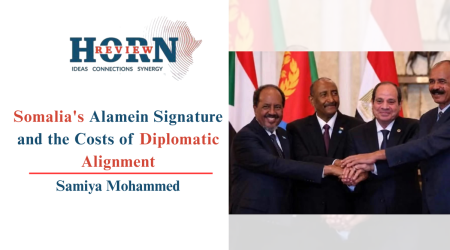
Somalia's Alamein Signature and the Costs of Diplomatic Alignment
The Alamein Declaration between Egypt, Sudan, Eritrea and Somalia...
6
Oct
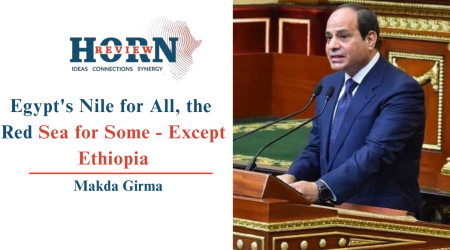
Egypt's Nile for All, the Red Sea for Some - Except Ethiopia
The contradiction was laid out almost perfectly at El Alamein....
6
Oct
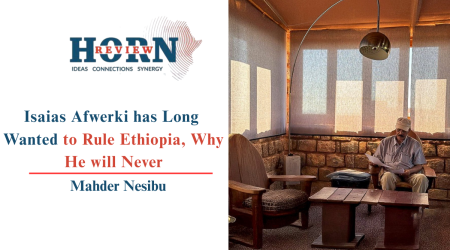
Isaias Afwerki has Long Wanted to Rule Ethiopia, Why He will Never
President Isaias Afwerki is among the most enduring figures in...
6
Oct
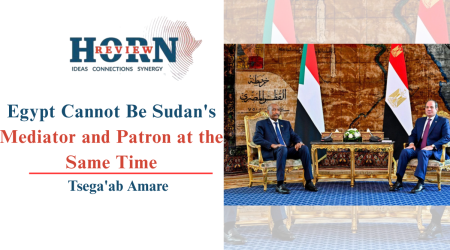
Egypt Cannot Be Sudan's Mediator and Patron at the Same Time
Abdel Fattah el-Sisi received Abdel Fattah al-Burhan in New...
6
Oct
Afwerki Calls for Non-Interference in Sudan as Eritrean Soldiers Continue Fighting for SAF
At the New Alamein summit in October 2026 Eritrean...
6
Oct
Sisi’s Sovereignty Sermon and the Proxy War Next Door
In New Alamein this past weekend, Egyptian President Abdel Fattah...
5
Oct
Egypt Displays Its Anti-Addis Coalition as Ethiopia Gains Against Rebels. What Comes Next?
Egypt's strategy of cultivating relationships around its chief rival in...