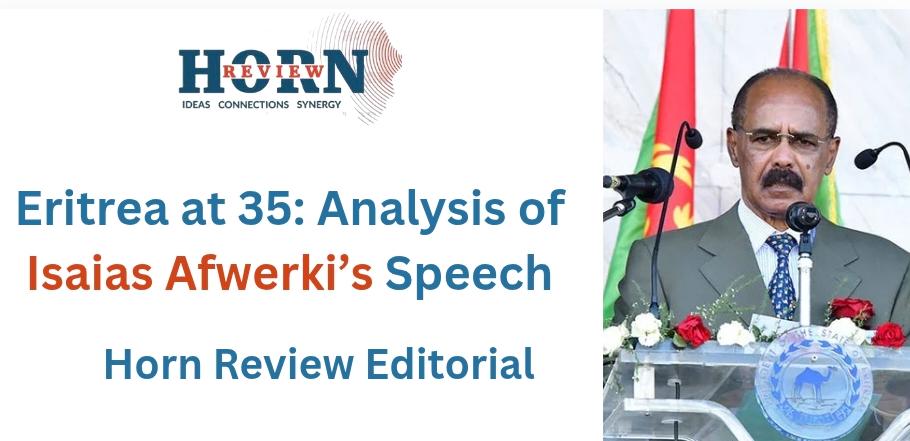
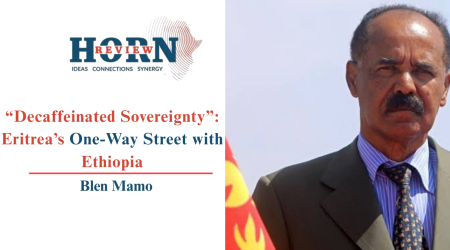
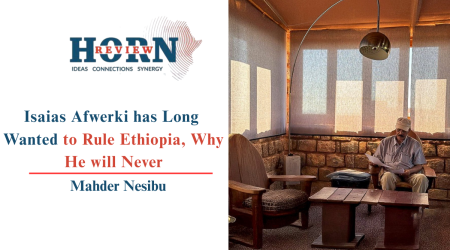
Isaias Afwerki’s address on the 35th anniversary of Eritrea’s secession from Ethiopia presents itself as a sweeping intervention in global affairs, yet it is equally an exercise in self-positioning – an attempt to speak not as the head of a small, highly centralized Red Sea state, but as a systemic critic of the international order and an interlocutor of great-power politics. The rhetorical architecture of the speech is thus inseparable from its political psychology: it attempts to elevate Eritrea’s voice into the register of global adjudication while leaving the empirical record of domestic state formation largely unaddressed. The substance of the address is dominated by a sustained critique of the United States, Western-led financial governance, and the perceived asymmetries of international law, particularly in relation to nuclear weapons and the treatment of Iran. Afwerki’s questioning of why certain states are permitted to retain nuclear arsenals while others are excluded is not presented as a narrow policy objection but as an indictment of the moral incoherence of the entire post–Cold War order. In the same register, the global financial system is characterized as an apparatus of structural dependency, sustained by institutional interests rather than developmental equity. These are not random critiques; they form a coherent ideological posture that situates Eritrea within a broader tradition of radical anti-hegemonic and quasi-socialist international thought, where sovereignty is defined in opposition to Western institutional dominance rather than through integration into it, or any form of regional or global governance architecture.
Yet what distinguishes this address is not merely its ideological content, but the scale of its self-representation. The speech consistently assumes the tone of a state speaking from systemic parity with major powers, rather than from the material and institutional position of a small state whose post-secession trajectory remains marked by contested outcomes in governance, economic development, and institutional consolidation. This inflation of geopolitical standing is not simply rhetorical excess; it is constitutive of a leadership style in which symbolic equivalence to global actors becomes a substitute for domestic benchmarking. Within this framing, regional instability across Ethiopia, Somalia, Sudan, and South Sudan is attributed primarily to ethnic fragmentation and external interference, while proposals for a Red Sea security architecture are advanced as expressions of sovereign regionalism insulated from outside influence. The analytical pattern is consistent: causality is externalized, and systemic disorder is framed as a product of foreign intrusion rather than the interplay of internal and regional political dynamics. This allows the speech to maintain moral clarity at the level of critique, while avoiding comparable scrutiny at the level of governance performance. What is notably absent from this architecture is any sustained reckoning with the role that Eritrea itself has been accused of playing within the very regional crises it diagnoses.
Over the years, the state under President Isaias Afwerki has faced repeated allegations from regional actors, international observers, and multilateral reports of involvement – direct or indirect – in neighboring conflicts, including accusations related to support for non-state armed groups in Somalia, for which Eritrea was at one point subjected to United Nations sanctions. Similar allegations have been raised in relation to the conflict in northern Ethiopia, where reports by international human rights bodies have cited the presence of Eritrean forces and alleged serious violations during the Tigray war period, leading to renewed international scrutiny and sanction. More recently, observers have also pointed to Eritrea’s evolving alignment within the Sudanese conflict, including claims of strategic positioning alongside elements of the Sudanese Armed Forces, as well as broader concerns regarding the permeability of borders and the use of regional air and land corridors in ways that deepen the militarization of an already fragmented theatre. In parallel, historical tensions with neighboring states such as Djibouti, and the long-running entanglement with Ethiopia’s internal political fault lines – including shifting relations with factions associated with the Tigray People’s Liberation Front, Fano militias and other armed actors – continue to inform perceptions of Eritrea as an active, and at times destabilizing, participant in regional power contests. The significance of these assessments lies in what they reveal about the asymmetry of Afeworki’s speech’s moral geography. The same discourse that attributes instability overwhelmingly to external interference does not engage, even at the level of acknowledgment, with the accumulated body of accusations and counter-accusations that situate Eritrea not only as an object of regional instability but also as an active agent within it. The omission is therefore not merely selective; it is constitutive of a narrative in which responsibility is consistently projected outward.
The same logic extends to his discussion of United States policy under Donald Trump, where a wide-ranging critique of American foreign policy in Latin America, fiscal sustainability, and tariff strategy is deployed to reinforce the argument of structural Western decline. Yet this intervention carries an additional layer of political signaling that cannot be ignored. At a moment when Washington is reportedly reconsidering the easing of sanctions on Eritrea, the timing and tone of such expansive criticism acquire a strategic ambiguity. It introduces uncertainty into what might otherwise be interpreted as a gradual recalibration of relations. Whether this reflects a deliberate posture or a recurrent pattern is secondary to the perception it generates: that engagement with Eritrea remains contingent not only on policy shifts but on the volatility of its leadership’s external messaging. It is in this tension that Afwerki’s political persona becomes most visible. His discourse oscillates between systemic critique and personalized assertion, between structural analysis and declarative moral judgment. The result is a leadership style that is at once ideologically assertive and strategically unpredictable – one that resists easy categorization but consistently attempts to reassert itself as intellectually and morally positioned above both its regional peers and the constraints typically associated with small-state diplomacy.
Critically, this posture coexists with a persistent absence of public, measurable accounting for 35 years of state formation. The address does not substantively engage the material record of Eritrea’s domestic evolution – whether in institutional depth, economic transformation, educational expansion, healthcare capacity or regional posture and global standing. This omission is persistent and functional: it allows the leadership narrative to remain anchored in external critique rather than internal evaluation, in global contradiction rather than domestic performance. Seen in this light, the speech is not simply a commentary on world affairs. It is an act of positioning – one that constructs Eritrea as a moral and ideological interlocutor of global systems while simultaneously eliding the asymmetry between that aspiration and the lived realities of a small state whose post-secession trajectory remains contested. The effect is a carefully sustained duality: radical in its critique of Western dominance, expansive in its geopolitical imagination, yet markedly restrained in its willingness to subject domestic governance to equivalent standards of scrutiny. The result is a political narrative that is simultaneously assertive and evasive – assertive in its condemnation of global structures, and evasive in its engagement with the metrics by which state formation is ordinarily assessed.
By Horn Review Editorial