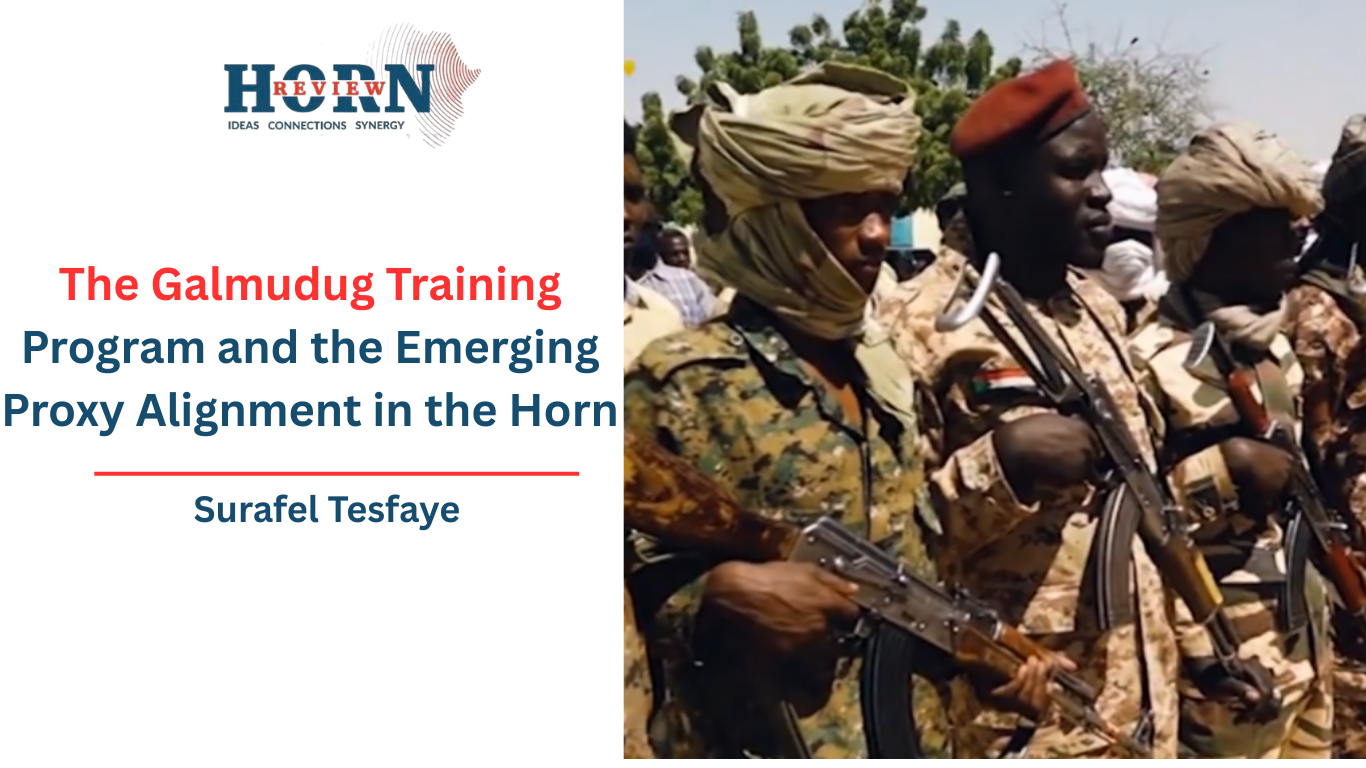
Reports from February 2026 indicate that a Sudanese Armed Forces (SAF) detachment has been conducting a covert training program for approximately 1,000 Somali recruits in Galmudug. To understand the implications of this development, it must be placed within the sequence that began in August 2024, when Egypt and Somalia signed a major defense pact. That agreement revived a military relationship dormant for decades and marked Cairo’s return to active security engagement in Somalia. The process moved from diplomacy to hardware in September 2024, when Egypt delivered artillery and anti-aircraft systems to Mogadishu its first significant arms transfer to Somalia in over forty years. This constituted the overt dimension of a new regional alignment.
While Egypt’s role unfolded publicly, a parallel and far less visible track began taking shape inside central Somalia. By December 2024, training had commenced at the Adado camp in Galmudug, where approximately 973 recruits entered instruction under retired SAF veterans, including Brigadier General Omar Al-Siddiq Ibrahim Mohamed. Simultaneously, 432 additional recruits were prepared in Guriel to form a “civil guard,” which was later integrated into the main formation in March 2025. The arrangement was formalized on February 27, 2025, through a confidential “top-secret” contract under which NISA’s Director of Administrative and Financial Affairs committed monthly payments to six Sudanese officers and nine NCOs. At no point was the program publicly announced.
The institutional channel through which this initiative was structured is central to its meaning. Rather than passing through the Ministry of Defense, the program was organized under the National Intelligence and Security Agency (NISA). By employing “retired” Sudanese personnel instead of active-duty officers, the federal government preserved plausible deniability and avoided defining the initiative as a formal military partnership. Keeping the project “off-book” further reduced exposure to international oversight. Although the UN arms embargo on Somalia was lifted in late 2023, transparency obligations remain in place, particularly regarding the formation and training of “irregular” forces. Operating through NISA effectively shields the unit’s size, equipment profile, and command structure from routine reporting requirements.
This approach also explains the absence of Somalia’s principal security donors. The United States, Turkey, and now Saudi all of whom support the Somali National Army (SNA), including the Danab and Gorgor units were not involved in this initiative. These partners typically resist parallel forces outside Ministry of Defense supervision. The emergence of what is increasingly described as a “third force” under NISA therefore introduces institutional dualism within Somalia’s security architecture: one structure aligned with donor-trained national units, and another vertically tied to intelligence leadership.
Once this institutional shift is understood, the internal political consequences become clearer. Although increased security capacity may appear beneficial on the surface, local reactions within Galmudug reveal deeper tensions. The recruits are widely believed to be drawn primarily from the Ayr sub-clan of the Habar Gidir (Hawiye), the same sub-clan as Mahad Mohamed Salad. While Galmudug broadly reflects Hawiye/Habar Gidir dominance, it remains internally fragmented by rivalry between Ayr, Saleban, and Sacad communities across Mudug and Galgaduud. In that context, the rapid buildup of an Ayr-dominated force is interpreted by rival sub-clans not as neutral state-building, but as a shift in coercive leverage.
This perception is reinforced by precedent. Historical disputes over grazing land, water access, and political representation have repeatedly escalated into violence. Reports from mid-2023 alleged that NISA resources were used to support Ayr militias during clashes near Dhusamareb. When nearly 1,000 men are subsequently trained in Adado and Guriel areas associated with Ayr influence the development is viewed through that existing lens. The balance of power does not change in theory; it changes in lived security calculations.
These tensions extend beyond sub-clan rivalries to broader territorial sensitivities. Relations between Galmudug and Puntland have long been fragile, particularly in contested border zones. Puntland authorities have expressed concern about “unregulated” militias operating near their frontier, fearing that such forces could become instruments in future land disputes rather than tools of national defense.
Even within Galmudug itself, the geography of the program carries political weight. Adado, formerly the state capital and historically associated with Saleban constituencies, has expressed dissatisfaction since administrative authority consolidated in Dhusamareb. Establishing and expanding a trained formation in Adado and Guriel, while executive leadership remains centered elsewhere, intensifies suspicions about who ultimately controls the “civil guard.” Critics therefore frame the initiative as a “private” army formed under federal cover, raising concerns that it may secure sub-clan dominance or political continuity rather than serve the broader coalition of eleven clans that constitute Galmudug.
These internal frictions intersect directly with the ongoing campaign against Al-Shabaab. The federal government has relied heavily on Macawiisley community militias, many of which initially received support from the United States and Turkey. However, once it became evident that some militias prioritized clan disputes over counterinsurgency, external assistance increasingly shifted toward strengthening the regular SNA. In such an environment, perceptions matter. If NISA is seen as empowering one sub-clan disproportionately, other communities may reconsider cooperation or seek alternative security arrangements, thereby weakening the cohesion necessary for sustained counterinsurgency operations.
Beyond domestic dynamics, the regional dimension deepens the strategic implications. The positioning of approximately 1,000 Sudanese-trained recruits near Ethiopia’s eastern frontier introduces a latent pressure point. Although no border confrontation has occurred, the presence of an intelligence-linked formation along routes historically used by Ethiopian forces under African Union mandates alters threat perceptions. Reports that Sudanese trainers possess expertise in electronic surveillance and border monitoring further amplify these sensitivities, as such capabilities could enable monitoring of Ethiopian troop movements in real time.
Historical memory reinforces this unease. Adado and Guriel were central strongholds of the Islamic Courts Union (ICU) in 2006, and several local mentors associated with current recruits previously fought Ethiopian forces during that period. While history does not predetermine future conflict, it shapes strategic interpretation.
Sudan’s financial capacity also raises questions. Given the SAF’s ongoing conflict with the Rapid Support Forces (RSF), it is unlikely that it is independently financing this program. More plausibly, it functions as a technical sub-contractor within a broader arrangement, potentially supported by actors aligned against the UAE, which is widely believed to back elements of the RSF. In exchange, Sudan may gain intelligence cooperation or political backing within African Union forums. Indeed, during a February 2026 AU Peace and Security Council session, the SAF was referred to as Sudan’s “transitional government,” a diplomatic formulation consistent with the emerging Egypt–Somalia–Sudan alignment.
At the financial level, it is improbable that the SAF is independently funding this initiative. More plausibly, it functions as a technical sub-contractor within a broader arrangement. In return, Sudan may gain intelligence cooperation or regional positioning advantages, particularly concerning RSF movements or UAE-linked activities in Somalia sub regions.
Eritrea represents the earlier layer of this evolving network. Between 2019 and 2021, thousands of Somali recruits underwent mass-scale training in camps such as Sawa and Gergera. Many returned in 2023 and 2024 and were integrated primarily into NISA rather than the SNA. The current Sudanese-led training therefore appears less as a standalone initiative and more as a specialization or refinement phase for these Eritrea-trained loyalists. Unlike US-trained Danab or Turkish-trained Gorgor units, these forces are closely tied to intelligence leadership and presidential authority.
Taken together, the Galmudug program reflects the convergence of multiple strands: Egypt’s overt military re-entry, Sudan’s covert technical role, Eritrea’s prior mass training infrastructure, and NISA’s consolidation of a parallel force structure. The outcome is not merely a localized security adjustment. It reshapes internal clan dynamics, institutional balance within Somalia’s security sector, and regional threat perceptions along a sensitive frontier. How these forces are ultimately deployed will determine whether this architecture stabilizes the state, entrenches internal fragmentation, or opens a new front in an already fragile regional order.
By Surafel Tesfaye, Researcher, Horn Review


Comment (1)
[…] that committed monthly payments to Sudanese officers and non-commissioned officers. By employing “retired” Sudanese personnel instead of active-duty officers, the federal government preserved plausible […]