At the United Nations Security Council meeting on Somaliland held on 29th of December, convened following Israel’s decision to recognize Somaliland, the Israeli representative invoked the mass violence committed against the Isaaq population under the regime of Siad Barre. Israel recalled that it had raised concerns about atrocities in northern Somalia as early as 1990, drawing attention to a historical record that continues to shape Somaliland’s political identity and claims to statehood. While Israel’s recognition is inseparable from its own geopolitical calculations, the reference to the Isaaq case reopened an older and largely unresolved debate about international responsibility and the role external actors played in Somalia’s descent into collapse.
For Somaliland, the campaign waged by the Barre regime against the Isaaq population constitutes one of the foundational elements of its claim to independence. Somaliland authorities and much of its political class consider the violence—particularly the large-scale bombardment of Hargeisa and Burao, mass killings, and forced displacement in the late 1980s—to amount to genocide. In addition, a range of credible academic institutions, including Yale University’s Genocide Studies Program, as well as international human rights investigations, have documented the systematic and state-directed nature of the campaign. While international consensus has stopped short of formal legal adjudication, the violence is widely considered by scholars and Somaliland itself to meet the threshold of genocide.
This historical experience has been central to Somaliland nationalism and its long-standing quest for independence from Somalia. Unlike other secessionist claims in Africa, Somaliland’s argument is grounded not only in colonial-era boundaries but also in a narrative of divergent paths taken with the ever-fragile Somalia. Yet this context was conspicuously absent from the sweeping condemnations that followed Israel’s recognition. Several states, led diplomatically by Egypt, rejected the move outright, framing it exclusively as a violation of Somalia’s sovereignty and territorial integrity, without addressing the historical grievances or present-day realities that underpin Somaliland’s political project.
Egypt’s reaction cannot be understood in isolation from its historical engagement with Somalia. During the Cold War and its aftermath, Cairo viewed Somalia primarily through a strategic lens shaped by rivalry with Ethiopia and Arab-Israeli politics. This perspective translated into sustained political and military support for the Siad Barre regime, particularly during the 1970s and 1980s. Egyptian assistance, including arms transfers and diplomatic backing, contributed—directly and indirectly—to the regime’s durability at a time when its internal legitimacy was rapidly eroding.
Barre’s rule, which lasted from 1969 until 1991, evolved into an increasingly repressive system reliant on coercion and clan-based exclusion. By the late 1980s, this culminated in a military campaign against the Isaaq population in northern Somalia, aimed at crushing the Somali National Movement (SNM). Cities were indiscriminately shelled, civilian infrastructure was destroyed, and large segments of the population were displaced or killed. Egypt did not publicly challenge these actions at the time, nor did it recalibrate its Somalia policy in response to the scale of violence. Rather, Cairo’s interest-based foreign policy contributed to the survival of a regime whose collapse, when it finally came, left behind a fragmented and deeply unstable state.
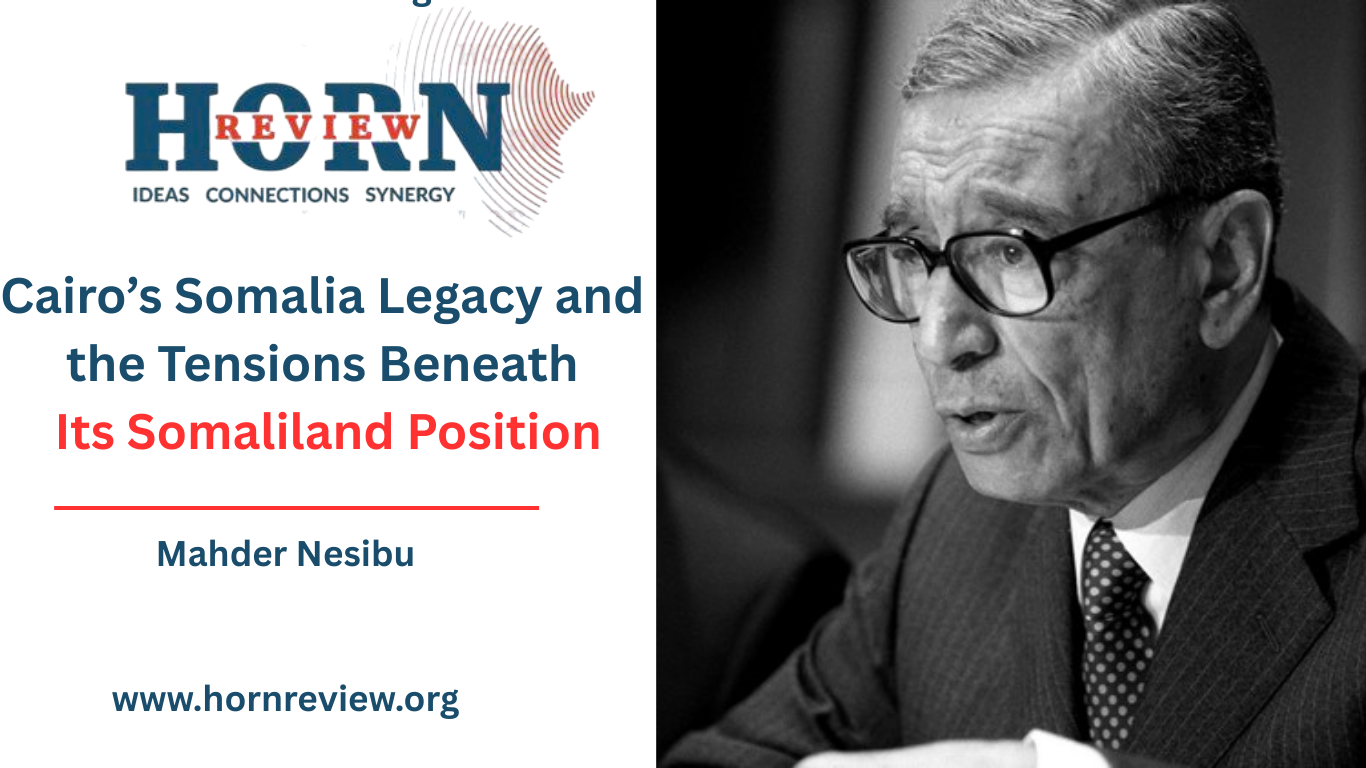
The figure of Boutros Boutros-Ghali illustrates the continuity—and contradictions—within this policy framework. Before becoming Secretary-General of the United Nations in 1992, Boutros-Ghali was a central figure in Egypt’s foreign policy establishment, serving as foreign minister and playing a key role in shaping Cairo’s regional engagements, including its relationship with Somalia under Barre. His tenure at the UN coincided with Somalia’s total state collapse and the first major international intervention of the post–Cold War era.
Boutros-Ghali’s leadership during the Somalia crisis was controversial. While the UN became heavily involved in humanitarian and peacekeeping operations after Barre’s fall, the organization never meaningfully addressed accountability for the atrocities committed during the regime’s final years. Among many Somalis, particularly in the north, Boutros-Ghali was viewed not as a neutral international civil servant but as a figure associated with the policies that had sustained Barre. This perception undermined trust in the UN’s role and reinforced the belief that international institutions were either unwilling or unable to confront the political roots of Somalia’s collapse.
Against this backdrop, Egypt’s current opposition to Somaliland’s recognition appears less as a principled defence of international law than as a continuation of a long-standing policy approach that privileges formal sovereignty over political reality. Since 1991, Somalia has struggled with chronic instability, repeated cycles of conflict, and fragmented authority, despite sustained international engagement. Somaliland, by contrast, has developed a functioning political system, held multiple competitive elections, and maintained relative stability for over three decades without significant external assistance.
This divergence was notably absent from the condemnations issued in response to Israel’s recognition. Little attention was paid to Somaliland’s record of local governance, peaceful transfers of power, or internal security. Instead, the response centred on general principles of territorial integrity, effectively treating Somalia as a coherent sovereign entity despite the empirical evidence of its prolonged dysfunction. From Somaliland’s perspective, this reinforces a pattern in which international actors acknowledge neither past suffering nor present achievements.
Israel’s decision to recognize Somaliland is itself part of strategic considerations in the Red Sea region, shifting regional alignments, and Israel’s broader foreign policy objectives. Yet Israel’s invocation of the Isaaq case at the Security Council served as a pointed reminder of historical failures—particularly those of states that now claim the mantle of legal and moral authority. By recalling the violence of the late 1980s, Israel implicitly highlighted the role external backers, including Egypt, played in sustaining a regime whose actions helped destroy the Somali state.
Egypt’s leadership in organizing opposition to the recognition thus carries a deeper irony. The same foreign policy tradition that once supported Barre in the name of regional stability now insists on preserving the territorial framework produced by Somalia’s collapse, while disregarding the alternative political order that emerged in Somaliland. This continuity suggests that Cairo’s Somalia policy has been guided less by outcomes on the ground than by enduring strategic reflexes.
In this sense, the controversy surrounding Somaliland’s recognition is not only about Israel or international law. It is also about unresolved legacies. The Isaaq campaign, considered by Somaliland and many scholars to constitute genocide, remains unaddressed at the international level. The stability Somaliland has achieved remains unacknowledged by many of its critics. And Egypt’s role—past and present—continues to shape regional debates in ways that often obscure, rather than confront, the consequences of earlier policy failures.
By Mahder Nesibu, Researcher, Horn Review