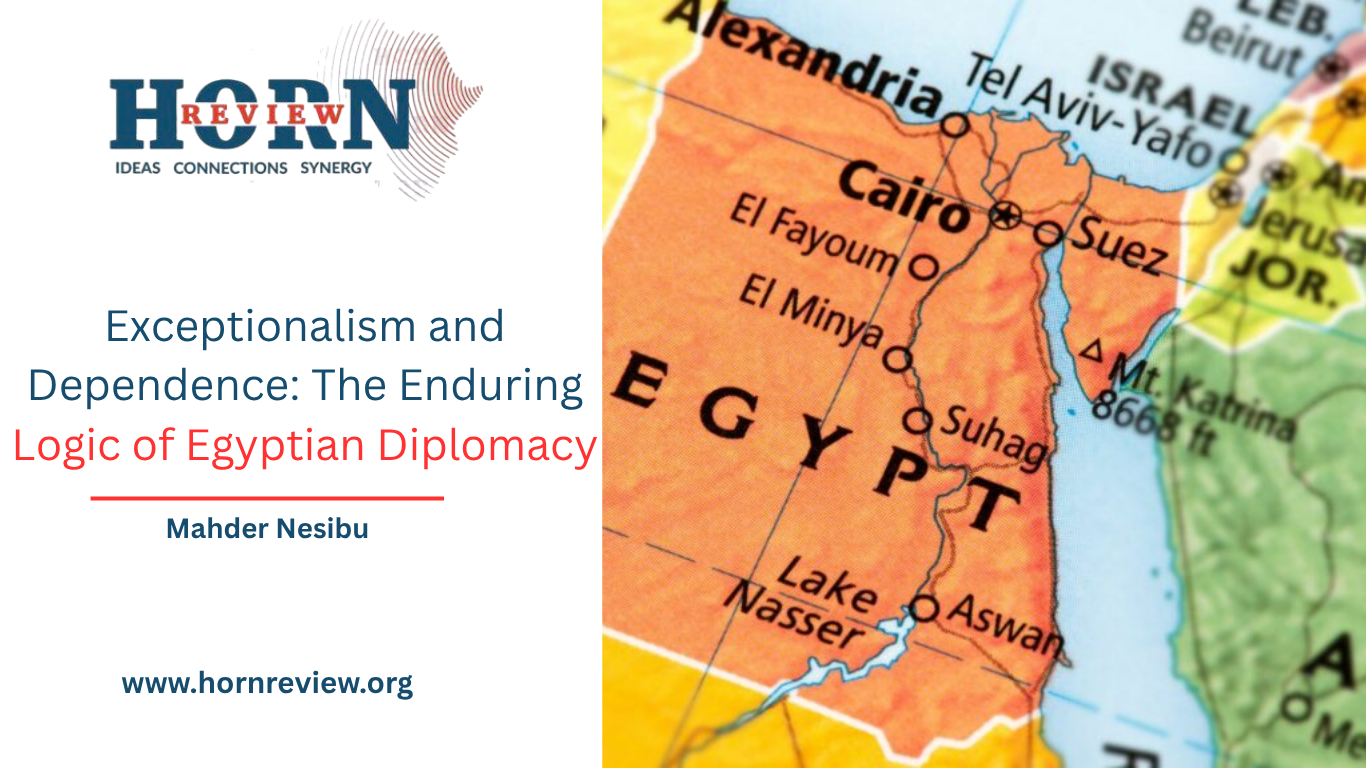
Egypt’s foreign policy has long been guided by a conviction that the country is exceptional—singular in its civilization, central in its geography, and destined to play a leading role in both the Arab and African worlds. Yet beneath this confidence lies a sense of existential vulnerability, born of dependence on a river that originates beyond its borders. The Nile has bound Egypt’s fate to lands it does not control, and this dependence has shaped the logic of its diplomacy more profoundly than ideology or leadership ever could. Across monarchies, revolutions, and republics, Egypt has sought to reconcile its image as a civilizational centre with its material insecurity. The result has been a foreign policy that constantly oscillates between aspiration and anxiety, grandeur and fragility.
This tension became visible during the rise of modern Egypt under the rule of Muhammad Ali in the nineteenth century. His ambition to create a powerful, self-sufficient state reflected the early stages of Egypt’s exceptionalism, yet even then control of the Nile Valley was treated as an imperative of survival. Expansion toward Sudan, the equatorial sources, and later the Ethiopia’s western lands and coastal areas was not only strategic but existential, driven by the conviction that Egypt could not depend on the goodwill of others for the lifeblood of its civilization. Later, under British occupation, the idea of protecting the Nile evolved into an institutionalized doctrine. London’s interest in safeguarding its imperial routes converged with Cairo’s insistence that no upstream development should endanger Egyptian water security. When independence arrived, this policy logic had already hardened into a principle of statecraft.
Gamal Abdel Nasser gave Egypt’s exceptionalism its most coherent ideological form. His project of Arab nationalism extended Cairo’s influence across the Middle East and North Africa, but his foreign policy still revolved around the defence of the Nile. Nasser presented Egypt as the natural leader of Africa and the Arab world, yet his African diplomacy, while rhetorically inclusive, rarely transcended the old hydrological hierarchies. The drive to preserve Egypt’s hydro-hegemony remained constant, even as he supported liberation movements elsewhere on the continent. To Nasser, leadership and security were inseparable. Ethiopia, as the principal upstream state, occupied a special place in this calculus. Although there was no active conflict, the relationship was clouded by a policy of destabilization, reflecting Egypt’s belief that any independent use of the Nile by Ethiopia would challenge its historical rights.
Anwar Sadat inherited this strategic mindset but recalibrated its expression. His peace with Israel and his shift toward the United States marked a pragmatic turn, yet the underlying assumptions did not change. Sadat’s Egypt remained a state defined by its vulnerability to the Nile’s flow and its claim to a special role in regional order. His Foreign Minister, Boutros Gali’s statement that “the next war in the region will be over water, not politics” summarized the enduring anxiety. By aligning with Washington, Sadat sought not only economic and military assistance but also guarantees for Egypt’s regional centrality. His foreign policy embodied the idea that Egypt’s exceptional status required external recognition, even if that meant dependency on new patrons.
Under Hosni Mubarak, these patterns solidified. Egypt’s diplomacy became cautious and bureaucratic, but the hydropolitical doctrine persisted with quiet intensity. Cairo maintained a network of influence across Sudan and the Nile Basin, using development aid, intelligence cooperation, and institutional diplomacy to block or delay upstream initiatives. The discourse of shared development seldom masked the underlying asymmetry. For Ethiopia, which saw the Nile as a sovereign resource vital to its own development, Egypt’s insistence on historical rights represented an attempt to freeze colonial-era arrangements. The two countries’ divergent worldviews—Egypt’s exceptionalism and Ethiopia’s assertion of equality—heightened mutual mistrust.
The 2011 revolution and the brief presidency of Mohamed Morsi did little to alter this dynamic. Even during domestic upheaval, Egypt’s strategic elite remained fixated on the Nile question. Morsi’s confrontational rhetoric toward Ethiopia, though short-lived, reflected the depth of institutional continuity in foreign policy. When Abdel Fattah al-Sisi consolidated power, he inherited both the anxiety and the ambition of his predecessors. His government presented itself as modern and assertive, capable of restoring Egypt’s regional influence, yet the central dilemma persisted. The Grand Ethiopian Renaissance Dam (GERD) became the focal point of a broader psychological struggle over Egypt’s sense of control and vulnerability.
Sisi’s diplomacy has thus combined negotiation with deterrence. Egypt’s approach to the dam was centred around calls for diplomatic campaigns with warnings of existential threat. The language of rights and survival dominated official discourse, revealing how deeply the logic of hydro-hegemony is embedded in the state’s identity. Even as Cairo seeks diverse partnerships with the Gulf, Europe, and Russia, its foreign policy toward sub-Saharan Africa continues to revolve around the protection of the Nile. Initiatives such as Egypt’s renewed engagement with the African Union or its participation in peacekeeping missions serve both symbolic and strategic purposes: they project influence while safeguarding the perception of Egypt as the rightful centre of regional stability.
Beyond the Nile, Egypt’s exceptionalism continues to shape its orientation toward the Arab world and the Mediterranean. The belief in a unique civilizational mission has driven its search for leadership, yet the same conviction has often produced rigidity when others challenge its authority. In the Gulf, Egypt has acted as both a partner and a rival, balancing its dependence on financial support with its desire for autonomy. In Sudan, Cairo’s interventions have been guided by the same principle that has long defined its southern policy: instability near the Nile must be controlled or contained. Even its outreach to Russia and China can be interpreted through the lens of vulnerability—an attempt to diversify alliances without surrendering strategic independence.
What endures through all these transformations is a doctrine that treats security as the foundation of identity. Egypt’s political system, regardless of ideology, has viewed regional leadership as both a right and a necessity. Its exceptionalism provides a sense of historical purpose, while its dependence on the Nile imposes perpetual restraint. The contradiction has produced a foreign policy that is simultaneously assertive and defensive. For Ethiopia and the states of the Nile Basin, this means engaging with a problematic neighbour that sees the river as an extension of its sovereignty. For the wider region, it means that Egypt’s diplomacy will continue to oscillate between cooperation and control, seeking to reconcile its imagined centrality with the practical limits of geography.
Egypt’s long struggle to align its sense of grandeur with its material vulnerabilities defines its place in the international system. The persistence of this paradox—between a self-image rooted in ancient continuity and a dependence on forces beyond its command—explains much of its conduct toward Africa and the Arab world. The Nile remains both perceived as a source of life and a mirror of anxiety. As long as that duality endures, Egypt’s foreign policy will continue to move within the narrow corridor between survival and supremacy, forever negotiating the terms of its exceptionalism.
By Mahder Nesibu, Researcher, Horn Review