The presidency of Hassan Sheikh Mohamud, who returned to Villa Somalia in 2022, is increasingly reshaping the space Somalia occupies in the geopolitics of the Horn of Africa. Although Hassan Sheikh’s term in office officially ended in May 2026, he has extended it through constitutional changes, citing the goal of implementing a one-person-one-vote system to replace the country’s long-held clan-based suffrage. This has in turn worsened the fractures within the federal system, as regional leaders and former presidents alike continue to dispute his legitimacy. Regional resistance, made more acute, compounds the fracture presented by the case of Somaliland, a de facto state over which Somalia claims sovereignty. Somaliland itself received its first recognition in December last year, from Israel, marking a significant step in its pursuit of statehood. The move runs parallel to Hassan Sheikh’s deepening engagement with Turkiye, itself part of a broader pattern of engagement by Middle Eastern states in the Horn of Africa.
Somalia’s fragility, although a constant reality in the Horn of Africa for decades, has taken on a dimension that presents greater risks for the region. This is visible in the way Mogadishu’s fractured politics now compound a shifting foreign policy and an evolving security landscape. These realities, above all, should alarm neighbouring Ethiopia, as the country stands to bear the weight of an increasingly fractured and polarised Somalia.
The principal concern is the African Union peacekeeping mission in Somalia nearing collapse. The mission’s latest iteration, AUSSOM, has recently been left reeling after the United States decided in July to pull its funding for the mission, channelled through the United Nations’ office in Somalia, which has itself begun withdrawing from the country. Although consultations continue within the African Union and among troop-contributing countries, the future of the peacekeeping mission, which has kept Mogadishu from an al-Shabaab takeover since 2007, remains uncertain. This was not the first setback to the mission. President Hassan Sheikh had initially removed Ethiopia, traditionally the largest troop-contributing country and a frontline state against al-Shabaab, from the mission in December 2024, before later limiting its troop allocation significantly. The rationale was a reaction to the Memorandum of Understanding Addis Ababa had signed with Somaliland, widely viewed as a recognition-for-sea-access arrangement.
Although bilateral arrangements exist to allow Ethiopian Defence Forces to operate in the country, Mogadishu’s rationale appears to be an increased reliance on the Somali National Army (SNA). Ethiopia’s withdrawal became evident in August, when it handed a key base in Somalia’s Bay region to the SNA, a strategic position it had held for more than a decade.
The logic of increased Somali responsibility is a point of consensus between Ethiopia and the AU-UN bodies backing the mission. However, Mogadishu’s security strategy, primarily one of rapid militarisation, risks seeding other dilemmas for the country and the region. This was made visible when Hassan Sheikh appointed Abdirisak Mahamud Haji, nicknamed “Eritrea”, to head the air force. Haji’s roots in the Ogaden National Liberation Front (ONLF), a secessionist movement in Ethiopia’s Somali region, add to his long tenure in Eritrea, including training and ties to the Eritrean National Security system. Haji’s rise followed the reported return of some 5,000 troops from Eritrea, an arrangement he had helped facilitate in 2019.
Exacerbating Eritrea’s influence within the Somali National Army is the historical position it has held in the country. At the height of the war on terror, when Ethiopian forces were bogged down in Somalia fighting al-Shabaab through the 2000s and early 2010s, Eritrea entered the Somali scene with the backing of the ONLF and al-Shabaab itself. Alongside this, it cultivated a network of relationships with Somali politicians who, at the time, opposed the federal government backed by Addis Ababa.
Among the reshuffles in the Somali army is the rapid expansion of troops. In mid-August, the country graduated a batch of 3,000 troops, its largest since the collapse of the Siad Barre regime in 1991. This move has drawn considerable scepticism and criticism, particularly over its timing, as President Hassan Sheikh runs on a disputed mandate and as regional states such as Puntland resort to forceful challenges of Mogadishu’s position, which is seen as increasingly centralising. Compounding this is the fragility of the security system itself. Within the ranks of the Somali National Army, figures like Sahal Abdullahi Omar, appointed by Hassan Sheikh in 2024 to lead the SNA’s ground forces, share roots with Haji in the secessionist factions of the ONLF and are reportedly drawing ethnic Somali-Ethiopians into the SNA’s rapid expansion.
Although the ONLF itself has been politically integrated within Ethiopia after a peace deal in 2918, and its radical elements weakened with minimal capacity to challenge Ethiopia’s national security on a substantial scale, its potential for entrenchment within the Somali security space is growing. This problem is compounded by the fact that irredentist claims around “Greater Somalia”, which led Siad Barre, Somalia’s former longtime dictator, to invade Ethiopia in 1977, have resurfaced. This was invoked by the president himself in June, when he described Ethiopian territory as one of the “missing parts” of his country.
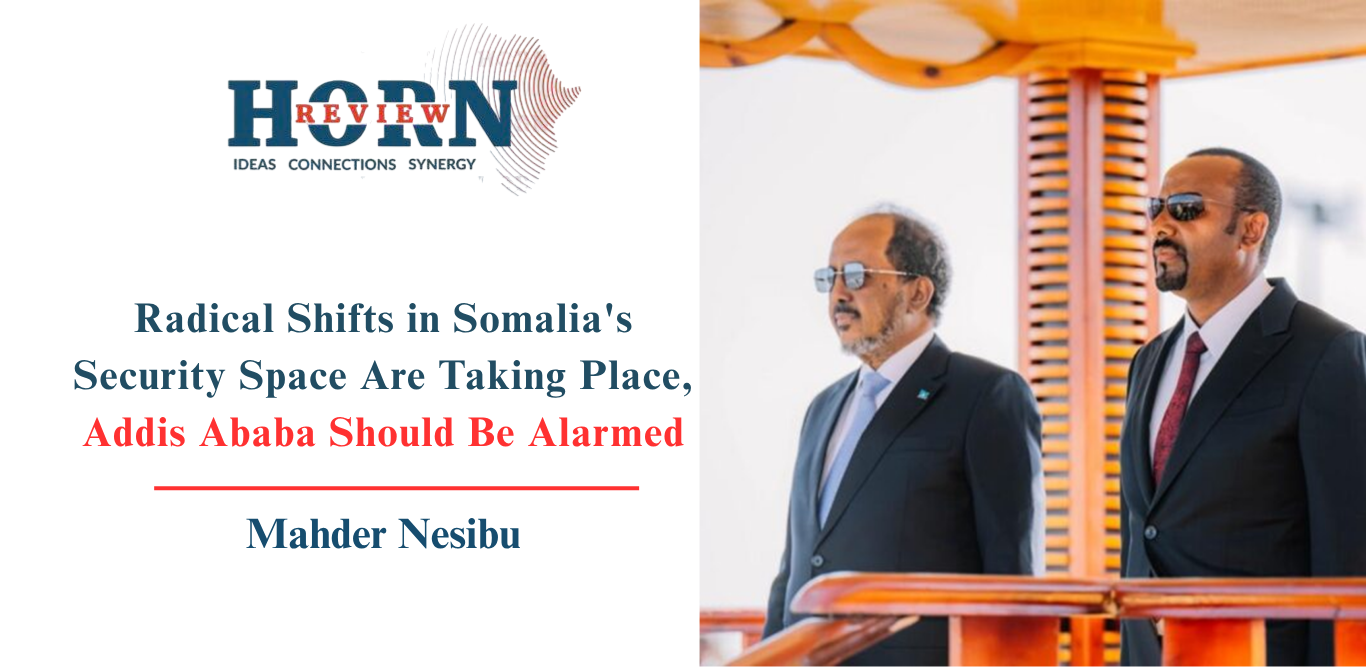
This stands in contrast to the positive relations the president enjoys with Ethiopia’s Prime Minister, Abiy Ahmed. Besides resolving the fallout that followed the memorandum of understanding, engagement at the leadership level shows consistent understanding and coordination. The shifting dynamics on the ground in Somalia nonetheless maybe a source of concern for Addis Ababa.
Somalia’s foreign policy in recent years has not favoured Ethiopia either. Although Turkiye, which has undoubtedly emerged as Mogadishu’s biggest backer, also enjoys a strategic relationship with Ethiopia, the depth of its engagement with Somalia, increasingly bordering on dependency, presents a dilemma. To begin with, the rapid expansion of Ankara’s security footprint inside Somalia represents the emergence of a middle power in the Horn of Africa possessing major influence over its neighbour. Nor are the consequences limited to this. Partly motivated by its growing rivalry with Ankara, and in part to secure a foothold in the security architecture of the Red Sea and the Gulf of Aden, Israel’s recognition of Somaliland, and its likely security presence there in the near future, brings this Middle Eastern rivalry to Addis Ababa’s doorstep.
Although both Israel and Turkiye are strategic partners to Ethiopia, Somalia has also been forging closer ties with other Middle Eastern powers such as Saudi Arabia and Qatar too. More alarmingly, it has also been building ties with Egypt, currently Ethiopia’s principal rival. Alongside Eritrea’s clandestine influence over the Somali state and its security architecture, Egypt’s more overt and formal presence presents real risks for Ethiopia. For one, although AUSSOM’s future is in serious question, Egypt joined as a troop-contributing country, committing over a thousand troops and dispatching them to Mogadishu in January this year. Although Egypt has backed the SNA through weapons deliveries, the deployment of Egyptian Defence Forces personnel marks an expansion of the relationship and, indirectly, an escalation with regard to Ethiopia. For Addis Ababa, which regards its border with Somalia as a matter of primary security interest, and has extended that concern to Somalia itself by fighting al-Shabaab and backing the Villa Somalia government for decades, the recent shifts in the country demand close scrutiny. Ethiopia has, in recent years, been occupied with security considerations to its north and west, with regard to Eritrea and Sudan, and the volatility there. However, the ever-present threat of secessionist movements like the ONLF resurfacing, compounded by al-Shabaab’s growing threat as AU peacekeeping possibly draws to an end, demands the country’s attention to the east. Somalia is more important now, as the Middle Eastern order Ethiopia is currently navigating is itself manifesting in its neighbour, and in more dangerous form. Somalia risks serving as a ground for the expansion of the anti-Ethiopia alliance, headed by Eritrea and Egypt, that has itself surfaced in recent years.
By Mahder Nesibu, Researcher, Horn Review