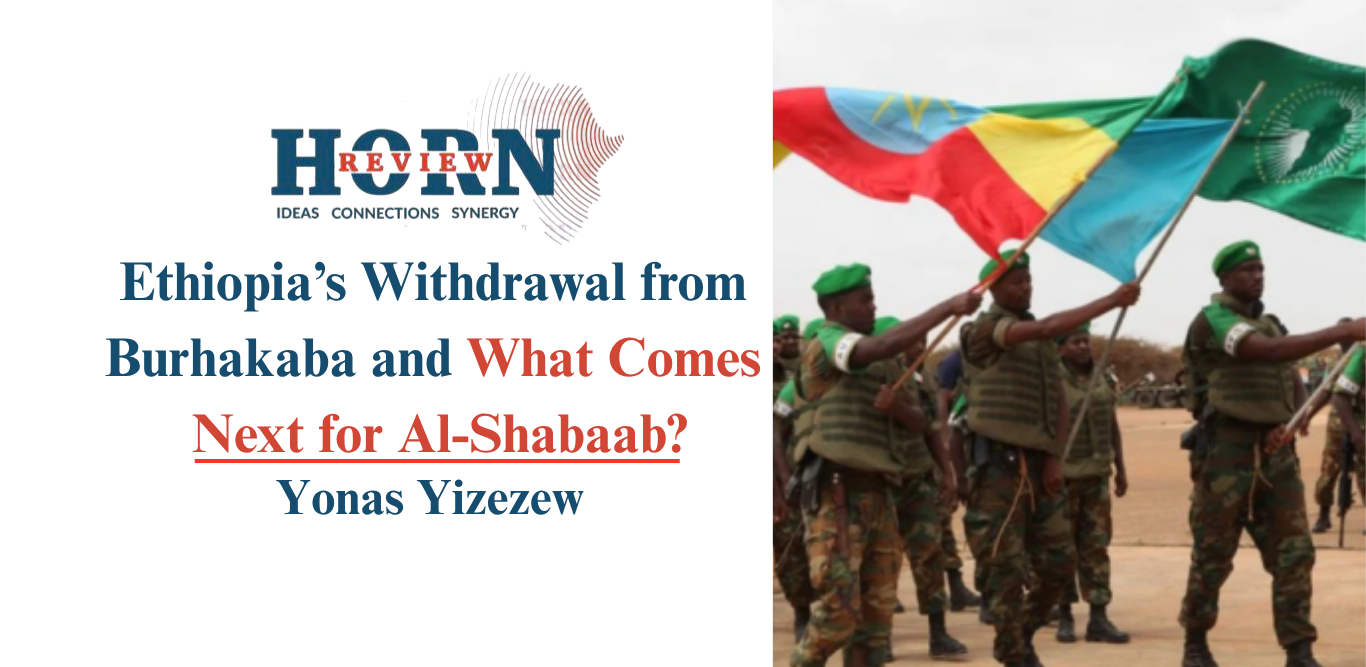
The recent handover of the Burhakaba forward operating base by Ethiopian National Defence Forces serving under AUSSOM marks an important step in the ongoing reshaping of the security presence in south-central Somalia. It forms part of a broader process in which Ethiopian forces are gradually transferring positions to Somali forces. On 8 August the base, occupied continuously by Ethiopian troops since 2014 under successive African Union frameworks, was formally transferred to the Somali National Army’s 60th Division with logistical assistance from the United Nations Support Office in Somalia. The town sits astride the main road linking Mogadishu to Baidoa, the administrative centre of South West State, and is surrounded on all sides by areas under varying degrees of Al-Shabaab influence. Local reporting indicates that the physical withdrawal of the Ethiopian contingent occurred shortly after the ceremonial transfer, and that similar handovers of additional positions in the Bay region are anticipated in the coming weeks.
Ethiopia has repeatedly affirmed its commitment to the mission and to the preservation of gains made against Al-Shabaab over two decades of successive deployments. The precise operational and logistical reasons for the specific timing of the Burhakaba transfer have not been detailed publicly beyond the progressive handover framework of AUSSOM and the broader sustainment pressures facing the mission. Ethiopian forces continue to maintain a presence at multiple other locations in Bay and Bakool, reflecting a calibrated adjustment rather than a wholesale retreat.
This development cannot be isolated from the broader trajectory of the African Union mission. AUSSOM, which succeeded the Transition Mission at the beginning of 2025, was designed as a lighter, more focused support operation intended to accelerate the transfer of security responsibility to Somali forces. In 2024 Somalia initially sought to exclude Ethiopian troops from the successor mission because of the memorandum of understanding Ethiopia signed with Somaliland. The Ankara Declaration mediated by Turkey in late 2024, together with subsequent bilateral understandings and high-level visits, restored a measure of cooperation and allowed Ethiopian forces to remain under the new AU framework, albeit in reduced numbers relative to earlier peaks. Relations improved, yet Somalia’s subsequent moves have remained unpredictable and sometimes hostile to Ethiopian interests—ranging from fluctuating political alignments to internal federal–member-state tensions that complicate unified security planning. This residual unpredictability requires Ethiopia to manage its posture carefully.
The operational environment surrounding these withdrawals has deteriorated. The United States notified the African Union in early July 2026 that it would no longer support the extension of the United Nations Support Office in Somalia beyond the end of the year. UNSOS has supplied the critical logistical backbone—fuel, transport, medical evacuation, communications and infrastructure—without which AUSSOM cannot function at scale. The American decision rests on a judgment that Somalia has failed to translate years of external investment into sustainable national ownership of security. Washington has indicated it will not block renewal of the AUSSOM mandate itself, but it will oppose any Security Council resolution that preserves UN logistical support. The result is an acute funding and sustainment crisis. Troop-contributing countries meeting in Kampala at the end of July acknowledged the gravity of the situation and called for an extended transition of eighteen to twenty-four months, yet they produced no credible alternative financing mechanism. UNSOS has reportedly begun processes for the commercial disposal of substantial inventories of equipment, a tangible signal that planners anticipate a contraction of the mission’s footprint.
The timing is especially significant. While Al-Shabaab is strengthening its capabilities—including expanded drone operations for surveillance (with growing potential for armed use), technical expertise, and alliances or supply linkages (notably with the Houthis in Yemen that have facilitated training and equipment)—Somalia and its external partners are relatively decreasing their collective efforts. This convergence of trends includes the US funding cutoff for UNSOS, Somalia’s intensified internal political and institutional crises, a shifting regional order, and the absence of sustainable alternative sustainment. The group continues to refine rocket systems, seek counter-surveillance technology, maintain resilient financing through taxation, and exploit governance vacuums, positioning itself to test newly transferred positions more aggressively.
The risks attached to Ethiopian withdrawals from positions such as Burhakaba are therefore magnified by this larger uncertainty. Al-Shabaab has demonstrated a consistent pattern of exploiting gaps left by departing foreign forces. Earlier drawdowns under ATMIS and bilateral arrangements in places such as Dinsoor, Mahas and several Lower Shabelle towns were followed by militant advances that recovered territory and disrupted supply lines. Burhakaba’s geography—encircled by insurgent-controlled countryside—makes it particularly vulnerable. Somali forces taking over the base lack the same depth of experience, heavy weapons, aerial support and sustained logistics that Ethiopian units had developed over more than a decade. The group is likely to increase pressure on the perimeter and surrounding settlements, testing whether the 60th Division and any residual partner forces can hold key access routes.
A cascading effect is possible. If Al-Shabaab succeeds in isolating or overrunning newly transferred positions, the credibility of the entire transition process suffers. Supply routes serving remaining AUSSOM contingents become less secure, forcing further contractions. The federal government’s request for a two-year delay in foreign troop withdrawals collides with the fiscal reality that no such extension currently has funding. Political fragmentation inside Somalia compounds the difficulty. Federal–member-state tensions, electoral and constitutional disputes, and competing external alignments have repeatedly diverted attention and resources from the counter-insurgency effort. When central and regional authorities are at odds, coordinated operations against Al-Shabaab become harder to sustain, and local forces more susceptible to clan-based pressures or even tactical accommodations with the militants.
For Ethiopia the implications run in several directions simultaneously. Addis Ababa has long treated the presence of a resilient Al-Shabaab as a direct threat to its own eastern border and to the stability of the wider region. Ethiopian forces have historically functioned as a buffer in Gedo, Bay and Bakool, containing cross-border infiltration and denying the group secure rear bases. A rapid or disorderly contraction of that presence raises the prospect of increased militant activity along the frontier, potential refugee flows, and the need to reinforce domestic border deployments.
Regional dynamics add further layers. Kenya, Uganda, Djibouti and, more recently, Egypt maintain contingents whose own sustainment is equally dependent on the same logistical pipeline. An abrupt contraction of AUSSOM could produce a patchwork of bilateral or unilateral deployments, each driven by national rather than collective priorities. Egypt’s growing security relationship with Somalia and its deployment of troops, equipment and air assets under AUSSOM (and bilaterally) is rooted in part in Nile-related tensions with Ethiopia. This presence, while formally framed as support for Somali defence against Al-Shabaab, is assessed as not fully or primarily intended to strengthen a unified regional effort. Instead, it risks introducing competing spheres of influence inside the same theatre and further undermining cohesion. Gulf states have already demonstrated a willingness to back rival Somali actors, further affecting the security landscape. In such an environment Al-Shabaab’s capacity to present itself as the sole coherent alternative to a divided and externally dependent political order would increase.
Patterns observable over the past several years suggests that withdrawals timed to political or fiscal calendars rather than to demonstrable Somali force readiness tend to produce territorial reversals. The 2025 offensives that recovered ground in Hiran and Lower Shabelle after earlier ATMIS drawdowns provide a recent template. The difference now is that the entire mission faces an existential funding cliff at the end of 2026, so isolated handovers risk becoming the opening phase of a wider, poorly resourced exit.
What a managed versus unmanaged process would mean is therefore decisive. A carefully sequenced transfer accompanied by reinforced Somali holding forces, residual partner enabling support and credible political reconciliation between Mogadishu and the federal member states could still limit the damage and allow a gradual assumption of responsibility. An accelerated or under-resourced drawdown, by contrast, risks recreating the conditions that allowed Al-Shabaab to expand after the Ethiopian intervention of 2006–2009 and after successive partial withdrawals since. In the worst case the group could regain the capacity to threaten major population centres more directly, raise recruitment and taxation in recovered areas, and project instability outward into neighbouring states. Ethiopia and regional countries would then confront both a more dangerous border and a diminished ability to shape the security environment through presence on the ground. The wider region would face heightened risks of spillover, refugee movements, disrupted trade routes, and the empowerment of a more technologically capable and networked Al-Shabaab.
The Burhakaba handover is therefore less an isolated tactical adjustment than a visible symptom of converging pressures: the structural weaknesses of Somali security institutions, the political contestation that continues to undermine unity of effort, the abrupt withdrawal of the logistical underpinnings that have sustained African Union operations for nearly two decades, Al-Shabaab’s concurrent capability gains, and a shifting regional order in which external actors pursue parallel national interests. How these pressures are navigated in the remaining months will determine whether the transition consolidates a fragile equilibrium or opens space for a significant reverse in the long campaign against Al-Shabaab—with direct consequences for Ethiopia’s border security and the stability of the Horn of Africa as a whole.
By Yonas Yizezew, Researcher, Horn Review