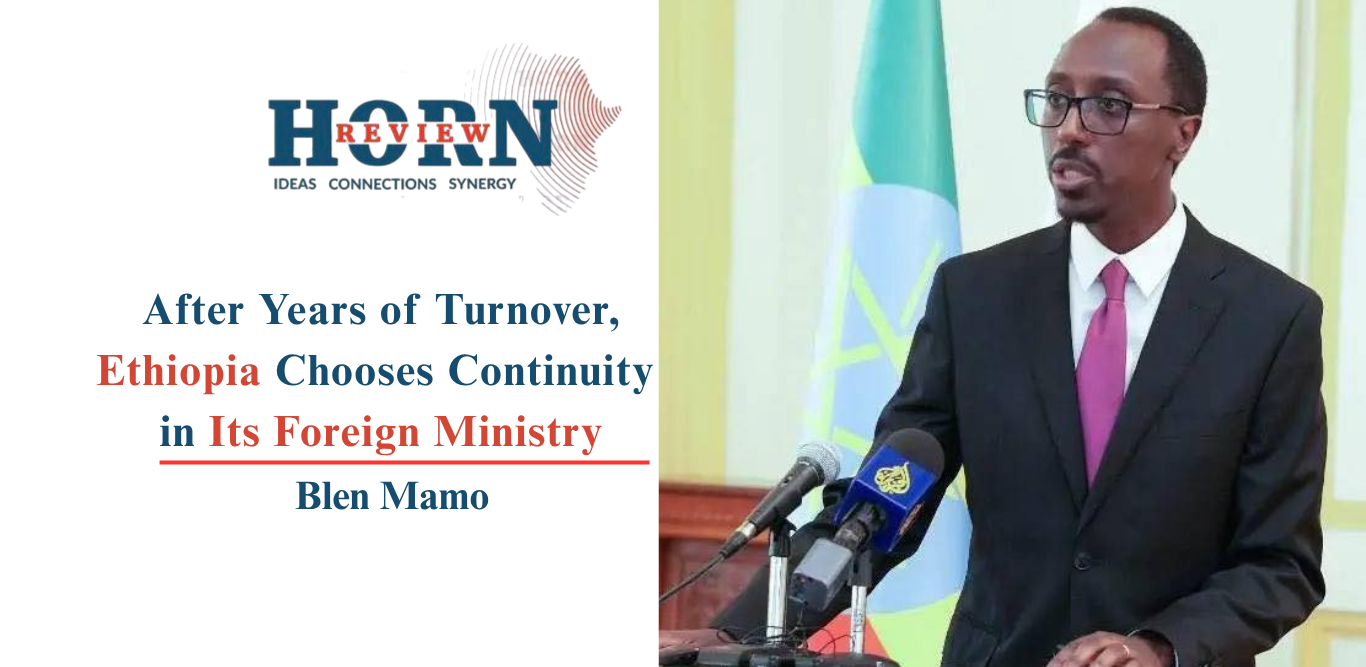
Abiy Ahmed’s decision to retain Gedion Timothewos as foreign minister for another five-year term is beyond a mere administrative decision, a potentially consequential choice about the institutional future of Ethiopian diplomacy. Since the Prime Minister came to office in 2018, Ethiopia has had five foreign ministers in roughly six years. That degree of turnover is not inconsequential in Africa’s premier foreign-policy establishment operating in one of the continent’s most complex geopolitical environments. Diplomatic strategy depends heavily on accumulated knowledge, personal relationships, negotiating history and an intimate understanding of how international law, domestic political calculations and global dynamics intersect with external interests. Frequent changes at the top of the foreign ministry inevitably interrupt that accumulation. The significance of Gedion’s continued tenure, therefore, lies not simply in avoiding another change of personnel. Rather in the fact that Ethiopia now has a foreign minister whose individual intellectual and political capacities make continuity itself potentially valuable.
Gedion assumed the foreign ministry after one of the most difficult periods in the history of modern Ethiopian diplomacy. The 2020 Tigray war did not merely produce a devastating internal conflict; it generated a profound external crisis for the Ethiopian state. Addis Ababa found itself confronting unprecedented diplomatic pressure, deteriorating relations with important international partners, intense scrutiny within multilateral institutions and a rapidly changing regional environment. The years following the war, in which Gedion himself played a direct role in bringing the conflict to an end as a key government representative in the Pretoria peace negotiations, required Ethiopia not merely to manage the aftermath of conflict but to reconstruct its diplomatic space almost simultaneously. The task involved repairing strained international relationships, recalibrating Ethiopia’s engagement with global powers, restoring diplomatic credibility and advancing its interests within an increasingly competitive Horn of Africa and Red Sea geopolitical environment. Gedion therefore entered the foreign ministry not simply as an administrator of a post-conflict diplomatic order, but as an actor who had already participated in shaping the political settlement from which that new diplomatic phase emerged.
It is against this background that Gedion’s tenure must now be assessed. His period at the foreign ministry has coincided with Ethiopia’s effort to move from the diplomatic crisis generated by the 2020–22 war toward strategic re-engagement, but that transition has now been overtaken by a renewed and potentially far more complex security crisis. Since fighting resumed between the federal government and the TPLF on 23 September, the conflict has rapidly acquired a regional dimension, with Ethiopia and Eritrea severing diplomatic ties and reports indicating the presence of Eritrean forces inside Tigray. Ethiopia therefore requires at this moment not merely institutional continuity in its foreign policy, but a foreign minister with a deep understanding of the historical, political and substantive intricacies of the conflict confronting the state. Gedion’s direct involvement in the Pretoria negotiations, his knowledge of the political forces that shaped the previous war, and his subsequent experience rebuilding Ethiopia’s external diplomatic position give him an institutional and strategic understanding that is particularly consequential as the country once again enters a period in which diplomacy will be significantly entangled with national security.
The significance of his appointment is therefore inseparable from his personal intellectual formation. Gedion is not a conventional foreign minister whose principal asset is simply diplomatic experience accumulated through a long career in the foreign service. His background in law provides him with a conceptual framework particularly suited to the kinds of questions Ethiopia now increasingly confronts internationally. Ethiopian foreign policy routinely operates at the intersection of sovereignty, constitutional questions, international law, treaty interpretation, territorial disputes, regional security arrangements and the institutional architecture of multilateral diplomacy. These are not questions that can be reduced to conventional diplomatic messaging. They require an understanding of how political objectives can be translated into legally defensible positions and how legal arguments can subsequently be converted into diplomatic leverage. That legal orientation is particularly consequential for a country such as Ethiopia, whose external interests are frequently contested through competing interpretations of sovereignty and international norms. The ability to distinguish between what is politically desirable, what is legally defensible and what is diplomatically attainable is one of the most important forms of statecraft available to a foreign minister. Gedion’s training gives him an intellectual advantage in navigating precisely that space. It enables him to approach diplomacy not merely as the management of relationships but as the construction of arguments, positions and negotiating frameworks through which national interests can be advanced.
Yet his competence cannot be understood through his legal background alone. Perhaps equally important is his familiarity with the internal political architecture of the Ethiopian state. Ethiopian foreign policy cannot be divorced from Ethiopian domestic politics. The country’s federal structure, competing political constituencies, security concerns, historical narratives and contested conceptions of sovereignty all influence the external positions that the government is able, or willing, to defend. A foreign minister who understands these dynamics from within the political system possesses an advantage over someone whose knowledge of Ethiopia is primarily diplomatic or bureaucratic. The international representation of Ethiopia requires an appreciation of the domestic political constraints behind its positions, just as much as it requires knowledge of the external environment. This is also why Gedion’s political alignment with the ruling establishment matters. The foreign ministry does not independently determine the strategic direction of Ethiopian foreign policy. The most consequential choices ultimately reflect the priorities and strategic calculations of the government and, particularly under Ethiopia’s current political system. Gedion not only understands those priorities, but also possesses the confidence of the political leadership and can translate them into coherent diplomatic policy that has the potential to reduce the distance between political strategy and diplomatic execution. His institutional value lies in the possibility of strategic coherence: the ability of the foreign ministry to speak externally with a clear understanding of the government’s broader objectives.
That combination of legal sophistication, political understanding and strategic orientation is what distinguishes the argument for Gedion’s continued tenure from a generic argument for bureaucratic stability. Continuity by itself is not necessarily an asset. A state can preserve an ineffective institution indefinitely. What makes continuity consequential is the competence of the person around whom institutional memory is being accumulated. Gedion’s value to Ethiopia is therefore not simply that he has already spent two years in the foreign ministry. It is that those two years have created the beginnings of a body of experience that could become considerably more valuable with time. A foreign minister who remains in office long enough begins to understand not only the formal positions of other governments but the people, incentives, sensitivities and historical experiences that sit behind those positions. Negotiations acquire a history. Relationships acquire depth. Previous disagreements become points of reference rather than previous episodes. International counterparts develop expectations about how Ethiopia will negotiate, while Ethiopian officials develop a more sophisticated understanding of what different partners are actually prepared to offer. This is part of the tacit knowledge of diplomacy, and tacit knowledge is among the most difficult forms of state capacity to reproduce.
This is particularly important for Ethiopia because the country is attempting to operate simultaneously across several overlapping geopolitical theatres. Its interests extend from the Horn of Africa to the Red Sea, from the African Union to the Gulf, and from relations with neighbouring states to increasingly consequential partnerships with the United States, China, Europe and other global actors. Ethiopia cannot afford a foreign policy that is constantly reset according to the arrival of a new minister. It requires strategic continuity capable of distinguishing between temporary diplomatic turbulence and enduring national interests. Gedion’s potential contribution is therefore larger than the management of the foreign ministry during a single political cycle. Now given the institutional stability of another five years, he could move from being a minister who inherited a damaged diplomatic environment to becoming one of the principal custodians of a new phase of Ethiopian statecraft. Rebuilding diplomatic relationships is one task; converting that recovery into an enduring diplomatic doctrine is another. The latter requires time, institutional memory and a sufficiently capable political actor to connect individual initiatives into a coherent strategic trajectory.
His reappointment is consequently not an affirmation that Ethiopia should become dependent on one individual. On the contrary, the ultimate objective should be to strengthen institutions sufficiently that foreign policy does not depend entirely on personalities. But institutions are built through people, and certain individuals are better positioned than others to convert experience into institutional capacity. Gedion’s importance lies in his ability to serve as a bridge between the political leadership, the legal architecture of the state and the diplomatic machinery through which Ethiopia engages the international system. After years in which ministerial turnover disrupted that accumulation, Ethiopia now has an opportunity to establish a period of continuity around a minister whose particular competencies correspond closely to the country’s present diplomatic requirements. Gedion’s reappointment did not simply extend the tenure of a foreign minister. It marks the beginning of a longer process through which Ethiopian diplomacy acquires something it has lacked amid years of disruption: institutional memory anchored in a capable and strategically trusted political actor.
Authors Bio
Blen Mamo is Executive Director of Horn Review and a researcher specializing in law, international security, and geopolitics in the Horn of Africa. She holds an LL.B and an M.Sc. in International Security and Global Governance.