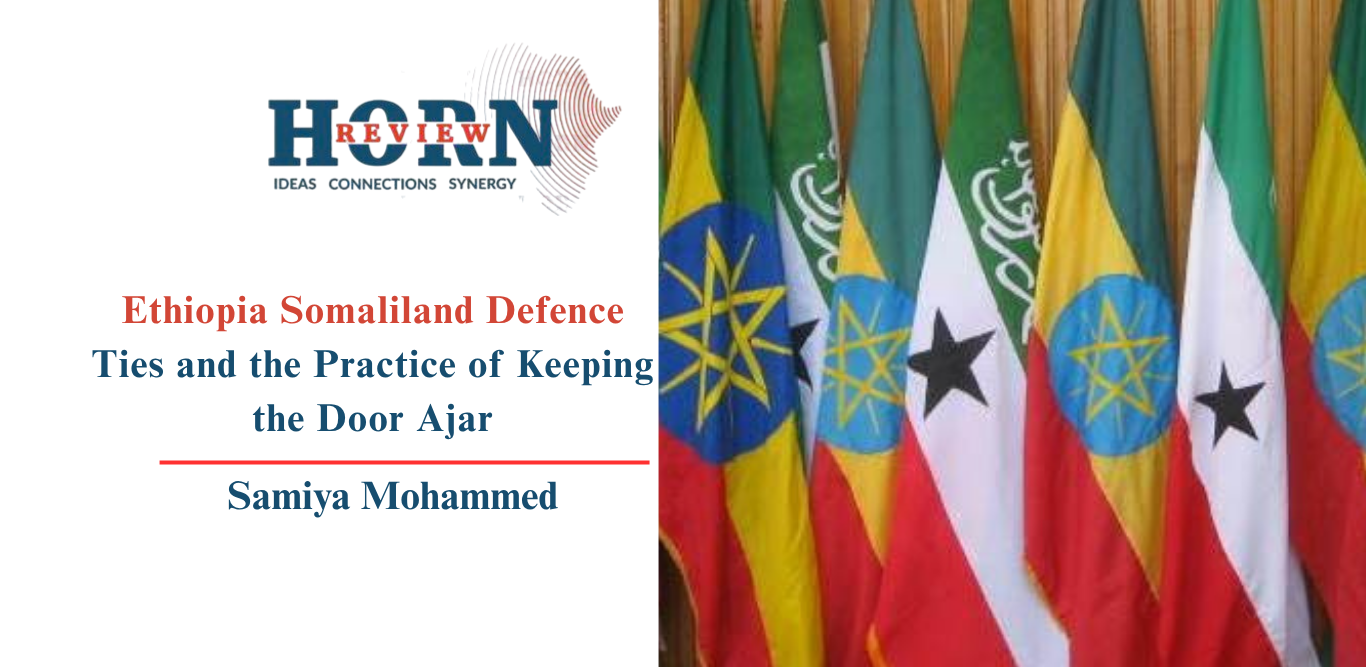
The recent meeting between Brigadier General Nimcaan at the army’s headquarters and Ethiopian envoy Teshome, Ethiopia’s consul general in Somaliland and the embassy’s defense attaché presents a data point. The meeting lies in what it confirms rather than what it announces as this meeting constitutes continuity with a message. It demonstrates that while the bigger political deal stays frozen Ethiopia and Somaliland are keeping their practical military relationship alive. The statement issued afterward is a low key public confirmation that the practical relationship continues regardless of the stalled high politics.
The parties discussed defense relations, strengthening security cooperation and regional security challenges. Teshome briefed on recent regional developments, Nimcaan reaffirmed closer military ties for peace and stability. These formulations are analytically important because they operate entirely within the military and technical domain. There is no language of political recognition, sovereignty or formal alliance and the vocabulary is deliberately confined to functional cooperation. This is consistent with a pattern in which the practical relationship is insulated from the political track. The references to regional security challenges and recent regional developments function as diplomatic shorthand allowing both sides to acknowledge shared threat perceptions without publicly naming specific actors or crises. The reaffirmation of closer military ties for peace and stability is a standard formula that signals continuity without escalation.
The political track with Somaliland remains on the shelf But Ethiopia maintains ambiguity and engagement instead of killing the option. This is a classic hedging strategy and keep multiple options open, avoid irreversible commitments and preserve flexibility in the face of uncertainty. Maintaining a cooperative relationship with Somaliland’s military establishment provides Ethiopia with situational awareness, potential access and a degree of influence in a critical border zone.
The timing of the meeting is tied to friction with Eritrea. Ethiopia is currently clearing its own territory after an internal rebellion that Eritrea chose to fuel and support with troops. It is Ethiopia reasserting control over Ethiopian soil after Eritrea crossed in. Eritrea’s denials and UN letters calling Ethiopia’s position a declaration of war are the standard response of a state caught backing insurgents. Framing every Ethiopian move as a plot to seize Assab is Eritrea’s way of turning a defensive operation into an existential threat narrative. The current fighting is about Ethiopian territory and rebel support first. In this context, keeping the Somaliland military relationship warm is basic contingency planning. Ethiopia is securing a useful partner and a potential sea route while its northern flank is hot. The meeting with Nimcaan was therefore an operational necessity in a period of heightened regional uncertainty.
Somaliland’s participation in the meeting serves a distinct but complementary set of objectives. Somaliland is happy to host and signal partnership. The meeting allows Somaliland to demonstrate that it is a reliable security partner not just a claimant to statehood and this is a form of strategic branding. Somaliland is also using the relationship to push its recognition case. Somaliland keeps saying Berbera is ready and it supports Ethiopia’s needs. Every engagement with Ethiopian officials is a data point in Somaliland’s broader argument that it is a functioning state deserving of international recognition. The logic here is that Somaliland is converting military cooperation into political capital. It is building a track record of reliability that it hopes will eventually translate into formal recognition.
The meeting confirms that the operational and political tracks of the Ethiopia and Somaliland relationship are decoupled with the high politics track remaining frozen, recognition politics staying frozen and the bigger political deal staying on the shelf while the operational track remains active through the continuation of the practical military relationship, the discussion of defense relations, the strengthening of security cooperation and the addressing of regional security challenges. This decoupling is not accidental but rather a deliberate strategy on both sides that allows the relationship to survive political stagnation, allows both parties to retain optionality and allows the door to remain ajar.
The regional environment makes the continuity more rather than less relevant. Internal rebellions, cross border support for armed groups and competition over access corridors have repeatedly tested the capacity of Horn states to manage simultaneous challenges. Ethiopia’s current effort to reassert control over its own territory after external involvement shows the importance of reliable partners on other flanks. Somaliland’s willingness to host and to restate readiness supplies one such partner without requiring immediate resolution of recognition questions. The resulting arrangement is deliberately incomplete with military dialogue proceeds, political settlement does not. Both sides appear prepared to live with that incompleteness for the time being.
Public statements of this kind also serve an internal audience. In Somaliland they reassure domestic constituencies that external engagement continues and that the territory’s strategic assets remain of interest. In Ethiopia they demonstrate that security institutions are maintaining multiple lines of contact even while forces are committed elsewhere. Neither audience receives promises of rapid political change yet both receive evidence that the relationship has not been discarded. In environments where maximalist claims travel quickly a restrained public confirmation can itself be stabilizing.
The practical military relationship is likely to continue along the lines already visible. Further meetings, information exchanges, and low profile coordination on regional security challenges can be expected so long as both sides judge the channel useful. Progress on the higher political track will depend on factors well beyond. The pattern established by the Nimcaan and Teshome meeting continuity of practical contact, public affirmation of cooperation and deliberate restraint on larger political claims offers the most reliable guide to near term behaviour.
In short, the encounter at Somaliland army headquarters was a deliberate restatement that the military relationship remains active that both sides prefer engagement to rupture and that this engagement can proceed independently of the frozen political deal. Ethiopia continues to hedge its Red Sea options and to manage its eastern flank while addressing challenges on its northern frontier. Somaliland continues to host to signal partnership and to keep its recognition case visible. The statement that followed is low key public confirmation of precisely that reality with practical military ties endure regardless of the stalled high politics track and both parties intend to keep them that way.
By Samiya Mohammed, Researcher, Horn Review