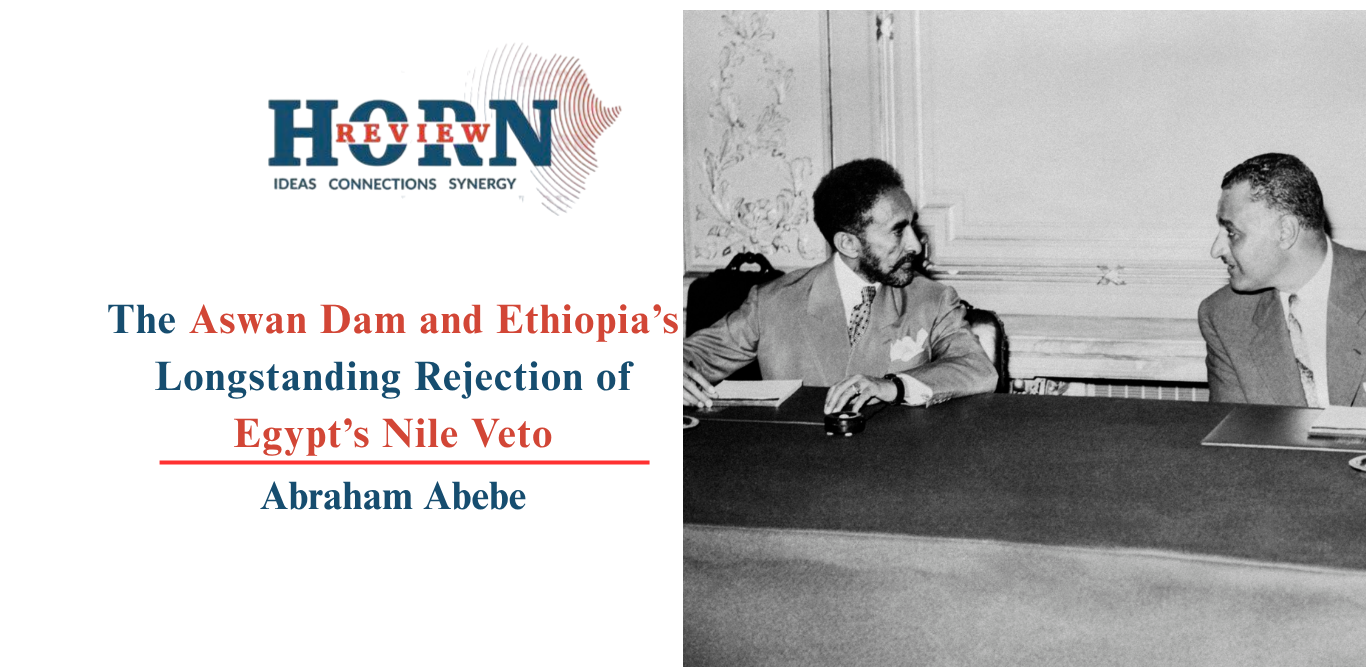
On 29 May 1956, before construction of the Aswan High Dam began, the United States Embassy in Addis Ababa sent the U.S. Government a telegram recording Ethiopia’s objection to any attempt to restrict its future use of the Nile. Reporting Emperor Haile Selassie’s reaction to American support for Egypt’s plans, the Embassy stated: “Believe Ethiopia will not now or in future admit that the Aswan Dam project restricts its future use of Nile Waters.” The message captured a position that remains central to Ethiopia’s Nile policy: Egypt’s decision to develop the river could not determine the limits of Ethiopia’s own development. Six decades later, the Grand Ethiopian Renaissance Dam (GERD) has turned this longstanding objection into a tangible challenge to the notion that Egypt’s existing water infrastructure should dictate how upstream countries pursue their development.
The diplomatic significance of this record extends beyond Ethiopia’s objection to one American policy. The Embassy emphasised that the Emperor objected to U.S. support for Egypt’s project without meaningful consultation with other upstream states. It also warned that disregarding Ethiopia’s interests could seriously undermine U.S.-Ethiopia relations. The Embassy called for Ethiopia and other riparian nations to be directly involved in consultations and for major decisions to be based on prior agreement. It therefore recommended collective decision-making on Nile development rather than treating the Aswan project as an isolated undertaking. The telegram documented not only Ethiopia’s opposition to restrictions on its future water use but also the diplomatic consequences of excluding upstream countries from decisions affecting the shared river.
This historical position helps explain the central issue in the modern Nile dispute: the distinction between developing a river for national benefit and claiming authority over how neighbouring countries use it. Egypt’s efforts to secure its water and development interests raise a fundamental question: should existing infrastructure and historical patterns of water use permanently limit other riparian states’ development opportunities? Ethiopia rejected this principle in 1956, long before the GERD was conceived. Its objection reflected a longstanding position that downstream decisions should not determine Ethiopia’s future development.
The GERD has brought this disagreement into practical focus. Built on the Blue Nile in Ethiopia, the dam demonstrates the country’s determination to use its water resources for electricity generation, economic transformation and regional development. It also challenges a historical pattern in which established downstream uses have carried disproportionate weight in determining the politics of the Nile. Ethiopia contributes over 85 per cent of the Nile’s flow through the Blue Nile and other tributaries originating in its highlands. Yet this substantial contribution has not translated into equivalent recognition of Ethiopia’s development interests in historical arrangements governing Nile water use.
Egypt’s opposition to the GERD raises an unavoidable question: on what basis can Cairo claim a veto over Ethiopia’s upstream water use? No riparian state possesses an inherent right to determine the development choices of the entire basin. Egypt’s dependence on the Nile is a serious consideration, but that dependence does not confer exclusive authority over a shared river. Historical patterns of water use, including those established during the colonial era, cannot automatically be treated as permanent entitlements that prevent upstream countries from pursuing legitimate development goals. Ethiopia should not be required to subordinate its economic future indefinitely to Egypt’s preferences.
The Cooperative Framework Agreement (CFA) provides an alternative to this downstream-focused approach. It entered into force on 13 October 2024 for states that ratified it, establishing a framework grounded in equitable and reasonable use, cooperation and sustainable development. These principles challenge the assumption that the Nile’s future should be shaped primarily by established downstream practices. The CFA provides a basis for recognising the interests of upstream countries, Egypt and Sudan, rather than treating colonial-era allocation patterns as the default reference for future development decisions.
Egypt should therefore engage constructively with the CFA and the principles of basin-wide cooperation. Continued reliance on colonial claims cannot resolve the fundamental disagreement over how the Nile’s resources should be shared. A sustainable framework must acknowledge the legitimate development needs of upstream countries and prevent any single state from exercising unilateral authority over water-use decisions. Ethiopia’s position illustrates the importance of equitable utilisation: its contribution to the Nile does not entitle it to control the entire river, just as Egypt’s historical use does not entitle it to veto upstream development. Egypt’s failure to contribute water to the Nile further underscores why its downstream position cannot serve as the basis for exclusive authority over the basin.
Rejecting an Egyptian veto does not mean rejecting international water law. Shared rivers require cooperation, and development must comply with applicable international obligations. The 1997 UN Convention on the Law of the Non-Navigational Uses of International Watercourses establishes equitable and reasonable utilisation, cooperation and the duty to prevent significant harm as core principles for governing shared watercourses. These principles must be considered together. The obligation to prevent significant harm does not automatically freeze existing patterns of water use or give downstream states an unrestricted right to block upstream projects. Equally, the right to development does not exempt a state from considering how its actions may affect other riparian states.
Applied to the GERD, this framework affirms Ethiopia’s right to use its water resources in accordance with equitable and reasonable utilisation. It calls for cooperation that respects the legitimate interests of all riparian states, rather than an arrangement in which Ethiopia’s development remains subject to Egypt’s unilateral approval. Egypt cannot make direct involvement in the dam’s operation a precondition for accepting its existence. Consultation should facilitate cooperation and the management of shared interests, not become a mechanism for denying Ethiopia the benefits of developing its own resources. The objective should be to manage the river fairly without preserving one country’s historical advantage at the expense of another’s future.
The historical record therefore reinforces the contemporary legal and political argument. Ethiopia’s opposition to Egypt’s attempt to control Nile development unilaterally predates the Aswan High Dam. The 1956 telegram demonstrates that Ethiopia rejected the principle that Egypt’s development of the river could determine or restrict Ethiopia’s future water use. The GERD has brought this longstanding disagreement into sharper focus, exposing the limits of an approach that treats downstream infrastructure and historical use as grounds for controlling upstream development. Resolving the dispute requires cooperation, but neither historical arrangements nor unilateral demands can override equitable and reasonable utilisation among riparian states.
For Ethiopia, the historical lesson is unmistakable. In 1956, it explicitly rejected the idea that the Aswan High Dam could restrict its future use of Nile waters. The GERD has brought that longstanding position into practice, challenging the assumption that Egypt’s historical use of the river can determine Ethiopia’s development prospects. The Nile’s future must not be governed by the precedent of an earlier downstream project, but by equitable and reasonable utilisation, cooperation and recognition of the development interests of all riparian states.
By Abraham Abebe, Researcher, Horn Review