
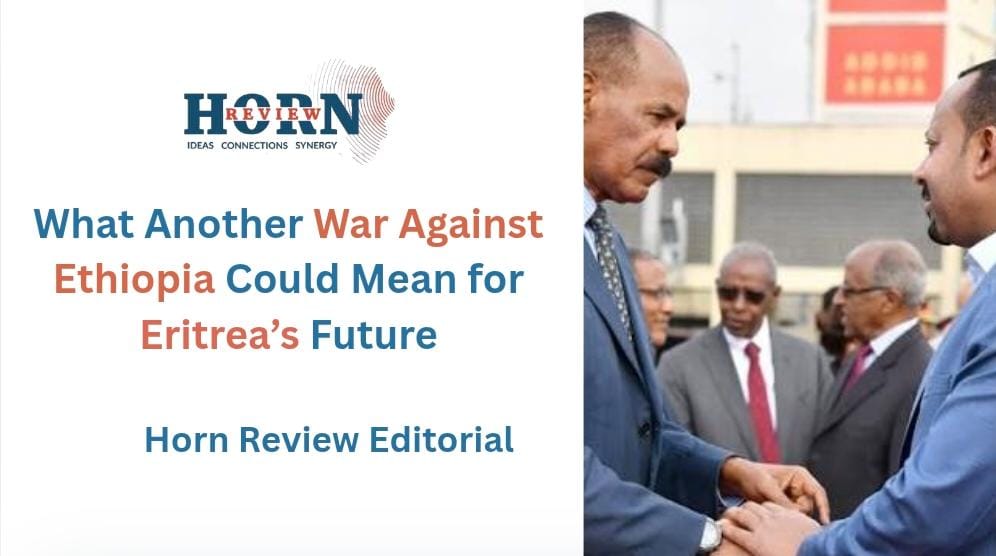
What Another War Against Ethiopia Could Mean for Eritrea’s Future
Another Ethiopia–Eritrea war would not be a replay of 1998. The geography would be familiar, the historical grievances would be recognizable, and the central actors would again include Addis Ababa and Asmara, but the strategic environment surrounding them has changed profoundly. The conflict would unfold in a Horn of Africa already fragmented by the war in Sudan, sharpened by competition over the Red Sea, transformed by Gulf rivalries, complicated by Egypt’s confrontation with Ethiopia over the Nile, and increasingly penetrated by external powers whose interests intersect but do not necessarily coincide with those of the regional states. Most importantly, Eritrea would not be confronting Ethiopia in isolation. The emerging configuration around northern Ethiopia suggests something considerably more complicated: an interaction among Eritrea, elements of the TPLF, armed actors in Sudan, and external states whose interests converge around containing Ethiopia’s strategic ascent.
From an Ethiopian strategic vantage point, therefore, the central question is not whether Ethiopia could defeat Eritrea in another conventional war. That framing is too narrow and, in some respects, strategically misleading. The more consequential question is what a renewed conflict would do to the balance of power in the Horn, whether Eritrea could sustain a prolonged confrontation with a state possessing vastly greater demographic and economic depth, and whether an attempt to constrain Ethiopia could instead accelerate the very regional transformation that Asmara has sought to prevent. The answer is likely to depend less on the opening phase of a conflict than on what follows it. Eritrea has considerable military experience, difficult terrain, a highly mobilized security state and a demonstrated willingness to absorb extraordinary costs. It would be a serious mistake for Addis Ababa to translate Ethiopia’s demographic and economic superiority mechanically into an assumption of rapid military victory. Yet the structural asymmetry between the two states is undeniable. Ethiopia’s population is more than thirty times Eritrea’s, while the disparity in economic and military scale is even greater. Ethiopia therefore possesses a depth of manpower, economic activity and potential logistical capacity that Eritrea cannot easily reproduce. Such asymmetry does not decide wars by itself, but it becomes increasingly consequential as a conflict moves from a short campaign into a contest of endurance.
That distinction was less important in the first hours of the 1998–2000 Eritrean war against Ethiopia than it would be in a prolonged twenty-first-century conflict. Modern warfare is not sustained by courage and manpower alone. It consumes fuel, precision munitions, drones, air-defence systems, communications equipment, transport capacity, intelligence assets,artificial intelligence, cyber and drone weapons, foreign currency and industrial inputs. The longer a conflict lasts, the more the economic structure beneath the military establishment becomes decisive. Ethiopia’s current economic trajectory, despite some of its vulnerabilities, gives it a fundamentally different capacity for replenishment and adaptation than Eritrea’s tightly controlled and internationally isolated economic system. This does not mean that Ethiopia should seek such a war. Quite the opposite. From an Ethiopian national-interest perspective, the objective has always been to prevent a military confrontation from becoming the mechanism through which Ethiopia attempts to solve problems that are fundamentally political and strategic. The strongest Ethiopian position is not that Eritrea must be defeated. It is that Eritrea must not be permitted to acquire a durable veto over Ethiopia’s sovereignty, internal political order, maritime interests or regional economic development. That distinction is essential because the immediate military question obscures a larger transformation taking place around the Red Sea.
Ethiopia’s landlocked status is no longer merely an economic inconvenience. It has become a strategic variable. Roughly 90 percent of Ethiopia’s external trade has historically moved through Djibouti, creating an extraordinary dependence on a single maritime corridor. Ethiopia’s search for alternative access through Berbera and other routes is therefore not reducible to an appetite for territorial expansion; it is also a rational response to structural dependence. Eritrea’s possession of Assab and Massawa consequently gives it an asset of enormous strategic significance. But that asset can be understood in two fundamentally different ways. Asmara regards its coastline as a shield against Ethiopian strategic ambitions, to contain the latter. Ethiopia largely regards the same coastline as evidence of Eritrea’s motivation to its maladaptive and adverse diplomatic positioning in the region, and of the unresolved structural consequences of Eritrean secession leading to its unjust abruption from independently accessing the Red Sea maritime corridors. The collision between these two perceptions lies near the heart of Eritrea’s disruptive conduct and unceasing subversion against the Ethiopian state. However, it has to be dully noted that Eritrea’s subversion and proxy confrontation does long precede Ethiopia’s pursuit for access to the sea. It predates not only Ethiopia’s current administration but Eritrea’s very statehood itself.
Yet there is an important strategic paradox for Eritrea. Any form of military or proxy attempt to strategically suffocate Ethiopia has only made Ethiopian maritime ambitions more just, more urgent, more politically entrenched and more geographically dispersed. Ethiopia’s perception that its legitimate pursuit for access to the sea is unfairly threatened by any single neighboring state has only led to its rational response to not necessarily to concentrate exclusively on a single sea outlet. Rather to construct a portfolio of maritime options that results in an Ethiopian state that is progressively less dependent upon any single coastal state. This is why the question should not be reduced to whether Ethiopia wants Assab. The more important question is whether Ethiopia can construct a strategic environment in which no neighboring state possesses the ability to turn Ethiopia’s geography into a permanent constraint on its national development and national security. That is the first major paradox of a new war: a confrontation intended to contain Ethiopia’s maritime ambitions could accelerate its institutionalization.
The second paradox concerns Tigray. The most consequential change since the 2020 Tigray war is that the northern Ethiopian theatre is no longer simply a bilateral Ethiopia-Eritrea frontier. The Tigray question has become the principal internal variable through which external actors can influence Ethiopia’s northern security environment. The reversal in relations between Eritrea and hardliner elements of the TPLF is particularly significant. Eritrean forces fought alongside Ethiopian federal forces against the TPLF during the 2020–2022 war with their own pretext and political calculations; yet following Eritrea’s conduct during the war and its subsequent Pretoria agreement, Eritrea remained outside the settlement and relations with Addis Ababa deteriorated sharply. The TPLF subsequently moved back toward a more confrontational posture against the federal government, culminating in the restoration in May 2026 of its pre-war regional political structure under Debretsion Gebremichael. This apparent convergence between Asmara and the TPLF hardliners therefore deserves careful treatment. It should not be described simplistically as a permanent Eritrea–TPLF alliance. The historical relationship between the two is too antagonistic for that interpretation to be analytically satisfactory. There have been increased documented Eritrean engagement with the TPLF and the possibility of Egyptian, Sudanese and Eritrean support for its military objectives. Here, it is important to note proxy relationships are inherently unstable. The interests of the Eritrean regime and the TPLF will rarely remain perfectly aligned once the immediate objective changes. For Eritrea, a TPLF force capable of pressuring Addis Ababa is strategically useful. But a powerful, autonomous ethnic Tigrayan political-military entity immediately south of Eritrea is not necessarily desirable in the longer term. The TPLF, meanwhile, may view Eritrean assistance as a means of regaining political leverage within Ethiopia, but that does not mean Tigrayan interests are identical to Eritrean strategic interests. The two parties may therefore cooperate tactically while competing over the political order that would emerge after any confrontation. This is precisely where Ethiopia possesses an underappreciated strategic opportunity.
The federal government’s strongest response to Eritrea–TPLF convergence has not necessarily been to treat every political actor within the TPLF as an extension of Asmara. There is sufficient clarity within the Ethiopian establishment that such an approach would risk converting an external security problem into a self-reinforcing internal conflict. Ethiopia’s objective has instead been to separate legitimate Tigrayan political interests from the strategic calculations or miscalculations of external actors. Hence Eritrea lost much of the value of the proxy relationship. However, Ethiopia still confronts the most dangerous scenario imaginable: not an imminent conventional war with Eritrea, but a sustained northern security crisis in which Eritrean forces exert pressure from outside and inside the border while TPLF forces escalate the pressure from within, with the possibility of additional supply, financing and diplomatic support arriving through Ethiopia’s adjacent and distant neighbors. That is why the emerging proxy dimension is as important as the bilateral military balance. A war involving Eritrea and Ethiopia has certainly been fought politically for the past two years before it is fought militarily. The first battlefield has been attribution. Eritrea had repeatedly attempted to establish Ethiopia had initiated the ground for aggression, while it continued to consistently violate Ethiopia’s sovereignty, support proxies and orchestrate subversive activities. Ethiopia, by contrast, has strongly maintained a clear distinction between its national-security objectives and any rhetoric suggesting territorial expansion, and repeatedly called for mediation and dialogue with Isayas Afeworki’s regime..
This is especially important because Addis Ababa has already formally accused Eritrea of military aggression, territorial occupation and support for armed groups inside Ethiopia. In February 2026, Foreign Minister Gedion Timothewos demanded Eritrean withdrawal from Ethiopian territory and an end to support for armed groups, while simultaneously stating that Ethiopia remained open to dialogue on maritime matters, including access through Assab. Eritrea rejected Ethiopia’s accusations with no substantial argument, rather the usual summary dismissal. That diplomatic positioning is strategically valuable for Ethiopia. It allowed Addis Ababa to clearly frame the issue not as a demand for Eritrean territory, but as a question of sovereignty, non-interference and regional security. That distinction should be preserved with exceptional discipline. Eritrea was aiming its framing of “territorial revisionism” by Ethiopia would allow it and its allies to transform an Eritrean military intervention or proxy conflict into a broader diplomatic campaign against Ethiopian ambitions. Ethiopia instead consistently and efficiently framed its position around territorial integrity, reciprocal sovereignty, negotiated maritime access and opposition to cross-border proxy warfare; positions which now possess a stronger legal and diplomatic foundation.
The regional environment makes this contest over narrative even more important. Egypt cannot be treated as an incidental actor in the emerging equation. Cairo’s strategic concerns about Ethiopia are not confined to the Nile and the Grand Ethiopian Renaissance Dam. They are also rooted in the Red Sea and its broader conception of its strategic depth in northeastern Africa. The GERD was inaugurated in September 2025, and Egypt has continued to regard Ethiopia’s control over the Blue Nile as a matter of national security. At the same time, Egypt has deepened relationships with states surrounding Ethiopia, including Sudan, Eritrea, Somalia and to an extent, Djibouti. From an Ethiopian perspective, however, Egypt’s role should be analysed without reducing every regional development to a single Egyptian conspiracy.
Cairo has its own interests. So does the Eritrean regime, Sudan’s SAF, the TPLF and so forth. Even numerous Gulf states pursue their own commercial and security agendas. These interests overlap at particular moments, but they are not identical. That is precisely why Ethiopia regarded the emerging configuration as a network of converging interests rather than a monolithic alliance. Nonetheless, it’s no doubt that Egypt’s incentive is to constrain Ethiopia’s strategic freedom, particularly on the Nile and in the Red Sea. Eritrea’s incentive is to prevent Ethiopia from becoming sufficiently powerful in the region, which is perceived as a threat by Isayas Afeworki’s establishment. Radical elements of the TPLF seek to recover economic and political dominance, and territorial leverage within Ethiopia. Sudan’s military establishment has its own security and irredentist calculations that has increasingly intersected with Eritrea’s strategic position. Gulf actors are competing for influence over ports, trade routes, agricultural resources and the security architecture of the Red Sea. Saudi Arabia and the UAE, in particular, have developed competing regional networks, while the wider Gulf rivalry increasingly intersects with conflicts in Ethiopia, Sudan, Somalia, and Eritrea. The consequence is that Ethiopia faces a situation in which several actors benefit from limiting Addis Ababa’s strategic freedom without sharing a common long-term project. That distinction has shaped Ethiopian diplomacy for a while now. The objective, though, is not to defeat an imagined unified anti-Ethiopian bloc. It is to prevent temporary convergence among otherwise competing actors from becoming a durable strategic coalition. This is particularly relevant to Sudan. The Sudanese war has transformed Ethiopia’s western strategic environment. Eritrea has maintained political and military support for the Sudanese Armed Forces, while the Sudanese conflict has simultaneously created opportunities for external powers to establish networks extending across the Red Sea and the Horn. The possibility of Sudanese actors becoming involved in the northern Ethiopian theatre therefore creates a second axis of pressure on Ethiopia.
That said, a future Ethiopia–Eritrea conflict could consequently become regionalized through two distinct mechanisms. The first would be direct military intervention. The second, and arguably more dangerous, would be logistics. Weapons, financing, intelligence, sanctuary, political recognition and commercial networks can be more consequential than formal military alliances. The emergence of proxy warfare throughout the Horn means that a state does not necessarily need to deploy large numbers of troops to alter the military balance of another country. This is why Ethiopia’s western frontier and northern frontier can no longer be analysed independently. An Eritrea–TPLF configuration supported by the Egyptian and Sudanese networks had already created a potential strategic corridor of pressure extending from the Eritrean border toward western Tigray and the Sudan frontier. For Ethiopia, that scenario is more dangerous than a conventional border confrontation because it would create strategic ambiguity. Addis Ababa now finds itself fighting an adversary without a single identifiable front, while external proxy stakeholder states maintain plausible deniability.
The appropriate Ethiopian response is now therefore beyond troops at the border. It is the development of a more sophisticated national-security architecture capable of identifying, attributing and disrupting transnational support networks before they well mature into military campaigns. This is also where Egypt’s role becomes more complicated. Cairo does not necessarily need Eritrea for a military victory against Ethiopia. From an Egyptian strategic perspective, it may be sufficient for Ethiopia to remain preoccupied with internal and northern security challenges, because prolonged instability reduces Addis Ababa’s capacity to concentrate on economic transformation, maritime expansion and regional diplomacy. A weakened Ethiopia is strategically different from a defeated Ethiopia, and the latter may not even be desirable for Egypt because state collapse would produce uncontrolled consequences across the Nile Basin and Red Sea. Here, Ethiopia should be cautious about interpreting Egyptian policy solely through the language of confrontation. Egypt’s strategic interest may be better understood as constraint: preventing Ethiopia from converting its demographic, economic and geographic potential into disproportionate regional influence. That is a contest Ethiopia can manage. It is however considerably harder to manage a regional war, and that is what Egypt is leaving at Ethiopia’s doorsteps – a regional war. Eritrea, however, has become the principal military instrument through which Egypt’s broader containment strategy is executed without possessing the strategic depth required to control its consequences. This is the third major paradox. Eritrea could bear the immediate costs of a confrontation whose strategic benefits accrue disproportionately to other actors. Egypt can remain geographically removed from the battlefield. Gulf states can recalibrate. External powers can change diplomatic positions. Sudanese actors can pursue their own war. TPLF leaders can negotiate with the Federal Government when circumstances change. Eritrea, by contrast, would remain physically adjacent to Ethiopia bearing all the costs of the war in the aftermath of it.
This asymmetry has been central to Ethiopian strategic thinking. The country that shares the border with Ethiopia has the least room to make strategic mistakes. A prolonged war would also expose Eritrea to a problem that cannot be solved through military success alone: demographic sustainability. Eritrea’s system of prolonged national service and militarization has historically provided the state with extraordinary mobilization capacity, but it has also contributed to persistent migration and international criticism. Leading Human Rights Institutions continue to document the extensive and indefinite character of national service and the country’s severe restrictions on political and civic life. A major new war would therefore impose its costs upon a society already structured around prolonged mobilization. This creates a potential feedback loop: renewed war requires greater mobilization; greater mobilization increases social and economic pressure; increased pressure encourages further emigration; emigration reduces the available human base; a shrinking human base requires greater coercive mobilization of those remaining. Such a cycle could weaken the very social foundations upon which Eritrea’s security model depends. Again, this does not imply imminent collapse. It means that Eritrea’s strategic margin for sustained confrontation is narrower than the battlefield alone suggests.
Ethiopia understands this asymmetry but does not seek to exploit it through indiscriminate destruction. That would be strategically counterproductive. The Ethiopian interest is not a collapsed Eritrea. A collapsed Eritrea would create precisely the kind of instability Ethiopia seeks to avoid: refugee flows, uncontrolled armed groups, weapons proliferation, competing external interventions, disruption of Red Sea shipping and potentially an ungoverned coastline of extraordinary strategic importance. For Ethiopia, therefore, the ideal outcome is not Eritrean state failure.It
is Eritrean strategic moderation. This is perhaps the most important distinction between Ethiopia’s mature national strategy and Eritrea’s maximalist war strategy. A stable Eritrea whose ports are commercially integrated with Ethiopia would serve Ethiopia’s interests far better than a devastated Eritrea whose territory becomes another theatre of proxy competition. The same logic applies to Ethiopia’s Tigray. A stable Tigray region is not merely a humanitarian objective. It is an Ethiopian national-security imperative. Every unresolved political dispute in Tigray creates an opportunity for external actors to intervene. Every armed faction operating outside a durable political settlement creates an entry point for foreign intelligence services, weapons networks and regional patrons. Every dispute over territory becomes a potential pretext for mobilization. The strategic task for Addis Ababa is now therefore to prevent Tigray from becoming the Horn’s equivalent of a permanent geopolitical fault line – denying external actors the legitimacy, local partnerships and logistical space required for proxy warfare. The Pretoria Agreement remains relevant precisely because its incomplete implementation has left unresolved political and security questions.
The TPLF’s restoration of its pre-war political structure in May 2026 demonstrated how fragile the post-war settlement remains. But Ethiopia also recognizes that a purely coercive approach could strengthen the very external actors it seeks to contain, hence its long held strategic restraint in the face of TPLF’s unceasing provocations for the past one or two years. Had Tigrayan political grievances been treated exclusively as security threats, Eritrea would have had a greater opportunity to present itself as a protector or strategic partner. With that understanding, Addis Ababa instead succeeded in separating political competition from military confrontation, neutralising the external proxy space contracts to an extent. This is why the TPLF cannot simply be removed from the equation by describing it as an Eritrean proxy. It is a political establishment, however eroding, with its own historical base, institutions, military structures and interests. Eritrea can influence it, assist it or align with parts of it, but cannot simply command it and that is going to continue to challenge the durability of the TPLF-EPLF/PFDJ alliance. That distinction should inform Ethiopian intelligence and diplomacy. The strategic imperative for Ethiopia is to fracture the external coalition by differentiating its components rather than treating them as a single enemy.
The same principle applies to the Gulf. The Horn is increasingly embedded within a Red Sea security system in which Saudi Arabia, the UAE, Qatar, Turkey and others possess overlapping economic and security interests. Saudi–UAE rivalry had increasingly intersected with conflicts and alignments across Sudan and Somalia. Ethiopia therefore has an opportunity to avoid becoming dependent upon any single external patron. Its diplomatic objective is now strategic diversification. Relations with the Gulf are conducted issue by issue rather than through bloc politics. Ethiopia has deepened economic relationships with states that benefit from Ethiopian growth while resisting the conversion of investment, ports or security cooperation into instruments of strategic dependence. The same principle applies to Turkey, China, the United States, Europe and the wider international system. Ethiopia does not intend to choose a bloc, rather to ensure that no bloc can determine Ethiopia’s strategic future without its consultation and consent. This becomes especially important in Washington.
For the United States and European partners, an Ethiopia–Eritrea war would not be merely another African conflict. It would threaten the security of the Red Sea, potentially destabilize Sudan further, create new displacement, complicate counterterrorism efforts in the Horn and disrupt one of the world’s most strategically important maritime corridors. Ethiopia has repeatedly made its case internationally in terms that connect its national interests to broader regional stability. The argument is straightforward: Ethiopia seeks peaceful maritime access, respect for its territorial sovereignty and an end to cross-border support for armed groups. It does not require the destabilization of Eritrea to achieve these objectives. Ethiopia’s maritime problem is real and it has considerably demonstrated its position that the solution to this specific problem is not a military one. The Ethiopian establishment has no appetite for war with Eritrea, unless otherwise dragged into it with the Eritrean regime’s unprovoked attack and aggression.
The February 2026 Ethiopian diplomatic position stated in a letter by the Ethiopian foreign minister, Gedion Timotewos, to his Eritrean counterpart Osman Saleh, itself demonstrated that Addis Ababa can combine firmness on sovereignty with openness to negotiations over maritime access, including Assab. This is strategically important because it leaves Eritrea with a choice. Either Isayas Afeworki continues to treat Ethiopia’s maritime aspirations as an existential threat and continues his subversion, militarization and proxy warfare. Or it recognizes that Ethiopia’s desire to stabilize and prosper, and its demand for diversified maritime access is unlikely to disappear and seek to monetize geography rather than militarize it. The second option would potentially transform Eritrea’s coastline from a strategic liability into an economic asset. The Red Sea could become a platform for economic integration rather than a permanent theatre of strategic rivalry. The irony is that this outcome would require precisely the kind of confidence in sovereignty that Eritrea’s current security doctrine has often sought to project but failed to obtain through militarization. From Ethiopia’s perspective, that is the strategic end-state worth pursuing.
Because if the question is what another war could mean for Eritrea’s future, the answer should not be limited to battlefield losses. A war could expose the limits of Eritrea’s demographic base, strain its economy, intensify migration, increase its dependence on external patrons, and transform the country from an autonomous regional actor into a theatre through which other states pursue their own strategic objectives. That last danger may be the most serious. The Horn’s history is full of wars in which local states became instruments of broader geopolitical competition. The current environment is even more susceptible to that pattern because the Red Sea has acquired extraordinary global importance, while the wars in Sudan and Gaza, the Houthis’ disruption of maritime traffic, Gulf competition and the strategic rivalry surrounding the Nile have all expanded the number of actors with interests in the region. Eritrea could therefore find itself fighting Ethiopia while others determine the political value of the conflict. That is a dangerous bargain.
For Ethiopia, the strategic lesson is equally important. Addis Ababa should not underestimate Eritrea, assume a quick military victory, and mistake structural advantages for immunity from strategic failure. Ethiopia’s vulnerabilities remain substantial: internal political fragmentation, unresolved tensions with the TPLF, the Sudan border threats, economic pressures and the possibility of multiple simultaneous security theatres. But Ethiopia also possesses advantages that no external actor can easily replicate: a strong military, a large demographic scale, geographic depth, economic potential, diplomatic weight, a large domestic market and the ability to build relationships simultaneously with multiple regional and global powers. The objective has been to convert those advantages into strategic resilience by strengthening the northern frontier without allowing militarization to become a substitute for politics; building a sophisticated foreign-intelligence and counter-proxy capability; maintaining diplomatic pressure on Eritrea while preserving channels for negotiation; preventing Tigray from becoming a permanent externalized security theatre; legitimising its port diversification and maritime access agenda; deepening relations across the Gulf without becoming captive to Gulf rivalries; and making Ethiopia’s Red Sea policy an economic and diplomatic project rather than a purely military one.
Most importantly, Ethiopia understands that the principal threat is not necessarily an Eritrean invasion or even an Eritrean–Ethiopian conventional war. The greater danger is strategic fragmentation. An Ethiopian state simultaneously confronted by an Eritrean military pressure campaign, an armed TPLF resurgence, instability along the Sudan border, Egyptian diplomatic sabotage, competing foreign interventions and additional regional security crises could be weakened without any one adversary ever defeating it. That is the logic behind Egypt’s proxy warfare spearheaded by the Eritrean regime. It is not to conquer Ethiopia rather to keep it sufficiently occupied, internally divided and externally constrained that it cannot translate its underlying national capabilities into strategic power.
For Ethiopia, this is the equation that matters most. It therefore needs to look beyond the question of whether Eritrea would win or lose a war. The more consequential question is whether Ethiopia can prevent its adversaries from transforming its internal political fractures and geographic vulnerabilities into a durable regional containment system. That requires military deterrence, but it requires much more than military deterrence. It requires political consolidation, intelligence and counter-intelligence efficiency, diplomatic sophistication, economic resilience and willingness to distinguish between actors who are temporarily aligned against Addis Ababa and actors whose long-term interests genuinely require Ethiopia’s strategic subordination.
The Eritrean leadership may believe that another confrontation can preserve its strategic autonomy by preventing Ethiopia from becoming a Red Sea power. Yet the opposite outcome is entirely possible. By escalating militarily, Asmara could accelerate Ethiopian maritime diversification, deepen Ethiopia’s security partnerships, harden Ethiopian public opinion around Red Sea access and encourage Addis Ababa to treat maritime security as a permanent pillar of national strategy.
In that sense, Eritrea’s greatest strategic danger may not be military defeat, rather strategic irrelevance. Eritrea will face a choice between remaining a militarized frontier state whose strategic importance depends upon Ethiopia’s insecurity and becoming a sovereign coastal state whose prosperity derives from Ethiopia’s economic rise.
For Ethiopia, the choice has been clear. It neither Eritrea’s collapse nor its subordination. It seeks a regional order in which Eritrea cannot threaten Ethiopia’s sovereignty, Tigray region cannot be weaponized indefinitely by external actors, Egypt cannot convert the Nile dispute into a comprehensive regional containment strategy, Sudan cannot become a permanent pressure point on its western frontier, and Gulf and other foreign competitions cannot turn Ethiopian territory or neighboring states into proxy theatres. The ultimate Ethiopian objective is therefore neither war nor appeasement. It is strategic freedom. A sovereign Ethiopia that is able to secure its territory, diversify its access to the sea, pursue its economic development and conduct an independent foreign policy without granting any neighboring state,or any coalition of external actors,the ability to veto those choices.
And that is precisely why another war with Ethiopia could prove so consequential for Eritrea. Asmara may enter such a conflict believing that it is defending the strategic order that secured Eritrean secession. But the war will instead accelerate Ethiopia’s maritime diversification, strengthen its security institutions, consolidate its northern frontier and fragment the very proxy architecture designed to contain it. And Eritrea would emerge from the conflict not only having lost/won battles but also losing the larger strategic contest. The most dangerous war for Eritrea, in other words, may not be the war it loses. It may be the war that changes the regional balance of power permanently against it.
By Horn Review Editorial

RELATED
Posts
15
Oct
The Aswan Dam and Ethiopia’s Longstanding Rejection of Egypt’s Nile Veto
On 29 May 1956, before construction of the Aswan High...
15
Oct
Why Somalia’s Hedge between Ethiopia and Egypt Cannot Last
The public position articulated by Somalia’s Deputy Foreign Minister Hassan...
15
Oct
Ethiopia Somaliland Defence Ties and the Practice of Keeping the Door Ajar
The recent meeting between Brigadier General Nimcaan at the...
15
Oct
Ethiopia’s Right to Self-Defence and the Strategic Fallacy of Symmetrical De-escalation
The growing calls for de-escalation to the Ethiopia–Eritrea crisis risks...
12
Oct
Ethiopia or Eritrea, Who Is the Aggressor?
Eritrea has answered, in kind, a letter that Ethiopia...

9
Oct
Eritrea’s Post-Pretoria Strategy and the Escalation in Ethiopia
Our latest report examines Eritrea’s post-Pretoria trajectory and how selective...
8
Oct
After Years of Turnover, Ethiopia Chooses Continuity in Its Foreign Ministry
Abiy Ahmed’s decision to retain Gedion Timothewos as foreign minister...
8
Oct
Ethiopia’s Northern Crisis: Actors, Interests and the Anatomy of Escalation
Our latest report, examines the renewed conflict in northern Ethiopia...
7
Oct
“Decaffeinated Sovereignty”: Eritrea’s One-Way Street with Ethiopia
There is a peculiar contradiction at the heart of Eritrea’s...
7
Oct
Leaked Documents Allege Sudanese Army Weapons Pipeline to TPLF-Aligned Forces as Tigray War Reignites
Leaked documents alleging a Sudanese army weapons pipeline to TPLF-aligned...