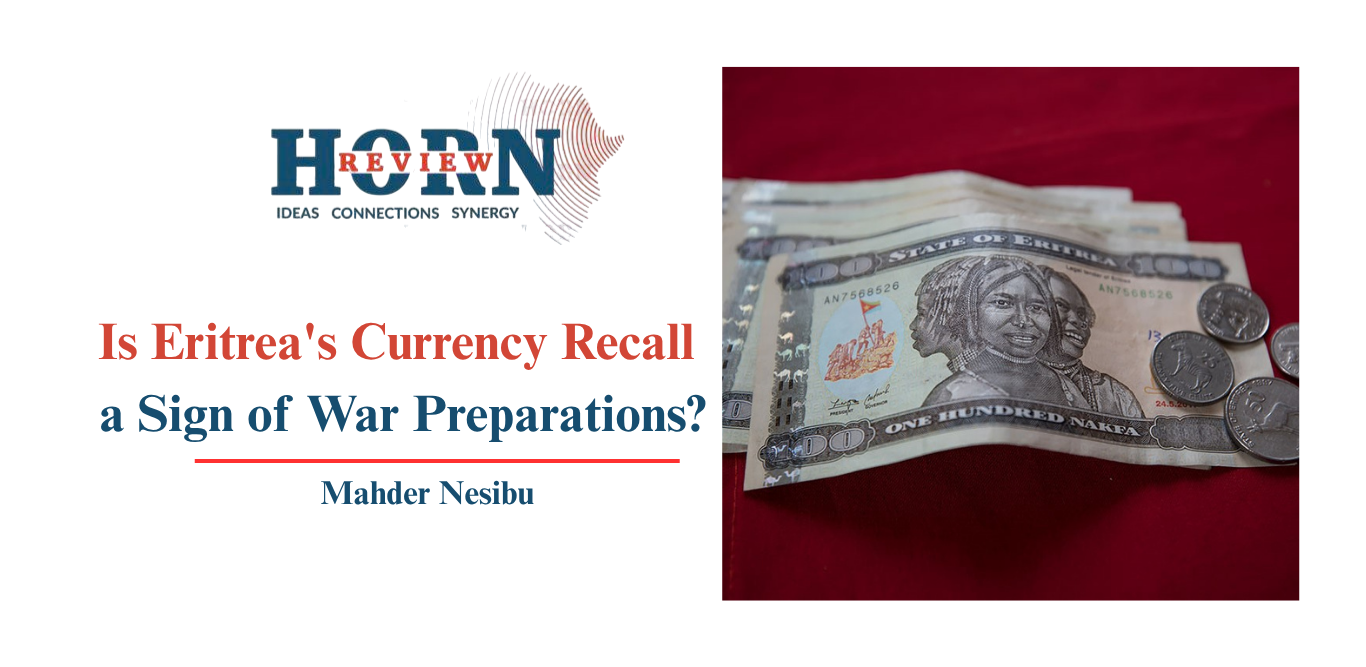
In March this year, news by The Reporter, a prominent Ethiopian outlet, revealed that the Eritrean Nakfa had become a major note in the informal markets increasingly prevalent in Tigray. This has been read as one explanation for Asmara’s decision this month to recall all Nakfa in circulation, with the central bank ordering that all cash holdings be deposited into bank accounts no later than July 31.
The Eritrean economy is as dysfunctional as it is opaque. No formal understanding of how it functions is available, since the regime maintains no formal relationships with international economic and financial institutions and discloses almost nothing about it. Its dysfunction is nonetheless visible. It has operated under the chokehold of the PFDJ, the People’s Front for Democracy and Justice, Eritrea’s sole ruling party since the country’s secession from Ethiopia in 1991; and has endured two decades of crippling sanctions tied to the permanent war footing the PFDJ leadership has kept the country on.
The Nakfa itself sits under strict regime control. Eritreans may withdraw only 5,000 Nakfa from the bank per month and must seek special permission to withdraw more. No functioning digital banking system exists, and cash exchange dominates trade. More significantly, the Nakfa cannot be legally exchanged for other currencies, including the dollar, since Eritreans have no independent role in the country’s import and export trade. That role belongs to the Red Sea Trading Corporation (RSTC), among other entities, all operating under Hagos Gebrehiwot, the regime’s Head of Economic Affairs and the President Isaias Afwerki’s principal financial operator. Established in the early 1990s as a party-controlled trading arm, the RSTC has since grown into Eritrea’s de facto sovereign wealth fund and its sole gateway to hard currency.
The Nakfa is best understood as a purely domestic currency, applicable only in an economy whose production and consumption at every stage remain under regime control. The RSTC, meanwhile, controls the country’s access to international currency, primarily the US dollar, through its monopoly on exports and its grip on remittance flows from the large Eritrean diaspora, reinforced by the mandatory two percent tax levied through Eritrean embassies abroad.
In recent years, however, northern Ethiopia and Sudan, both marked by conflict and instability, have grown increasingly reliant on the Nakfa for cross-border trade. In Tigray, where the Tigray People’s Liberation Front (TPLF) has established a fragile hold in opposition to the Ethiopian government, markets have increasingly adopted the Nakfa as governance has broken down and the flow of goods from Ethiopia’s other regions into Tigray has weakened, as the threat of renewed confrontation has grown since the conclusion of the 2020–2022 conflict in the region.
More critically, gold flowing from Tigray into Eritrea, driven by illegal mining the TPLF has pursued to shore up its finances, has induced something of a gold rush and has in turn become a catalyst for the growing alignment between the Eritrean regime and the TPLF leadership. Eritrea’s powerful generals, who control illegal cross-border trade including human smuggling, have benefited from this flow of gold and refugees out of Tigray, and appear in parallel to have mended relationships with their TPLF counterparts, men they fought against in the Tigray conflict only a few years earlier.
A similar pattern appears to be developing with Sudan, where cross-border trade has long persisted despite recurring border closures tied to the fluctuating relationship between Asmara and Khartoum. With the regime now aligned with the Sudanese Armed Forces (SAF), which alongside its allies controls the Sudanese territory bordering Eritrea, this trade appears to be flourishing. Cross-border ethnic groups, namely the Beni Amer, a community straddling the Eritrea-Sudan border with longstanding ties to both Eritrean security structures and Sudanese Arab-aligned networks, hold access to Eritrea that has made them instrumental to the relationship between Asmara and the SAF.
The regime had issued a similar recall in 2015, distributing new banknotes a year later. Its rationale then centred on Nakfa accumulating in neighbouring Djibouti, Sudan, and Ethiopia, as Eritreans exchanged goods with those countries outside the regime’s supervision, a pattern the regime’s own leadership, particularly the army, has driven. That precedent lends weight to the hypothesis that new banknotes could again follow this recall.
Asmara may be attempting to address the issue by reinforcing control over the currency. But the Eritrean economy may also be facing other pressures, likely forcing the regime to curb consumption among ordinary Eritreans in order to preserve the resources and hard currency reserves it needs for, amongst other clandestine activities, the import of goods. The confrontation between the United States and Israel against Iran, which shut down the Strait of Hormuz intermittently between March and June this year, sent fuel prices sharply upward and triggered fuel shortages across import-dependent economies in the region. The regime has stayed silent on how this has affected the Eritrean economy, and little is known of its adaptation, but as a country wholly dependent on Gulf imports for consumption, like its neighbours across the Horn, it will have felt the strain. The war, which shook the wealthy Gulf states where a significant portion of the financially capable Eritrean diaspora lives and works, has likely disrupted remittance flows as well, suggesting a parallel drop in money reaching the regime.
Or, more troublingly, this could point to a regime preparing for a major confrontation. The PFDJ, in an increasingly visible coalition with the SAF in Sudan and the TPLF in Tigray, has been locked in increasing hostilities towards Ethiopia. What Hagos Gebrehiwot once rationalised as necessary economic discipline during the no-war-no-peace years between Ethiopia and Eritrea may be reasserting itself now, with the country’s resources and its opaque economy again being repurposed, this time for a different confrontation.
By Mahder Nesibu, Researcher, Horn Review