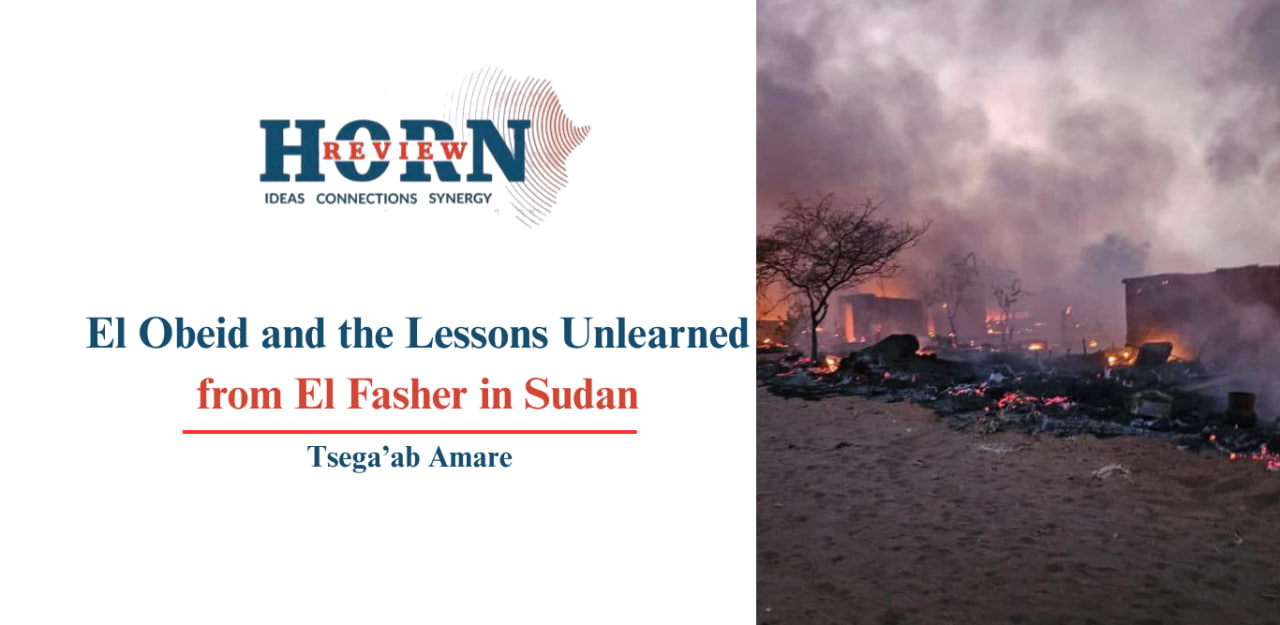
The RSF’s encirclement of El Obeid is the most consequential operational development in Sudan’s civil war since the fall of El Fasher in October 2025. Its significance operates on three levels: strategic, because El Obeid’s position makes its potential fall categorically different from the loss of Darfur; evidentiary, because the RSF’s preparations meet the threshold for operational rather than speculative assessment; and systemic, because the RSF is operating against a precedent it has already tested and found non-binding.
The operational comparison to El Fasher is accurate; the strategic comparison understates what is at stake. El Fasher’s fall in October 2025 completed RSF consolidation of a theater already largely under its control. El Obeid occupies a fundamentally different position. Sitting at the junction of Sudan’s two primary highway arteries, the east-west axis connecting Kordofan to Khartoum and the Nile Valley, and the north-south axis running through South Kordofan toward Sudan’s largest oil hub on the South Sudanese border, captured by the RSF in December 2025, El Obeid is the SAF’s operational headquarters for the entire central Sudan theater. Its fall would sever the SAF’s western supply corridor, eliminate its primary command infrastructure, and deliver the RSF a contiguous territorial arc from Darfur through Kordofan toward the Nile. The contest would shift from whether the RSF can consolidate its western gains toward whether the SAF can hold Sudan’s population heartland at all.
The humanitarian stakes compound the strategic ones. El Obeid is the primary distribution hub for relief operations across Greater Kordofan. UN Secretary-General Guterres described it on June 18 as “a crucial hub for humanitarian response efforts.” The city shelters an estimated 500,000 people, including over 100,000 internally displaced people; its loss would sever distribution chains serving populations across South and West Kordofan with already critically constrained access.
The RSF’s material preparations for an offensive meet the threshold for operational assessment. Since June 10, the group has conducted daily drone strikes on El Obeid. At least eight SAF fuel depots and several tankers have been destroyed, producing widespread shortages and degrading defensive capacity; the main power station was knocked out, cutting water supply and halting multiple hospitals. RSF forces have redeployed from western Sudan to positions near Kazgil and Um Sumeima, accompanied by several dozen armored vehicles and possibly air defense systems. The RSF has simultaneously re-sieged Dilling, 100 miles south of El Obeid, nearly doubling its monthly strikes there since March, while issuing video warnings to El Obeid residents replicating the pattern directly preceding its offensives on Babanusa and El Fasher.
The international response has been procedurally active. On June 18, UN High Commissioner Volker Türk warned explicitly that an imminent offensive risked serious international crime, citing the El Fasher pattern. A 29-nation coalition delivered a joint statement at the Human Rights Council expressing grave alarm at the risk of large-scale atrocities. On June 20, the Security Council demanded the RSF halt its assault, reaffirmed Sudan’s territorial integrity, and called on member states to refrain from external interference fueling the conflict.
Each instrument has a documented ceiling. The High Commissioner’s warnings carry normative weight without operational consequence. The Human Rights Council has no enforcement authority; its previous investigation into El Fasher produced a genocide conclusion, generating sanctions against three RSF commanders and no cessation of hostilities. The Security Council press statement is not a binding resolution; its reference to resolution 2791 (2025) cites a monitoring mandate extended to October 2026, not a new enforcement measure, and its language urging restraint on external interference names no state and attaches to no consequence.
The structural explanation is also identifiable. The UAE’s security and economic relationships with the US, UK, and France consistently place Sudan enforcement below the threshold of bilateral confrontation those governments are prepared to accept. Russia and China’s resistance to sovereignty-intrusive measures provides diplomatic cover that enables the Western P3 to produce unanimous alarm without binding action. The Security Council has issued unanimous statements across every major escalation in Sudan since April 2023; none has constrained RSF operational planning.
The El Fasher precedent is the central analytical problem. Across an 18-month siege under conditions of maximum international documentation, including more than 65 reports by Yale’s Humanitarian Research Lab, sustained Security Council engagement, and a Quad meeting in Washington days before the final assault, the RSF conducted what the UN Fact-Finding Mission concluded in February 2026 was genocide against the Fur, Zaghawa, and other non-Arab indigenous groups. At least 6,000 people were killed in the first 72 hours after the city fell. The RSF redeployed to Kordofan within weeks, the supply chain continued uninterrupted, and the El Obeid encirclement followed. Secretary General Antonio Guterres stated on June 18 that “far too many times in this conflict, clear warnings have failed to trigger concerted action.” This describes a structural condition rather than a coordination failure.
Targeted, named pressure on the Emirati supply architecture is the intervention most likely to carry operational weight. The UAE’s network has demonstrated sensitivity to disruption: the January 2026 closures of Somali overflight access and Libyan corridor constraints produced documented RSF logistical adjustment. Bilateral diplomacy and targeted sanctions against specific companies, aircraft registrations, and transit infrastructure documented by the Panel of Experts impose costs the current approach does not. The international community holds more evidence, stronger legal findings, and a more developed accountability record on Sudan than at any point during the El Fasher siege. The constraint at El Obeid is political rather than epistemic, and that is precisely what the response must address.
For the war to end, however, accountability cannot be selectively applied. Both the SAF and the RSF bear responsibility for conduct that has progressively dismantled Sudan’s political order and inflicted mass civilian harm, and any credible post-conflict framework must address violations across all parties without hierarchy or exemption. Beyond coercive measures, a durable settlement will require the emergence of a coherent civilian coalition capable of articulating minimum national priorities that could be civilian protection, humanitarian access, and a transitional governance framework, and engaging as a central interlocutor rather than a peripheral stakeholder. Without such a civilian anchor, external pressure and military balance alone are unlikely to translate into political resolution, but only into the continuation of war by other means.
By Tsega’ab Amare, Researcher, Horn Review