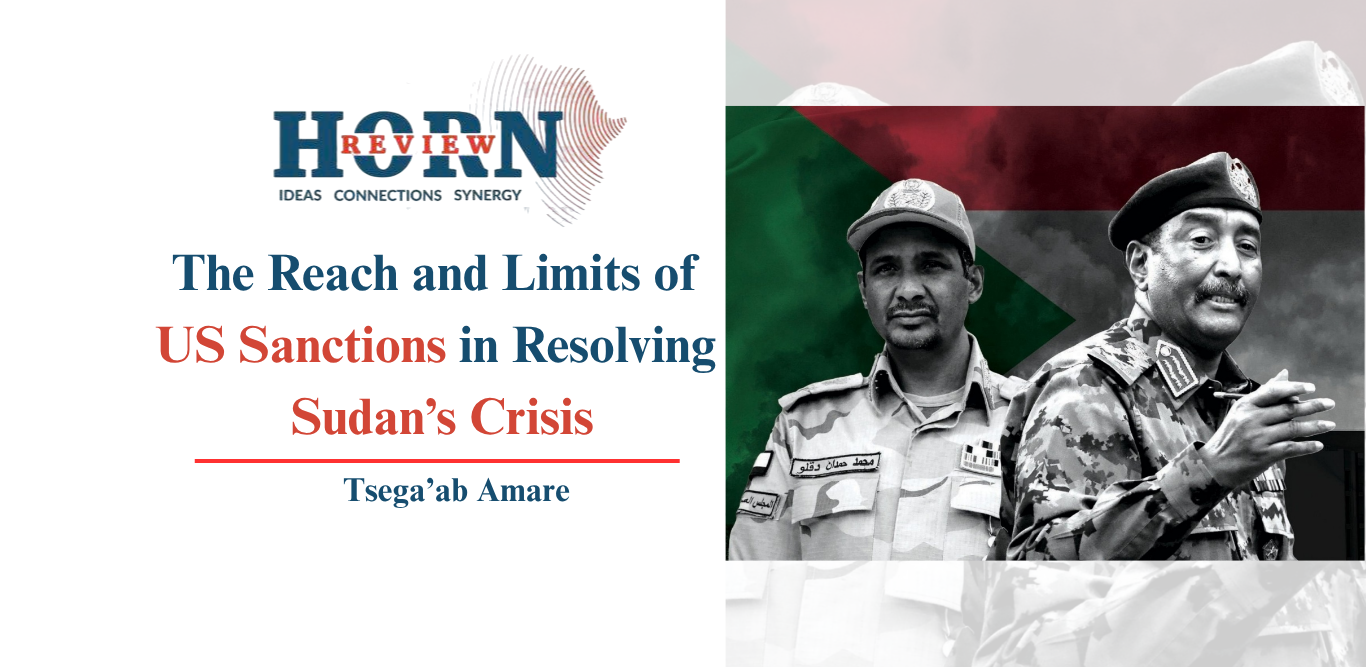
The recent new round of United States sanctions targeting procurement and recruitment networks supplying both the Sudanese Armed Forces and the Rapid Support Forces represents among the most comprehensive escalations in American Sudan policy since the conflict’s outbreak. The package’s invocation of the Chemical and Biological Weapons Control and Warfare Elimination Act for a second time, its explicit dual-sided targeting of belligerent supply chains, and its provisions opposing Sudanese access to multilateral financial institutions all represent genuine advances in Washington’s posture. Yet the package also crystallizes the central contradiction of US Sudan policy: Washington is willing to strike the capillaries of the conflict’s sustaining networks while declining to touch the arteries.
The most significant element in the recent announcement is not the individual designations but the CBW Act framework undergirding them. By invoking this legislation for a second time against Khartoum, the United States has moved beyond targeted commander-level sanctions and begun deploying instruments with systemic economic bite. The CBW Act provisions include US opposition to Sudanese access to loans from international financial institutions, tighter export controls on dual-use technologies, and restrictions on Sudanese state airlines operating in American airspace. If the World Bank, International Monetary Fund, and African Development Bank treat US opposition as a genuine constraint rather than one voice among several, Sudan’s access to post-war reconstruction financing could become structurally conditioned on CBW accountability. The United States wields considerable influence over these institutions, though the outcome depends in practice on whether major shareholders treat the American position as determinative, and is not automatic. That conditionality, if it holds, would introduce a new dimension to the political economy of any eventual settlement, since any governing authority emerging from negotiations would potentially need to address the CBW record to unlock concessional capital flows.
This package therefore operates across two temporal horizons. Treasury’s designations seek to impose immediate friction on wartime procurement networks, while the CBW framework seeks to shape the incentives of whatever political authority eventually emerges from the conflict by conditioning access to reconstruction finance. The former aims to constrain the conduct of war while the latter seeks to influence the terms of peace.
The dual-sided framing carries its own analytical weight beyond the CBW layer. By explicitly targeting networks supplying both the SAF and the RSF, Washington has declined to preserve the diplomatic convention of treating the SAF-aligned government as the sovereign party entitled to asymmetric protection. This is a subtle but real departure from prior US statements on Sudan, which maintained considerable tension between accountability language and the sovereign-recognition convention. This sanction partially resolves tension in the direction of conflict accountability, and the implication is that Washington has assessed that neither belligerent’s legitimacy claim is strong enough to warrant protective insulation at the level of arms procurement networks.
What distinguishes this round from prior designation exercises is the specificity of targeting. Rather than focusing primarily on commanders or political figures, the Treasury release names entities embedded within the procurement ecosystem itself: India-based SBL Energy Limited, implicated in routing explosives-related materiel to SAF manufacturing facilities; Sudan’s Target Multiactivities Company, linked to the Defense Industries System; and front companies involved in recruiting Colombian military veterans to provide tactical expertise to RSF units. The package moves downstream, from generals to the commercial and logistical layer that sustains both sides’ operational capacity. That shift is significant because it signals a more granular American understanding of how the war economy actually functions. The question that follows, however, is whether targeting that layer is sufficient to disrupt it in any durable sense.
To assess what these sanctions can realistically disrupt, the architecture of Sudan’s war economy requires some grounding. The conflict is not sustained by discrete, interceptable weapon shipments moving through formal channels. Both the SAF and RSF have constructed supply chains that deliberately exploit the fragmentation of Sudan’s territorial control and the jurisdictional gaps between regional financial systems. The RSF funds its operations primarily through gold extraction across Darfur and Kordofan, liquidating that gold through private charter flights and overland routes to Gulf trading hubs and using the proceeds to procure weapons across networks spanning southeastern Libya, eastern Chad, and, increasingly, Horn of Africa transit nodes including airports in Puntland. The SAF, operating under state-legal cover, leverages formal military-industrial procurement entities, state-to-state arrangements with regional partners, and maritime channels through Port Sudan for heavy conventional imports, including Turkish and Iranian drone platforms. An estimated sixty percent of SAF-linked gold production transits Egypt before entering formal currency markets, providing Khartoum with foreign currency reserves substantially insulated from SWIFT-based sanctions pressure.
Against this architecture, designating named procurement facilitators imposes real costs but not structural disruption. The networks are built to be resilient precisely because their principals have anticipated interdiction. When specific nodes are designated, the operational response is typically route substitution, front company rotation, and increased reliance on cash-and-barter circuits outside the formal banking system. The designations reach individuals and entities that can be named. They do not reach the gold-for-weapons conversion circuits that finance both sides’ operational sustainability, nor the shadow banking pathways through which the RSF’s Gulf-routed revenues flow. The humanitarian truce call at the close of the State Department statement reflects the same dynamic: issued in virtually identical form across more than two years of American Sudan statements, it has yet to alter belligerent incentives in any structural sense, though Washington almost certainly values it as a diplomatic signaling instrument for coalition-management purposes.
The package’s most consequential omission is also its most legible one. UN Panel of Experts reports, investigative journalism, and independent analytical work have traced extensive commercial and logistical networks linking Emirati-connected actors to RSF supply chains through regional transit hubs. The statement, however, calls for an end to all external support to the belligerents, addressed to unnamed partners. The State Department deliberately refrains from naming any specific state, but the omission is striking given the volume of public reporting on those networks. This appears to reflect, or at minimum is consistent with, the persistent political constraint at the center of US Sudan policy: that direct pressure on the external supporters for either side carries costs within the architecture of partnership that Washington has so far been unwilling to absorb. The result is a sanctions posture that designates mid-level procurement facilitators while the principal external financial architecture sustaining the RSF’s and the SAF’s operational capacity continues undisturbed.
The regional implications extend beyond the Sudan file. The CBW Act framework, if multilateral institutions treat US opposition as carrying genuine weight, creates a template for conditioning reconstruction access in conflict-affected states on weapons accountability records. That has structural relevance for any post-war Sudanese settlement, and it signals to regional actors that Washington’s escalation instruments are not yet exhausted.
The effectiveness of these sanctions should therefore be judged less by the number of entities designated than by whether Washington eventually proves willing to confront the financial and logistical ecosystems that sustain Sudan’s war economy at their most consequential nodes. Until that threshold is crossed, each new package is likely to increase transactional costs for procurement facilitators without fundamentally changing the strategic incentives of the belligerents or their principal external enablers.
By Tsega’ab Amare, Researcher, Horn Review