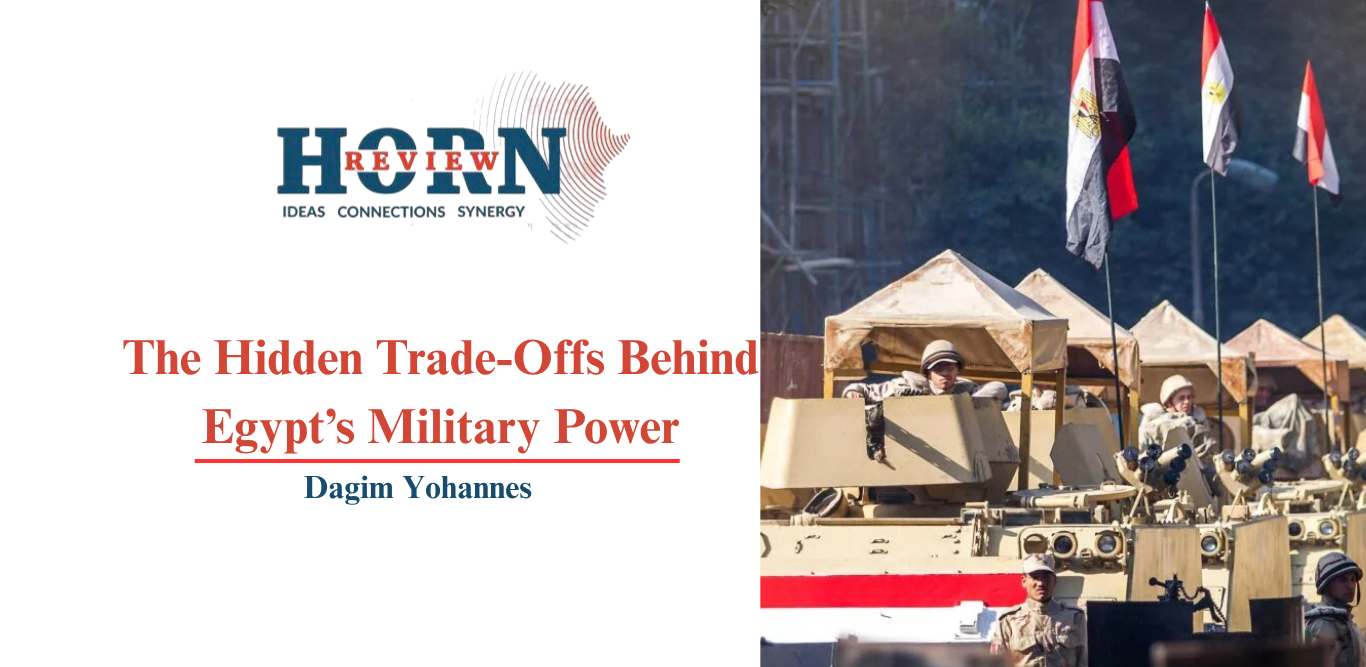
Egypt’s armed forces rank among the largest and most heavily equipped in the Middle East and North Africa. On paper, and in carefully choreographed parades, they project raw power, strategic depth, and credible deterrence. Yet beneath the surface of tanks, fighter jets, and missile batteries lies a different truth: the Egyptian military is not primarily designed to win modern wars. It is engineered first and foremost to prevent coups and safeguard regime survival. This is no accidental misalignment or bureaucratic failure. It is the deliberate outcome of more than seven decades of political engineering, stretching from the 1952 Free Officers Revolution to the present. What outsiders often dismiss as inefficiency, logistical chaos, or doctrinal rigidity is, in reality, a feature of the system, a rational response to the regime’s deepest fear: that the military itself could one day turn against its masters.
In Egypt’s civil-military relations, survival has consistently trumped warfighting effectiveness. The result is a force optimized for internal control, patronage distribution, and symbolic strength, even as its ability to conduct integrated, high-intensity operations against capable adversaries remains constrained. Since the 1952 Free Officers Revolution, Egyptian leaders have treated the military as both the foundation of the regime and its most immediate threat. This dual perception has shaped a system designed to manage and constrain military power from within. Coup-proofing in Egypt follows well-established patterns. Parallel institutions are created to counterbalance one another. Forces such as the Republican Guard, the Central Security Forces, and multiple intelligence agencies operate alongside the regular army, not only to defend the regime but to monitor it. No single institution is allowed to consolidate decisive power. Promotion systems reinforce this logic. Loyalty is prioritized over merit, while commanders are rotated frequently to prevent the formation of stable networks. Units are compartmentalized, limiting cohesion and reducing the possibility of coordinated action.
Command structures further reflect this concern. Authority is centralized, and strong, unified field commands are often avoided. In some periods, the Chief of Staff has directly overseen field armies and regional commands, ensuring that operational power remains closely tied to the center in Cairo.At the same time, the military’s deep involvement in the economy creates a system of patronage. Through construction projects, manufacturing, and infrastructure development, officers are tied to the regime through material incentives. This influence extends across key sectors. For example, the military holds a 51% stake in the Administrative Capital for Urban Development (ACUD) company responsible for the new administrative capital. It has also expanded into strategic industries such as cement production, including Egypt’s largest cement plant in Beni Suef, and food supply chains, including dairy products through the National Service Projects Organization (NSPO). Loyalty is not only enforced institutionally but also sustained economically. Under Hosni Mubarak, this system produced rigid institutional silos. After 2011, and especially under Abdel Fattah el-Sisi, the perceived threat shifted toward society itself. Coordination among security agencies increased, particularly in monitoring and suppressing dissent.
Yet the core logic remained unchanged. Commander rotations, loyalty purges, and centralized control continue to define the system. Even limited reforms illustrate these constraints. The East Canal Zone Unified Command, established in 2015, improved coordination in Sinai operations between the Second and Third Field Armies. However, it did not fundamentally alter the structure. Integration remained partial, and authority stayed centralized. Institutional fragmentation persisted.The consequences of this structure become clear when examined in operational terms. The Egyptian military is not simply constrained. It is structurally fragmented. Procurement patterns illustrate this clearly. Egypt’s arsenal draws from multiple external suppliers, including the United States, Russia, France, and China, alongside domestic production.
This diversity is often presented as strategic flexibility. In practice, it produces logistical strain. Maintenance systems become complex, spare parts are not easily interchangeable, and training pipelines are divided across platforms.This fragmentation extends beyond equipment. Doctrine and training follow similar patterns. Units operating different systems often develop distinct operational cultures, limiting interoperability. The ability to rapidly integrate forces across branches becomes restricted. Command structures reinforce this fragmentation. Centralization limits the autonomy of field commanders, while overlapping authorities create ambiguity. Decision-making becomes slower, and initiative is constrained. In modern warfare, where speed and coordination are decisive, such limitations are critical. Intelligence structures further complicate the picture. Multiple agencies operate simultaneously, often with overlapping mandates. While this ensures internal monitoring, it undermines efficiency. Information is not always shared seamlessly, and real-time battlefield awareness suffers. The result is not simply inefficiency. It is a system where fragmentation is built into the architecture of the military itself.In high-intensity warfare, effectiveness depends on integration, speed, and adaptability. The Egyptian military struggles in all three areas.
Combined-arms operations require close coordination between infantry, armor, artillery, airpower, and logistics. This coordination must often occur at lower command levels, where decisions are made in real time. Yet Egypt’s system discourages such autonomy. Initiative is limited because independent action is viewed as a potential threat. Logistical complexity further reduces effectiveness. Diverse platforms require specialized maintenance and training, slowing operational tempo. Units cannot easily adapt or reinforce one another, reducing flexibility in sustained conflict. Human capital issues deepen these weaknesses. When promotion is tied closely to loyalty, professional development suffers. Training becomes less rigorous, and opportunities for realistic joint exercises are limited. Non-commissioned officers, who are critical in modern militaries, are not fully empowered to act independently.These structural issues have been visible in recent operations. In Sinai, the military eventually succeeded in reducing insurgent attacks through the prolonged Comprehensive Operation Sinai 2018, but the campaign took years, required massive force deployments, and incurred high costs despite facing a relatively small enemy. Analysts have pointed to slow adaptation, heavy reliance on centralized direction, and difficulties in counterinsurgency as reflective of deeper institutional constraints. Similarly Egypt’s limited participation in the Saudi-led coalition in Yemen and its alleged support for Haftar forces in Libya highlighted challenges in expeditionary operations, coalition integration, and sustained high-tempo coordination.
Taken together, these factors produce a force that is capable in controlled environments but less prepared for dynamic, high-intensity conflict. Its strength lies in internal security and regime protection. Its performance in large-scale, integrated warfare is far more uncertain. This does not mean the Egyptian military is weak in absolute terms. It remains large, well-funded, and heavily equipped. But its effectiveness is uneven. It is strong where control and centralization matter. It is far less effective where flexibility, speed, and integration are required. Egypt’s military reflects the priorities of the system that built it. It is designed first to protect the regime from internal threats, second to manage society, and only third to confront external adversaries. What appears as inconsistency or inefficiency is not accidental. It is the result of a deliberate strategy. Fragmentation, diversification, and centralized control are not flaws in the system. They are its core features. This creates a fundamental trade-off. A military optimized for regime survival cannot simultaneously be optimized for high-intensity warfare. The very mechanisms that prevent coups also limit combat effectiveness. Egypt’s armed forces are, therefore, not simply underperforming. They are performing exactly as they were designed to.
By Dagim Yohannes, Researcher, Horn Review