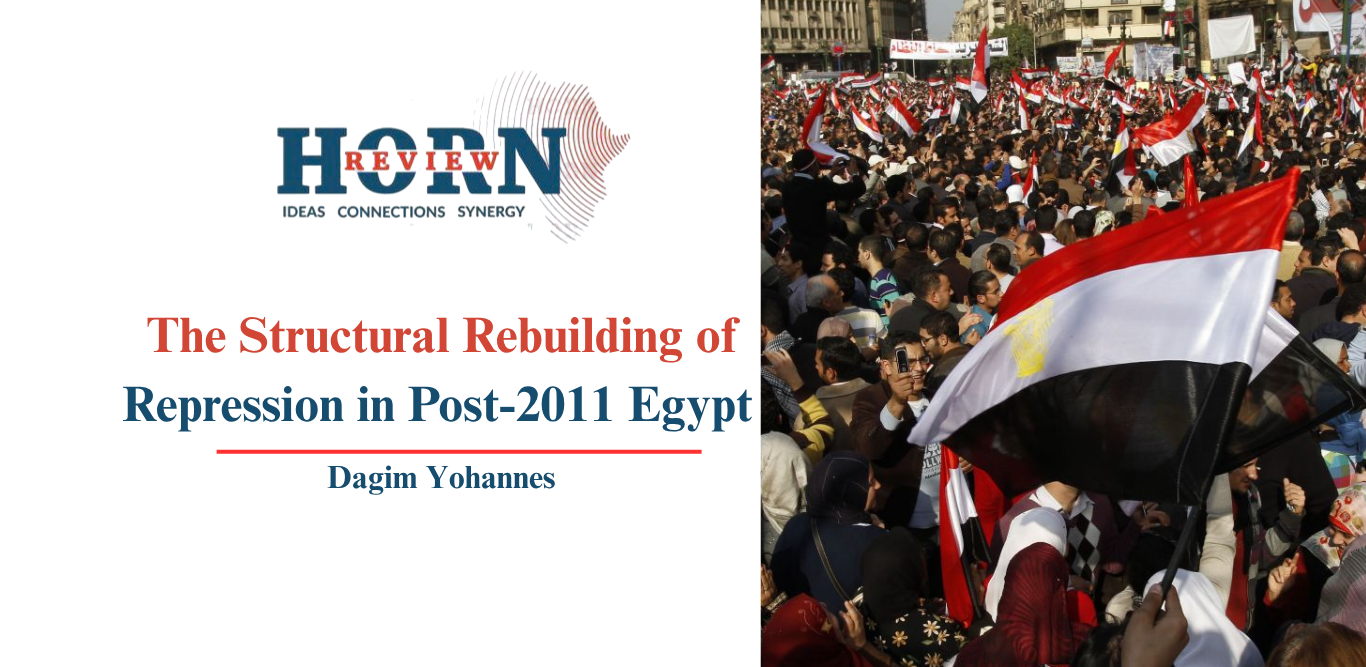
The events of 2011 in Egypt are frequently framed through the language of failure: a revolution that did not achieve its democratic aspirations, a transition that collapsed into renewed authoritarianism. While this narrative captures important elements of Egypt’s trajectory, it risks obscuring the more complex processes through which the Egyptian state reasserted control. Rather than simply restoring pre-revolutionary forms of authoritarianism, the post-2011 period witnessed a structural transformation in the mechanisms of repression. These mechanisms were not merely reactivated but reconfigured, embedding coercion within legal frameworks, institutional practices, and social relations in ways that have proven both adaptive and resilient. In the immediate aftermath of the uprising, the transitional justice process appeared to offer a pathway toward accountability and reform. The trial of Hosni Mubarak symbolized a rupture with the past, suggesting that state violence might be subject to legal scrutiny. Yet this process ultimately functioned less as a mechanism of justice than as a tool of political management. Selective prosecutions and the absence of systemic reform allowed key institutions, particularly within the security apparatus, to retain their power. This continuity became starkly evident following the Rabaa al-Adawiya massacre of August 2013, in which security forces killed at least 800 protesters in a single day, marking one of the largest mass killings of demonstrators in modern history and underscoring the state’s willingness to deploy mass violence with impunity.
Repression in post-2011 Egypt was not simply a return to earlier practices, but a reconfiguration of how coercion was exercised. By the mid-2010s, human rights organizations such as Amnesty International and Human Rights Watch estimated that between 60,000 and 100,000 political prisoners were being held in Egypt, reflecting the unprecedented scale of post-2013 repression. This expansion was facilitated by an evolving legal architecture that transformed repression into a codified and procedural system. Protest Law No. 107 of 2013 effectively criminalized unauthorized demonstrations, granting authorities broad discretion to ban or disperse gatherings. Similarly, Counter-Terrorism Law No. 94 of 2015 introduced an expansive definition of terrorism, enabling the prosecution of peaceful dissent, the restriction of media reporting, and the provision of sweeping immunity to security forces. Through these measures, repression was not arbitrary in appearance; it was institutionalized within the framework of legality itself, producing what can be understood as a normalized state of exception.
This legal transformation was reinforced by a broader process of securitization, in which dissent was systematically framed as an existential threat to national stability. Following the 2013 military intervention, the designation of the Muslim Brotherhood as a terrorist organization established a narrative that extended far beyond Islamist actors. Journalists, activists, and political opponents were increasingly subsumed under the category of terrorism, regardless of their ideological positions. High-profile cases, such as the prolonged detention of photojournalist Mahmoud Abu Zeid (“Shawkan”), who was imprisoned for over five years for documenting protests, illustrate how this framework operated in practice. By embedding repression within both national security discourse and international counterterrorism paradigms, the state was able to legitimize its actions while minimizing external criticism. Institutional restructuring further consolidated this system. Security agencies expanded their authority and autonomy, while mechanisms of oversight were weakened or removed. At the same time, the state reasserted control over physical space, particularly in urban centers such as Cairo. The strict enforcement of protest laws, combined with increased surveillance and the securitization of public areas, transformed the spatial dynamics of dissent. Public gatherings became not only difficult to organize but inherently risky, as the legal and physical environment worked in tandem to preempt collective action before it could emerge. Beyond formal institutions, repression also operated through the deliberate fragmentation of social and political life. The widespread use of surveillance, coupled with the broad application of anti-terrorism legislation, fostered an environment of mistrust in which individuals and groups were increasingly isolated from one another. This fragmentation was not incidental but strategic: by weakening horizontal networks and discouraging collective organization, the state reduced the likelihood of coordinated opposition. In this sense, repression extended beyond direct coercion, reshaping the social fabric in ways that inhibited resistance at its roots.
Civil society, which had played a central role in the 2011 uprising, was similarly constrained. NGO Law No. 70 of 2017 imposed extensive restrictions on funding, activities, and organizational autonomy, effectively bringing civil society under tight state control. While some organizations adapted by shifting toward less visible forms of engagement, their capacity to mobilize or exert political influence was significantly diminished. This transformation highlights the adaptive nature of repression: rather than eliminating civil society entirely, the state restructured the conditions under which it could operate, ensuring that it remained fragmented, monitored, and limited in scope. The Egyptian state,, has not simply restored authoritarianism; it has reinvented it. Through the integration of law, security narratives, institutional restructuring, and social fragmentation, repression has been transformed into a system that is both more sophisticated and more resilient. It is a system that does not merely react to dissent, but anticipates and preempts it, embedding control within the very structures of governance.
At the same time, this system remains inherently precarious. Its effectiveness depends not simply on the management of instability, but on its continuous production, through fear, fragmentation, and the systematic erasure of any viable space for coordinated opposition. Under Abdel Fattah el-Sisi, authoritarianism has not merely been restored but reconstituted in a more expansive and intrusive form, where repression is no longer episodic but infrastructural. Law, media, and coercive institutions operate in concert to foreclose dissent, rendering political contestation not only dangerous but structurally implausible.
The regime’s much-cited “stability” is less a condition than a process: one that must be relentlessly reproduced through surveillance, legal exceptionalism, and calibrated violence. Yet it is precisely this dependence on permanent control that exposes its limits. A system that cannot tolerate uncertainty must constantly suppress it, and in doing so, risks amplifying the very pressures it seeks to contain. Economic strain, elite fragmentation, or renewed forms of collective action could therefore unsettle what appears, on the surface, to be firmly consolidated rule. The lesson of 2011, then, is not that authoritarianism in Egypt is resilient in any absolute sense, but that its durability is contingent and politically constructed. Its apparent solidity rests on shifting foundations that require ongoing reinforcement. To understand Egypt’s post-2011 trajectory is thus to move beyond narratives of failed revolution or simple restoration, and instead to confront a more unsettling reality: an authoritarian order that is at once deeply entrenched and structurally insecure, one that endures not because it has resolved the contradictions it faces, but because it has learned how to govern through them.
By Dagim Yohannes, Researcher, Horn Review