Egypt’s Ethiopia Geostrategic Grammar: The Case of Politicide
The war in the Middle East showcasing the centrality of wars over chokepoints and corridors is likely to merge the Strait of Hormuz with that of the Bab el Mandeb Strait and the Red Sea corridor. The militarization of the Red Sea together with the potential closure of the Bab el Mandeb Strait as a result of the Middle East conflict would turn the critical sea lane into a maritime front with a potential probability to endanger the survival, existence and economy of Ethiopia which solely depends on this critical corridor for seafaring activities.
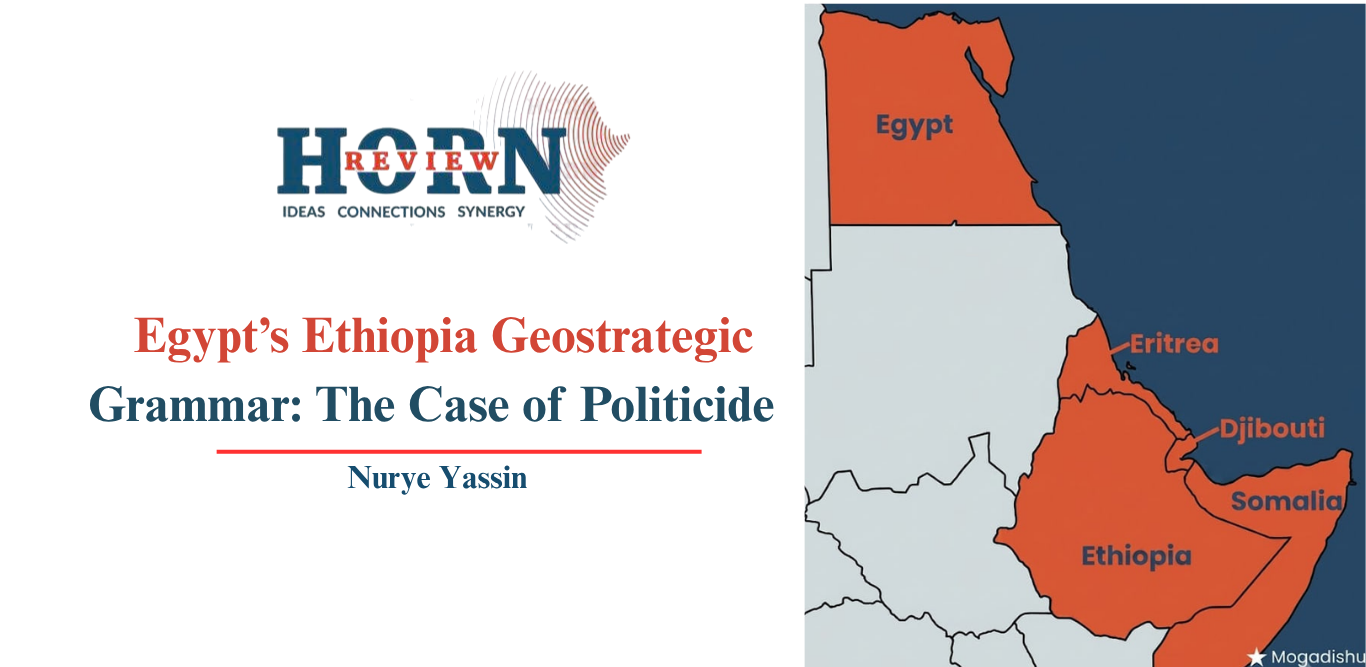
Beyond that, extra-regional actors are leveraging this situation to their own advantage and vying to form their respective blocs and create a regional order centered on their geopolitical designs in the African coast of the Red Sea. Egypt is one of them that is making inroads to create an Egypt-centered order in the Nile, Horn and Red Sea putting its stratagem in synch with Eritrea. Egypt hosting President Isayass of EPLF-Eritrea in June, 2026 is pursuing a region-wide policy that makes its open hostility with Ethiopia regional. Eritrea orbiting around Egypt has become a conduit for Egypt’s expanding influence in the Horn and Red Sea.
Egypt which originates and promotes the concept of the Arab National Security is now extending this same security imaginary to the security makeup of the Horn. Egypt is directly asserting that the Horn is a direct extension of its national security. That is an effort to make the countries of the Horn auxiliaries to its geopolitical projects and ambitions that target Ethiopia. Under the pretext of safeguarding the sovereignty of the countries of the Horn, Egypt presents itself as a protector of the littoral states of the Horn to create anti-Ethiopian regional front that constrains Ethiopia’s development and security. Cairo’s policy of expansionism is designed to pit the region or the countries of the Horn against Ethiopia. Countries like Eritrea are glad to serve as a regional proxy to play this geopolitical game that could destabilize Ethiopia and turn the region into ruins.
In the name of developing ports, establishing logistical hubs, deploying troops, and strengthening maritime connectivity in the littoral states of the Horn, Egypt is expanding its geo-economic, geopolitical and geo-security influence in the Red Sea and Gulf of Aden. Egypt’s presence manifested in the form of commercial and naval infrastructural linkages with the coastal states of the Horn would help it undermine Ethiopia’s physical, financial, digital and industrial connectivity and strain Addis Ababa’s ties with its neighbors. Egypt’s maritime presence in the region would create conditions that could decouple Ethiopia from the sea and corner it from the shifting regional and global power distribution. Egypt’s naval presence on the territorial waters and ports of the African coast of the Red Sea is an effort to monitor Ethiopia’s military shipments and intelligence assets with a potential implication of endangering its security, sovereignty and survival.
Furthermore, Egypt is advancing a mono-centric idea of securing and governing Red Sea with littoral-centric calculus and praxis within the framework of a closed security Grouping-Red Sea Council. This can be regarded as remaking the Red Sea map without Ethiopia through this same Council while undermining multi-centric, inclusive and open regionalism expressed in the form of the IGAD Red Sea Taskforce. Egypt which is stressing the importance of re-activating this same unilateral, closed and exclusive maritime grouping insists the Red Sea is a littoral matter. This means that the Red Sea Council is directed at expelling regional and non-littoral powers from the governance architecture of the broader Red Sea. Egypt, through the Council, seeks to turn the Red Sea into an Arab Lake, exercise total maritime domination, and place coastal states of the Horn in opposition with Ethiopia’s legitimate quest for sea access.
The whole idea of Egypt’s diplomatic and military outreach in the North Eastern Africa is not just destabilizing Ethiopia and delinking it from the Red Sea. It should be understood as the long-term dream of the destruction of Ethiopia–politicide. The fantasy of destroying Ethiopia means controlling the source of Tiqur Abbay (Blue Nile) and making Ethiopia sail without a coast. It is in this regard that Egypt aligning with the countries of the African coast of the Red Sea is expanding its web of logistics, port and base complexes in the North Eastern Africa. In fact, controlling the source of Tiqur Abbay and expelling Ethiopia from the Red Sea have continued for centuries and been the major foreign and national security objectives of Egypt under the Fatmids, Mamluks, Ottomans, British, Nassir, Sadat, Mubarak, Mursi and Sisi.
It is in this respect that Eritrea is a critical factor in this equation joining Egypt’s regional project of dislodging Ethiopia from the geography of the North Eastern Africa for control of the two waters–Nile River and Red Sea—critical for Ethiopia’s viability, survival and existence. The intensified Egypt-Eritrea alliance encompassing the whole region is a joint geostrategic endeavor to place Ethiopia in “forever wars” and make it a blockaded and landlocked nation, to use the words of an Egyptian Foreign Minister Abdelatty, “until Judgment Day.” The concept of Eritrea, which was invented and carved first by colonial powers, develops in Cairo in a bid to exhaust Ethiopia. Egypt under Nassir in association with some Arab states played a pivotal role in the creation and growth of Eritrean Liberation Front (ELF) and Eritrean People’s Liberation Front (EPLF) as forces that embroiled Ethiopia and the region in perpetual war for decades.
As the future is bounded by the past, there should be some historical facts that entwine Medri Bahri or EPLF’s Eritrea with Egypt. Egypt occupied Massawa from 1865 to 1885 with the objective of making Eritrea as a base for military operations against Ethiopia. Egypt’s military expansionism ended with defeats at Gura and Gundet by Ethiopian Emperor Yohannes IV who saw the Red Sea as Ethiopia’s natural boundary. In 1945, Egypt, tracing its history of occupation of Massawa, used the Arab League to place Eritrea under the Trusteeship of the Arab nations. Moreover, Egypt officially claimed Eritrea during the 1946 Paris Peace Conference and the 1950 UN Commission’s visit to Egypt for consultation on Eritrea. The UN taking note of the reports of a Four-Power Commission of Investigation and the UN Commission of Inquiry on Eritrea decided to federate Eritrea with Ethiopia. Egypt under Nassir proposed a State of the Union of Nile Valley. This superstrate along with Egypt’s claim to Eritrea collapsed with the reunification of Eritrea with Ethiopia. Additionally, Nassir tried to leverage Ethiopian Muslims as an instrument to pressure Ethiopia. Nassir also advanced another imaginative idea of Eritrean Arabism to turn the Red Sea into an Arab Lake and access the sources of the Blue Nile.
Moreover, an Egyptian UN Secretary General Boutros Ghali, omitting Ethiopia’s maritime civilizational historicity and its natural right for survival, facilitated from 1991 to 1993 the forcible severing of the Eritrean region from Ethiopia without any regard to Ethiopia’s historical, territorial, political, economic and strategic rights to the sea. Botros Ghali disregarded any proper examination of prior decisions of the UN on Eritrea. The issue of Eritrea defined as a colonial question is based on false premise—colonial treaties and border regimes that were abrogated by Fascist’s Italy’s invasion of Ethiopia in the 1930s and null by the UN sanctioned federation. This is an act of politicide—the transfer of the people and coastal region of Ethiopia to EPLF-Eritrea—concocted by Egypt in connivance with Tigrayan People’s Liberation Front (TPLF) and EPLF. Professor Tecola Hagos stated that Boutros Ghali has done what the Sultanates and military officers of Egypt failed to do so, adding he has succeeded in “dismembering Ethiopia, weakening its sovereignty, [and] checkmating its development prospect.” And again, Egypt was a major enabler to EPLF-Eritrea when it invaded Ethiopia in May 1998.
Furthermore, Egypt has championed the Arabization of the coastal states of the Horn of Africa. A case in point is that Egypt sponsored the accession of Somalia and Djibouti as well as Eritrea’s observer status in the Arab League. The people of Somalia, Djibouti and Eritrea do not see themselves as Arabs. The political alignment of Somalia, Djibouti and Eritrea with the Arab League does not reflect the geographical, racial and economic realities of the people of the region. Egypt’s geopolitical considerations are factors that condition the membership of these countries within the Arab League. This is Cairo’s geopolitical plot devised to mobilize and agitate the elites of the Horn of Africa against Ethiopia while stoking division and creating havoc in the region.
Advancing to the current situation, Ethiopia quest for sea access which is now amplified is defined by Egypt as a threat set to revise the borders of regional states of the Horn. This becomes as entry point for Egypt mischaracterizing Ethiopia’s search for sea access as an existential threat to itself and coastal states. What is now raised by Ethiopians is the restoration of Ethiopia’s legitimate sovereign access to the coast. What is to be reclaimed is not EPLF-Eritrean territory but a part of Ethiopian territory and people that were illegally and forcefully stolen and detached from the mainland by EPLF in connivance with TPLF in 1991. Ethiopia believes that its secure maritime access can be addressed through dialogue. However, Eritrea chooses Egypt over Ethiopia in port development, showcasing the hostile policy of the ruler in Asmara towards Ethiopia. The wars of straits and maritime corridors make it imperative and existential for Ethiopia to restore its natural and historical sea shore through lawful and peaceful means.
Professor Daniel Kendie captures this malign thinking exhibited by Egyptian establishment: When Ethiopia is weak and internally divided, Egypt can rest. But when Ethiopia is prosperous and self-confident, playing a leading role in the region, Egypt is worried. That is what we see in real time. The completion of the Grand Ethiopian Renaissance Dam that is poised to power industries and promote regional power trade and energy connectivity in the Nile, Horn and Red Sea is seen by Egypt as a threat. Given the existential threat to Ethiopia, the North Eastern Africa cannot have peace as long as Egypt sticks to this policy of politicide—the dream of destroying Ethiopians who inhabit Tiqur Abbay (Blue Nile) and Tekeze (Atbara). Egypt is unable to co-habit a post-GERD regional reality and is contriving to reclaim hydro, oceanic and geopolitical primacy.
It is of immense importance to recall Ethiopia’s responsibility to its history with the Arab and Islamic worlds. Ethiopia’s relations with the Arab and Islamic worlds demonstrate the power of justice and reason in the face of adversity, sanctuary in the face of persecution, cooperation at the time of need, and friendly relations during alienation. Unhappily, Egypt, which usually describes Ethiopia as a challenger of Arab National Security in the Arab League and Organization of Islamic Cooperation, attempts to fragment the family of Afro-Arab regional world besides manipulating these platforms to frustrate Ethiopia’s effort to utilize the resources of the Nile and access the sea.
Ethiopia, facing the militarization of Egyptian foreign policy, has stayed committed for collaborative approach on cross-regional issues of mutual importance that entwine the Afro-Arab regional world. Ethiopia, under Premier Abiy Ahmed (PhD), is at the forefront in revitalizing, to use the concept of Professor Ali Mazrui, “Afrabia”, as a new geopolitical construct aimed at bringing Africa and Arabia to synergize their respective economies, polities, minds and societies entwined by geography, religions, cultures and civilizations. Ethiopia’s revitalization efforts anchored on Afrabia marshals the respective competencies of the two regions to build an integrated geo-economic regionalism that will avoid the geo-politicization of the two regions as well as emerge as a new pole in a contested and less coordinated world.
Partners with influence should encourage Egypt to subscribe to the principle of the equitable use of the Nile as the water resources of the Nile are sufficient for equitable use by all riparian countries, including Egypt. Ethiopia is consistent underlining that its actions will never harm Egypt or Sudan while emphasizing that cooperation and dialogue are the best paths to mutual benefit. On the Red Sea, Ethiopia has made it clear that it strives for access to the sea through “reasonable and fair means” while privileging talking over fighting. As regards to the Horn, Ethiopia is of the view that strategic autonomy and geo-economic openness are the cardinal principles that govern the political, security and economic order of the strategic region. Ethiopia, facing clashes for existence, mainstreams diplomacy and invests in self-sufficiency, socio-economic resilience, and indigenous defense modernization to overcome the perils of this momentous era.
By Nurye Yassin, Researcher, Horn Review

RELATED
Posts
21
Oct
Egyptian Offer of Troops to Saudi Arabia: Why Now?
When President Abdel Fattah el-Sisi asked Egypt's parliament on 18...
21
Oct
Where Would Eritrea’s Future Lie in a War with Ethiopia?
After a succession of escalations, the armies of Ethiopia and...
21
Oct
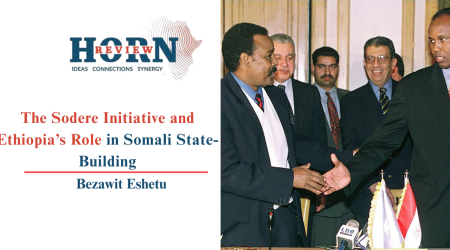
The Sodere Initiative and Ethiopia’s Role in Somali State-Building
Ethiopia’s initiative at Sodere brought Somalia’s rival factions into a...
21
Oct
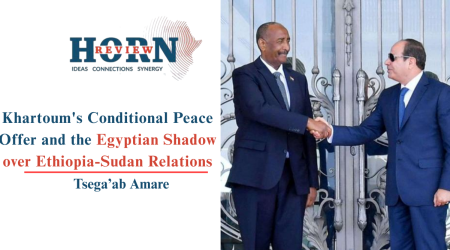
Khartoum's Conditional Peace Offer and the Egyptian Shadow over Ethiopia-Sudan Relations
Sudan's Foreign Minister, Mohi-Eddin Salem, told French Special Envoy...
21
Oct
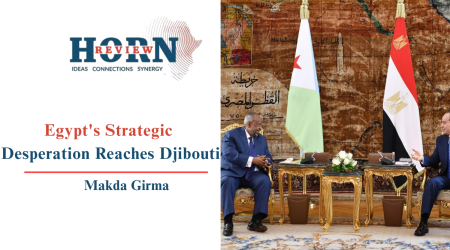
Egypt's Strategic Desperation Reaches Djibouti
Egypt's expanding involvement in Djibouti's maritime infrastructure has acquired renewed...
21
Oct
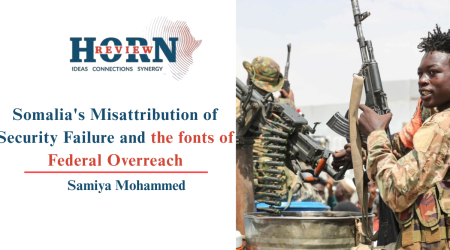
Somalia's Misattribution of Security Failure and the fonts of Federal Overreach
The federal government of Somalia under Hassan Sheikh Mohamud faces...
21
Oct
Sudan’s Drone War Reaches Abyei and Puts South Sudan’s Election on Notice
The drone strike on the Amiet market inside the disputed...
21
Oct
The El-Alamein Quadrilateral and the Risks of Geopolitical Polarization in the North East Africa
The rapid changes that are taking place in the North...