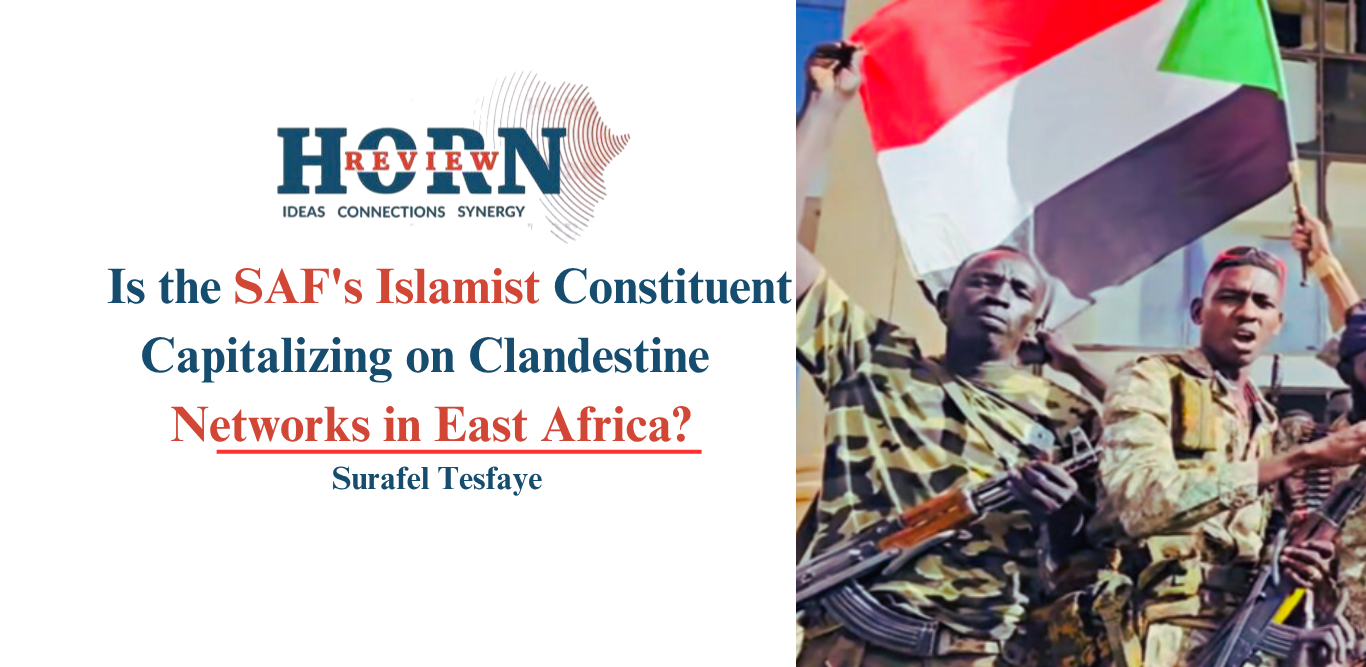
For more than three years, the world has inspected Sudan’s civil war as a power struggle between two generals: Abdel Fattah al‑Burhan of the Sudanese Armed Forces and Mohamed Hamdan Dagalo, known as Hemedti, of the Rapid Support Forces. Beneath this surface rivalry, however, a different form of war is being conducted. It is a war of networks, recruitment pipelines, and ideological expansion. Its front lines are no longer confined to Khartoum, Darfur, or any Sudanese border.
Instead, those front lines have moved into neighboring countries and their refugee camps. They are expanding beyond states near Sudan, reaching as far as Rwanda, with clandestine meetings in Egypt and Saudi Arabia, and spreading into the fragile borderlands of South Sudan, Uganda, and the Democratic Republic of the Congo. A vital figure in this shadow war is Al‑Misbah Abu Zeid Talha, a senior commander of the Al‑Baraa bin Malik Brigade. His movements across three countries in as many years, always protected by the highest levels of the Sudanese state, reveal a strategy that threatens to turn East Africa into a permanent theater of Islamist militancy.
The protection Abu Zeid enjoys explains why his travels matter. Every time he has been detained – by Saudi Arabia in 2024, Egypt in 2025, or Rwanda in 2026 – Burhan and top intelligence officials have immediately intervened behind closed doors. The SAF provides Abu Zeid with legitimate state credentials, including a Major’s rank in the Sudanese Army, and standard diplomatic protection. Because the SAF controls Sudan’s official state infrastructure, it can threaten to freeze bilateral intelligence sharing or disrupt regional partnerships if Abu Zeid is harmed. As a result, a man accused of war crimes and sanctioned by the United States and the European Union travels on a Sudanese military passport, shielded by the full weight of a recognized state.
Abu Zeid’s presence at the Mahama refugee camp in Rwanda in early this year was not a humanitarian visit or an ideological pilgrimage. It was a targeted recruitment and network‑building operation. Mahama holds more than 60,000 refugees, mostly from Burundi and the Democratic Republic of the Congo. Notably, the camp does not contain major groups of Sudanese citizens. This raises a logical question: since there are no significant Sudanese populations in the camp, is the Islamist group building a force of foreign mercenaries? The camp is a dense ecosystem of displaced persons, many of whom have lived in limbo for years, vulnerable to financial and ideological manipulation. Abu Zeid’s primary mission was to establish a human pipeline. He was there to recruit battle‑hardened or desperate individuals to replenish the Al‑Baraa Brigade’s losses in its war against the RSF.
Based on their geographical control, the RSF has a significant advantage in cross‑border recruitment that the SAF lacks. The RSF draws thousands of fresh fighters from Arab tribal networks in Chad, Niger, Mali, Libya, and even parts of South Sudan. These networks are built on long‑standing kinship and pastoral migration routes that ignore colonial borders. The SAF, by contrast, has no equivalent cross‑border tribal network. The SAF’s controlled geographical areas – including Port Sudan, Egypt, Eritrea, and Ethiopia – are a disadvantage for broader recruitment. The SAF depends on its traditional support base in the Nile Valley and eastern Sudan, not in the vast Sahelian or Saharan spaces that the RSF controls.
For this reason, the SAF is forced to look elsewhere for manpower, including refugee camps in East Africa. However, doing this with an Islamic group will give the Islamic groups freedom to function as an independent node and lead to form an independent network beyond the SAF’s leadership.
This recruitment strategy serves two interconnected purposes. The first is asymmetric resource building for the SAF, but that will operate under those groups’ control. Since the war causes severe manpower depletion for the SAF, targeting refugee camps like Mahama allows it to build a low‑cost, combat‑ready pipeline of displaced youths who can be integrated into auxiliary battalions. The second purpose is strategic sabotage of peace initiatives. The Al‑Baraa Brigade is explicitly sanctioned by the European Union and the United States for systematically obstructing and undermining efforts to resume a political transition in Sudan. The Islamist network backing Burhan is reluctant to accept a negotiated settlement. If the international community strikes a peace deal, it will mandate democratic civilian rule and exclude the Islamists from power. By expanding their militant network into East Africa, they signal to international negotiators that any peace deal ignoring them will result in destabilization of the entire region.
How did Abu Zeid reach Rwanda? He likely transit‑hopped via standard commercial air routes using a carefully constructed cover. He has a documented history of using medical leave or religious pilgrimages to travel globally. He previously ran political operations under the guise of an Umrah pilgrimage in Saudi Arabia and sought medical treatment in Egypt. This pattern of movement suggests a coordinated strategy to build out‑of‑theater safe havens. As the United States, regional states, and international bodies clamp down on the Sudanese Muslim Brotherhood, the group’s leadership is actively looking for financial logistics, safe houses, and shell network nodes outside Sudan.
The unchecked movements of these Islamist leaders present acute national security risks to the Great Lakes and East Africa beyond Sudan. First, there is the weaponization of the refugee crisis. This threatens to turn large‑scale humanitarian settlements across Kenya, Uganda, and Rwanda into volatile, politicized recruitment pools, risking local insurgencies. Second, the region will see an influx of illicit Sudanese funds attempting to wash through real estate and shell networks to bypass international sanctions. Third, allowing a highly radicalized, battle‑hardened Islamist group to build operational footprints in East Africa directly threatens to overlap with existing regional threats, such as Al‑Shabaab, making the entire security matrix highly unpredictable.
The historical manipulation of South Sudanese political factions by Khartoum is a well‑documented tactical playbook, so the timing of this Islamist expansion is particularly dangerous given South Sudan’s current situation. Building on South Sudan’s longstanding tension between Kiir and Machar, there will be a time when both sides look for external patronage. The Al‑Baraa Brigade and its SAF handlers can exploit this instability by supplying weapons to ethnic militias in the Upper Nile and Unity states in exchange for operational safe corridors or intelligence.
With millions of Sudanese fleeing south into South Sudan and west into Chad, refugee camps have become highly vulnerable. The Brigade’s recruitment model bypasses standard sovereign protocols to exploit displaced youth. Militant groups in diverse areas will likely mirror this approach, turning humanitarian zones into a marketplace for low‑cost, radicalized fighters. This would erode the distinction between civilian refugees and active combatants, with consequences for civilian protection across the region.
If the movement of these Islamist commanders continues, it will trigger a security breakdown across East Africa. The fact that Abu Zeid traveled deep into Rwanda using state‑vetted top cover proves that official passports and diplomatic channels are being weaponized. When sovereign states can no longer trust the biometric data or travel documents issued by neighboring governments, regional borders become blind spots. This allows high‑value targets to cross unchecked into fragile states.
Countries in the region have invested heavily in regional counter‑terrorism and stabilization operations. However, instead of containing regional threats, regional militaries will be forced to pivot inward to address domestic sleeper cells, illicit cash networks, and radicalization hubs, which deteriorates regional collective peace efforts. The ultimate long‑term risk is the creation of a continuous, interconnected jihadist corridor stretching from the Sahel, through Sudan, and directly down into the Great Lakes and the East African coast. By consolidating its network with highly radicalized networks within legitimate state structures, the Brigade will create an ideal environment for international terror franchises to cooperate, share logistics, and conduct asymmetric warfare on a continental scale.
What makes this situation distinct is the fundamental difference between how the two sides in Sudan recruit. The RSF relies mostly on tribal and ethnic lines. While brutal, that model has a natural limit: recruitment is constrained by tribal affiliation. The SAF, however, has adopted a different approach. By using ideological groups like the Al‑Baraa Brigade, they have unlocked a recruitment model that does not depend on borders or tribal backgrounds. Using religious grievances and political Islam, the SAF can recruit from refugee camps in neighboring countries. This shifts the war from a local Sudanese conflict into a borderless threat.
Since the region is highly prone to radical threats, the international community and neighboring governments must monitor how these Islamist networks are moving across East Africa. They are not just fleeing the war; they are expanding. They are building a shadow network that will be difficult to dismantle. If left unchecked, the Al‑Baraa Brigade and its patrons in the Sudanese military will export the violence of Sudan’s civil war to fragile states within reach.
A Critical Implication for International Peace Efforts
International peace initiatives that try to install a civilian government in Sudan must pay attention to these growing Islamist networks. Focusing only on delegitimizing Burhan or Hemedti will not address the underlying reality. Sidelining the two generals without addressing the Islamist infrastructure would likely create a power vacuum that the Al‑Baraa Brigade and its allies would fill. These groups are already building a web of recruitment, financing, and safe havens outside Sudan’s borders. If the peace process ignores their expansion, they will simply wait for international mediators to leave and then reassert their control. The international community must directly address the Islamist factions’ cross‑border activities as a central obstacle to any lasting settlement.
Otherwise, this could be the lasting legacy of the expansion of Islamic groups in Sudan under Burhan’s leadership. Even if a post‑war settlement is achieved, this legacy may be an interconnected Islamist network operating across East Africa. The immediate requirement is to prevent the training of a new generation of non‑Sudanese fighters. If this development does not receive enough attention, Sudan’s post‑war landscape and East Africa will have to deal with a permanent legacy of interconnected Islamist groups, while the Sahel faces tribal alliances built by the RSF. Sudan’s war may leave behind two deeply interconnected legacies: jihadist fighters and tribal militias that will destabilize the region for years to come.
By Surafel Tesfaye, Researcher, Horn Review