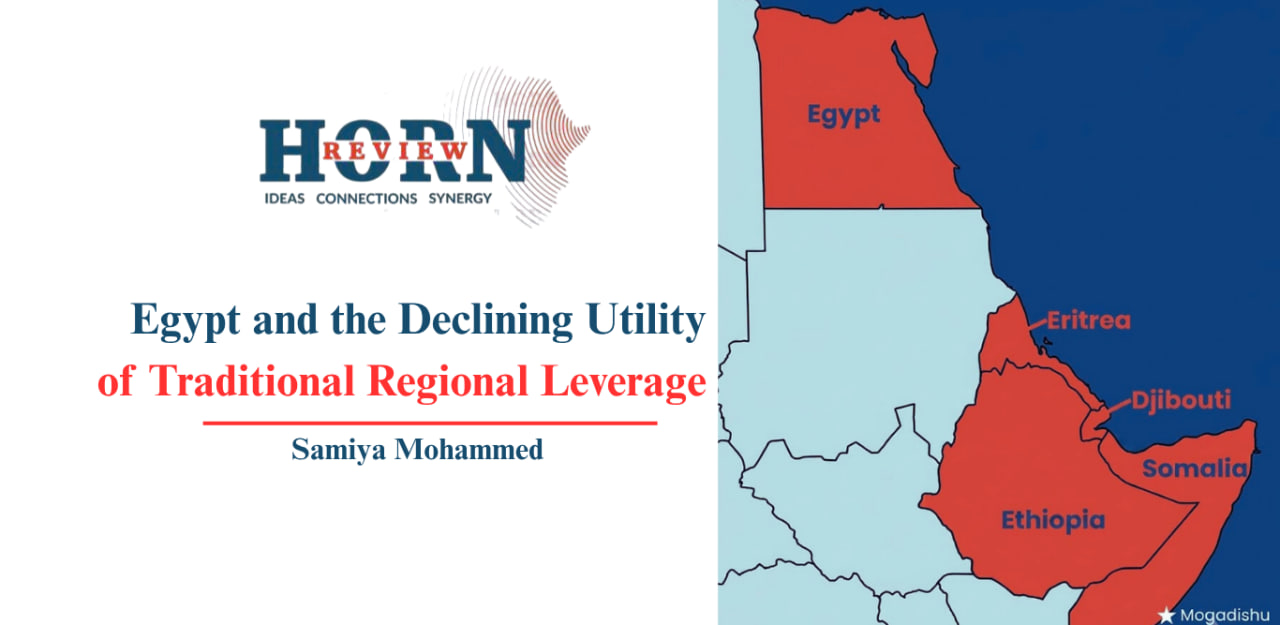
The telephone conversation between Egyptian Foreign Minister Badr Abdelatty and his Djiboutian counterpart was on its surface a routine diplomatic exchange. Both sides reiterated familiar positions on unilateral actions, state institutions, territorial integrity and cooperation in areas ranging from ports and logistics to energy, trade, maritime connectivity, infrastructure and private sector investment. The message reflected Egypt’s continuing attempt to maintain relevance in the Horn of Africa and the Red Sea region.
However for all its carefully constructed language the call raises a question about the changing balance of influence. At a moment when Egypt continues to accentuate sovereignty, regional coordination and economic partnership, a series of developments across the Horn suggests that Egypt’s traditional ability to shape outcomes may be facing growing constraints. The issue is not whether Egypt remains an important regional power even if that it is increasingly debated but whether the instruments through which it historically projected influence are becoming less effective in the current environment.
This distinction matters because discussions about Egypt’s regional role often oscillate between two extremes, portraying Egypt either as an indispensable power broker or as a state in irreversible decline. Neither interpretation fully captures reality. A more useful question is whether recent events point toward a gradual erosion of Egypt’s relative leverage in the Horn of Africa compared with previous decades. The contrast between diplomatic activity and tangible outcomes is increasingly difficult to ignore. Egypt’s engagement with Djibouti forms part of an effort to preserve influence across the Horn including closer coordination with Eritrea and other regional actors. Egyptian officials continue to frame these efforts in terms of regional stability and order.
However influence is ultimately measured not by declarations of principle but by the ability to translate preferences into outcomes. It is here that questions begin to come up. While Egypt maintains diplomatic networks, several of the assumptions that sustained its historical approach to the Horn appear increasingly challenged by regional realities. Historically reveals recurring limits. Efforts to manage regional politics through bilateral alignments frequently generated resistance from states unwilling to subordinate their own priorities to Egyptian concerns. Temporary tactical gains often gave way to longer term pushback as local actors asserted greater autonomy.
This historical pattern is relevant because the contemporary Horn of Africa is increasingly defined by precisely that trend. Regional governments are pursuing more independent foreign policies, diversifying their partnerships and resisting attempts by any external actor to dominate decision making. In such an environment, traditional methods of influence become more difficult to sustain. Recent developments provide several indicators of this shift. Perhaps reports regarding South Sudan’s decision to restrict or terminate Egyptian linked activities associated with facilities in the Pagak-Pajok area. Regardless of how one interprets the specifics, the importance lies in what the episode suggests about changing politics in Juba. If a government once viewed as receptive to Egyptian engagement becomes increasingly cautious about hosting arrangements perceived as compromising sovereignty or drawing the country into wider regional rivalries, this reflects a narrowing of Cairo’s room for actions.
Forward positions, training missions, technical cooperation arrangements and security partnerships have historically served as instruments through which states project influence. When these arrangements become politically costly for host governments, their sustainability comes into question. The issue is not simply the loss of a facility but what that loss may reveal about shifts in regional perceptions. A similar pattern can be observed elsewhere in East Africa. Countries such as Kenya and Uganda increasingly define their foreign policies through economic pragmatism rather than geopolitical alignment. These states continue to engage Egypt but they are equally willing to deepen ties with a wide range of regional and international partners.
This multidirectional diplomacy reduces the effectiveness of traditional influence. Whereas previous eras may have rewarded exclusive alignments, today’s governments often seek flexibility. They avoid becoming instruments in the competition of larger actors and instead maximize opportunities from multiple partnerships simultaneously. For Egypt this means that diplomatic engagement increasingly produces contact without necessarily generating political leverage. The evolving role of Gulf states further complicates Egypt’s position. Historically, Egypt could often count on Arab political support to reinforce its regional objectives. Today however Gulf governments are pursuing increasingly autonomous policies in the Horn of Africa. Their focus has expanded beyond security concerns to include ports, logistics, commercial investments, agricultural projects and maritime trade networks.
This shift reflects changing priorities. As a result Egypt can no longer assume that regional initiatives will automatically benefit from wider Arab backing. Perhaps the clearest illustration of this challenge lies in Egypt’s relationship with Eritrea. From Egypt perspective, cooperation with Eritrea serves practical purposes in regional affairs and Red Sea security. However the partnership also highlights a potential weakness. Strong regional influence is typically built upon networks of alliances, economic relationships and institutional partnerships. Excessive dependence on a limited number of security focused relationships can indicate narrowing rather than expansion.
Eritrea’s own regional position remains complicated by its isolation and limited economic weight. Cooperation with Eritrea is difficult to view it as a substitute for regional influence. If anything, reliance on Eritrea risks highlighting the extent to which other avenues of leverage have become less reliable. The observation is that the nature of regional influence appears to be changing. Governments across the region are demonstrating greater confidence in pursuing independent strategies that reflect domestic interests rather than external expectations. Viewed in this context, the Egypt and Djibouti conversation becomes more than a routine diplomatic exchange. It serves as a lens through which to examine an ongoing transition. However these are also areas in which competition is increasingly shaped by economic capability rather than political positioning.
The evidence therefore suggests that Egypt’s traditional model of influence is facing growing constraints. Bases and security arrangements appear vulnerable to political reconsideration. Regional partners are pursuing more autonomous foreign policies. Gulf support is becoming less automatic. Relationships increasingly provide limited advantages rather than decisive leverage. Taken together, these developments raise a serious question that is Cairo adapting quickly enough to a region in which influence is earned less through geopolitical positioning and more through outcomes that regional actors themselves increasingly define?
By Samiya Mohammed, Researcher, Horn Review